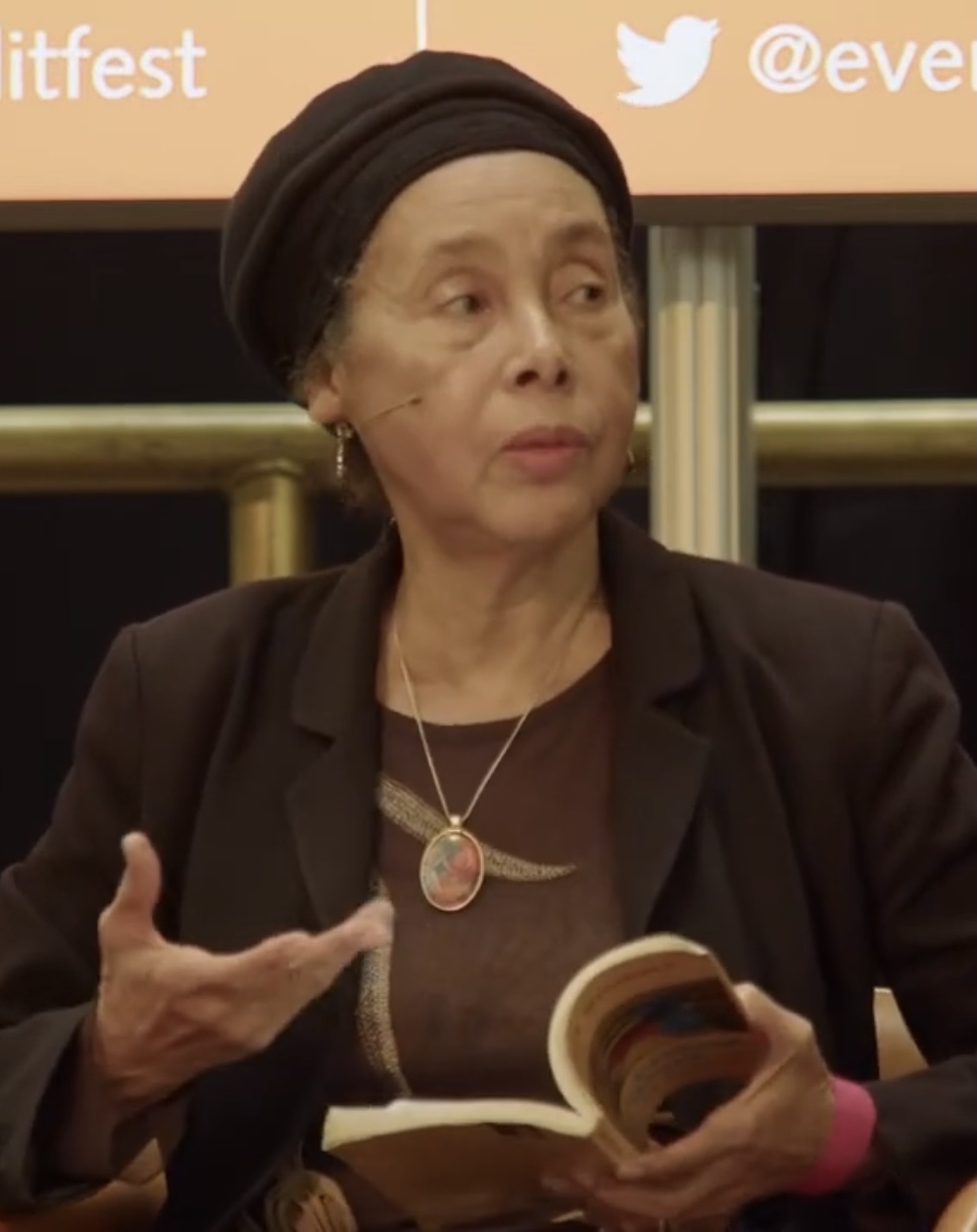
Grace Nichols has made poetry from the experiences of women whose voices refuse to remain in the background. Family relationships, racial hostility, the pleasures of language and the difficulties of belonging all enter her writing. Born in Guyana in 1950, she worked as a teacher and journalist before moving to Britain in 1977. Her career encompasses poems, a novel and books written or edited for children. That range matters: a classroom favourite offers one entrance to her work, but cannot contain the whole writer.1
Her first collection, I Is a Long Memoried Woman, won the Commonwealth Poetry Prize in 1983. By following it with The Fat Black Woman’s Poems in 1984, she established two markedly different ways of placing women at the centre of poetry.1
A childhood carried into language
Nichols grew up in Highdam, a coastal village in Guyana, in a household where books and music were familiar companions. Her father was a headmaster and her mother an amateur pianist. Remembering childhood in an interview with Morag Styles, she described both her appetite for reading and the freedom of climbing trees and exploring outside. The relationship between those activities helps explain something essential about her poetry: language comes alive through contact with the physical world, through movement, weather, sounds and things a child can touch.2
In her memoir for Liminal Spaces, Nichols recalls arriving in England on 3 November 1977 with John Agard and her four-year-old daughter, Lesley. She and Agard had met while working for The Chronicle in Guyana and hoped to become professional writers. Nichols had already completed roughly half of Whole of a Morning Sky, the novel she would publish later. Yet literary ambition did not cancel homesickness. Separation from relatives and familiar ways of visiting sharpened her turn towards poetry. Looking back, she describes an identity that became more fluid over time, with the Sussex landscape joining Guyana as a source of imaginative life. Arrival was a beginning whose meaning continued to change.3
Women speaking through historical memory
The origins of I Is a Long Memoried Woman were partly dreamlike. In a 2019 interview with Jacqueline Bishop, Nichols remembered dreaming of an African girl swimming towards the Caribbean, surrounded by flowers. She understood the image as an attempt to cleanse an ocean marked by the suffering of the Middle Passage. The collection, published in 1983, therefore emerged through imaginative engagement with history. Its voices are poetic creations, rather than a discovered autobiography or a claim that one documented woman experienced every event within it.4
Across five sections, the sequence moves through capture, enslavement, plantation life and resistance. Its women experience forced labour and sexual violence, but also remember, desire, believe and try to shape a future. Scholar Parimala Kulkarni emphasises the relationship between cultural memory and the recovery of a damaged sense of self. This helps explain why the collection’s emotional life is as significant as its historical setting. An account concerned only with what enslavers did would leave women defined by the power exercised over them. Nichols creates space for inward experience and for resources of endurance carried from Africa and remade in the Caribbean. Different voices and experiences enter that process; the sequence asks readers to attend to them without treating its imagined speaker as a complete account of all enslaved women’s lives.5
Finding a publisher was itself a negotiation over whose perspective counted. Nichols told Bishop that Oxford University Press admired the manuscript but felt Kamau Brathwaite had already covered the journey from Africa to the Caribbean. Her recollection reveals a problem with treating a historical subject as already occupied. A woman’s exploration of enslavement could ask different questions, even when the geography overlapped with an established male poet’s work.14
Humour, beauty and the right to take up space
The Fat Black Woman’s Poems makes its challenge through a more openly comic figure. Its central woman enjoys herself, questions authority and resists the terms on which others want to judge her. Her confidence can be awkward for politicians, lovers and anyone accustomed to controlling the conversation. Yet the collection extends beyond that memorable character into love, memory and women’s self-direction. Reading the whole book complicates the idea that Nichols offers a single mood of triumphant defiance. Affection and sadness sit beside wit. The variety allows pleasure to become a serious poetic subject while keeping vulnerability within view.6
In The Fat Black Woman Goes Shopping, an ordinary London shopping trip exposes a system of judgement. Cold weather, narrow clothing choices, mannequins and sales assistants combine to make the woman’s body seem inconvenient. The poem directs attention towards that environment: who has been imagined as the customer, and who must struggle to find something suitable? Its humour depends on sharply observed social encounters and a closing turn that links limited choice with the fashion industry’s preference for thinness. Repetition gives the shopping expedition an exhausting rhythm, while the woman’s irritation keeps her from becoming a silent object of inspection. She notices the people who think they are merely noticing her. A familiar errand becomes an argument about the power to decide which bodies belong in public space.7
Writing for the page and the ear
Nichols brings Guyanese Creole and standard English into the same poetic practice. These are resources for timing, intimacy, emphasis and shifts in mood. The Poetry Archive draws attention to the way their interaction creates possibilities for rhyme and rhythm, particularly when the poems are heard aloud. Readers can listen for where a phrase gathers speed, where repetition insists and where a short line changes the pressure of a sentence. Praise Song for My Mother, for example, builds its emotional movement through a returning structure and vivid images. Such craft deserves attention alongside the poem’s subject. Treating Creole only as evidence of background would miss what Nichols makes it do: speech becomes an organising force, shaping how memory reaches the listener.8
Children as readers and makers
Her writing for children shares this interest in what language can make possible. Come on into my Tropical Garden appeared in 1988, followed by Give Yourself a Hug in 1994. The two collections were later brought together as Sun Time Snow Time. Moving between Caribbean and British surroundings, these poems invite young readers to notice changing seasons, sensations and sounds. The publisher recommends them for reading aloud and reciting, an approach that gives children an active part in the encounter. A poem can be something to try with the voice, repeat with a friend or connect to one’s own surroundings. The movement between climates also offers a practical way of discovering that familiar experiences are not identical everywhere.9
Nichols has also helped determine what children encounter through anthologies edited with Agard. Under the Moon & Over the Sea won the first CLPE Poetry Award in 2003. Her Tate residency led to Paint Me a Poem, which brought responses to artworks together with children’s own poems. These projects make literary participation concrete: young people can meet a wider range of voices and discover that their responses to a painting can become writing too.2
Looking back at the painter
Visual art becomes a site of argument in Picasso, I Want My Face Back, published in 2009. Its opening sequence imagines the voice of Dora Maar, whose face appears in Picasso’s Weeping Woman. Nichols lets the represented woman speak back to the conditions of representation. The sequence’s interlocking parts echo the painting’s fractured surfaces while following an imagined movement towards self-reclamation. This is a literary interpretation, not access to Maar’s unrecorded thoughts. Its interest lies in changing the direction of attention: the woman in the image acquires questions and desires of her own. A portrait seems to fix a person in a single image; the changing angles of a sequence can unsettle that apparent finality. The poem’s form helps perform its argument. The collection also joins art with landscape and memory. It demonstrates how Nichols’s concern with women’s voices can generate formal experiments and encounters far beyond the settings of her earliest books.10
Sleeplessness, return and a changing perspective
The Insomnia Poems, published in 2017, makes the unsettled night a space for further exploration. Childhood memories, political anxieties and familiar stories enter the hours when sleep refuses to arrive. In One Night Comes Like a Blessing, Nichols gives sleeplessness an active, intrusive presence; thoughts become something replayed beyond the speaker’s control. The eventual arrival of sleep changes the poem’s movement and offers renewed capacity for ordinary life. That transformation depends on imagery and pacing as well as on an experience many readers recognise. Elsewhere, the collection draws on figures including Sleeping Beauty and Rip Van Winkle. The night opens connections between personal unease, inherited stories and the noisy public world that a closed bedroom door cannot entirely exclude. Stories about enchanted sleep or delayed awakening become ways of thinking about power, vulnerability and lost time. Familiar legends acquire fresh meanings when brought into contact with the disturbances of an adult life.11
Passport to Here and There, published in 2020, returns to the relationship between Guyana and Britain with the perspective of decades. A visit to Guyana generated a sonnet sequence, giving remembered places a compact, recurring form. In Landing, the speaker’s pleasure in approaching Georgetown meets the administrative fact of entering her birthplace on a British passport. That encounter holds affection and altered status together. Familiarity survives, but circumstances have changed. The collection moves across coastal memories, Sussex and wider public experience, suggesting that belonging can accumulate rather than settle into a single answer. Its return journey is therefore also an encounter with time: the person who remembers a place has a history beyond it, and the remembered place continues to exist outside the memory. The passport in the title belongs to that complicated traffic between recognition and estrangement.12
An achievement with many voices
The Queen’s Gold Medal for Poetry for 2021 recognised Nichols’s body of work, with particular attention to her first collection, prose and writing for younger readers. Her response described bringing Caribbean registers into an English language shaped by colonial inheritance, while recalling her parents’ concern about the child who read in bed by torchlight. That connection between reading and making is an appropriate way to approach her achievement. Across historical imagination, humour, poems for children and explorations of art, she has continued to make choices about what a voice can carry. The result invites readers to hear women thinking, remembering, challenging and enjoying the world in more than one register.13
Sources and further reading
1. Museum of Colour: Grace Nichols: My Words.
2. Morag Styles / Books for Keeps: Authorgraph 151: Grace Nichols, March 2005.
3. Grace Nichols / Open Book Publishers: So I Pick Up Me New-World-Self, in Liminal Spaces (2020).
4. Jacqueline Bishop / The Sunday Observer, preserved by Wadadli Pen: Stitching Together Memories: An Interview with Poet Grace Nichols, 5 May 2019 (page 1).
5. Dr Parimala Kulkarni / INFLIBNET: Grace Nichols, in African & Caribbean Writing in English.
6. Virago: The Fat Black Woman’s Poems.
7. Grace Nichols / Poetry Archive: The Fat Black Woman Goes Shopping.
8. Poetry Archive: Grace Nichols: biography and recordings.
9. Bloomsbury: Sun Time Snow Time: Poetry for children inspired by Caribbean and British life.
10. Bloodaxe Books: Picasso, I Want My Face Back.
11. Bloodaxe Books: The Insomnia Poems: description, contents and authorised extracts.
12. Bloodaxe Books: Passport to Here and There: description and authorised extracts.
13. The Royal Family: The Queen’s Medal for Poetry 2021, 10 December 2021.
14. Jacqueline Bishop / The Sunday Observer, preserved by Wadadli Pen: Stitching Together Memories: An Interview with Poet Grace Nichols, 5 May 2019 (page 3).
Image credit
Grace Nichols at the British Library in October 2022, in a still from the BOCAS UK session Ways in the World. Video still: The British Library, Grace Nichols at the British Library, 2022, CC BY 3.0. Video still as supplied on Wikimedia Commons; no further changes.






Join the conversation
Comments 0
Share a memory, ask a question or add to this story.
No comments yet. Add your perspective.
Add your voice
Create a free account and verify your email to leave a comment.
All comments are reviewed before publication.