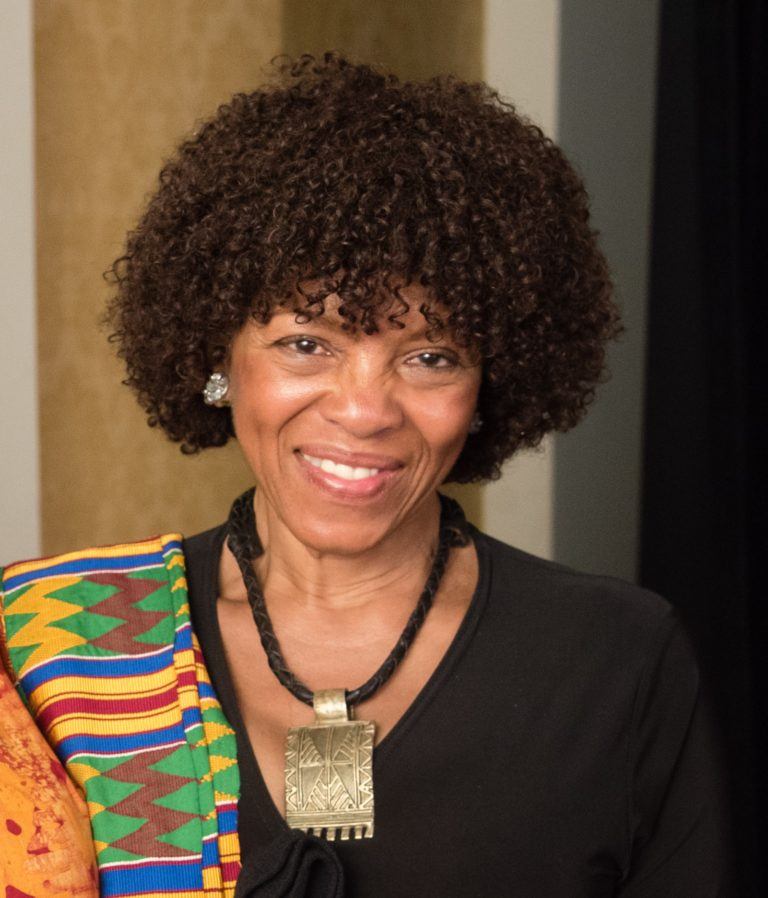
For twenty years, Margaret Busby helped decide what would appear under the Allison & Busby imprint. As its editorial director, she worked across fiction, poetry and non-fiction, bringing an international range of writing into British publishing. Her distinction as Britain’s first Black woman book publisher marks a significant change in who could exercise that authority. The books themselves explain what she did with it: she made choices about language, literary value and the readers a manuscript might find. Editing became a means of widening the conversation.1
Born in Accra, Busby came from a family with connections to Barbados, Trinidad and Dominica. Her background linked Africa and the Caribbean before either became a publishing category in her professional life. In his Black History Month UK profile, John Stevenson records her ambition to make poetry affordable for young readers. That ambition offers a useful starting point: the future publisher was thinking about who could buy a book, carry it away and make it part of everyday life.2
Starting with poetry and very little money
Busby and Clive Allison founded their company in 1967. The publisher’s own account describes a venture initially fitted around weekends, followed by full-time work and a Soho office in 1969. This was a small independent business entering a trade with established companies, reputations and distribution arrangements. Its list developed across fiction, serious non-fiction and children’s books. Building that breadth required the founders to turn enthusiasm into a working publishing operation, with the practical responsibilities that followed every decision to take on a title.3
In an interview with Chris Fite-Wassilak, Busby remembered meeting Allison at a friend’s party while she was at London University. Their shared interest was poetry. They began with three inexpensive paperback collections, printed 15,000 copies and discovered that they had no distribution system. Selling books to people in the street became part of their education. The episode captures both the attraction and the difficulty of independence: they could publish work they believed in, but they also had to get it into readers’ hands.4
Their responsibilities gradually separated. Recalling the partnership in a Financial Times interview, Busby described Allison concentrating on business and publicity while she focused on writers and manuscripts. The company’s range could be unexpectedly commercial, extending to a translated book about rats and a waterproof songbook for the bath. Literary commitment existed alongside the need to sell. That combination helps explain the resourcefulness demanded of a small publisher, whose next book could be very different from the last.5
The work behind the author’s name
Busby’s account of working with Buchi Emecheta makes the editorial relationship tangible. Both were young African women in London. Emecheta trusted her judgement, and Busby retyped manuscripts with the agreed changes incorporated. The task required attention to individual sentences alongside confidence in the writer’s larger purpose. Busby described the satisfaction of watching an author develop, even when the editor’s contribution disappeared behind the finished work. Her labour helped the writing take its public form while the story remained the author’s.4
Stevenson’s profile names Emecheta’s Second-Class Citizen, C. L. R. James’s The Black Jacobins and George Lamming’s The Pleasures of Exile among the titles on the Allison & Busby list. Val Wilmer, Rosa Guy, Andrew Salkey and Miyamoto Musashi also appear in his account. These writers cannot be reduced to a single subject or audience. Publishing their work together meant allowing political history, fiction and other kinds of knowledge to occupy the same bookshop, without demanding that one author stand for an entire community.2
Sam Greenlee’s The Spook Who Sat by the Door provides another example of a book with a long relationship to its editor. Its dark satire challenged racial power in the United States during the Black Power era. When Jacaranda Books prepared a new edition in 2024, Busby returned as the original British editor and publisher to write its introduction. Greenlee’s daughter, Natiki Hope Pressley, contributed an afterword. The new edition placed the novel in the hands of another generation while retaining connections to the people who had helped shape its earlier life. A publisher’s commitment could therefore extend well beyond a first appearance in print.6
Allison & Busby was taken over by W. H. Allen in 1987. Busby’s subsequent career included the editorial directorship of Earthscan, followed by freelance work as a writer, editor, critic and broadcaster. Her experience moved with her into different institutions and forms of publication.3, 1
A literary culture made through encounters
Busby’s publishing world also belonged to a larger network. The George Padmore Institute’s film about the International Book Fairs of Radical Black and Third World Books draws on her recollections alongside those of bookseller Janice Durham. Founded by New Beacon Books, Race Today Publications and Bogle-L’Ouverture Publications, the fairs brought international exhibitors and readers together between 1982 and 1995. Books circulated through orders, conversations and distribution agreements. Festivals around the fairs included theatre, music, films, political debate and children’s activities. This setting matters to Busby’s story because a literary culture needs places where people can meet its writers and discover what is being published. A book fair could make connections that a publisher working alone could never create.7
Her own work crossed those boundaries between forms. The SI Leeds Literary Prize’s profile records radio abridgements and dramatisations of writers including Jean Rhys, Sam Selvon, Wole Soyinka and Walter Mosley. She adapted James’s Minty Alley for radio and wrote for the stage, including Yaa Asantewaa – Warrior Queen. Such work involved further editorial decisions: what to retain, how a voice would sound and how a story could travel through performance. Her association with the prize as an ambassador also placed her experience within a network supporting writers. The skills developed around books could serve audiences listening to a broadcast or sitting in a theatre.8
Bringing Daughters of Africa together
Daughters of Africa, published in 1992, made the anthology itself a substantial editorial intervention. Speaking to Ellen Mitchell and Sophie Kulik for Africa in Words, Busby recalled Candida Lacey commissioning a collection of writing by women of African descent. She began with books on her own shelves, selecting passages from authors she knew, while encounters and occasional commissions widened the material. The selection challenged a literary establishment that repeatedly recognised a small group of famous African American women while overlooking a much larger international history.9
Busby also supplied a large bibliography, inviting readers to continue beyond the anthology. When New Daughters of Africa appeared in 2019, she described it as a companion volume. It connected contemporary writers with earlier generations rather than treating them as sudden arrivals. Contributors could choose how they wished to be represented; she did not impose one subject on everyone. The editor assembled the encounter while leaving space for differences of form, experience and intention.9
The newer anthology brings together around 200 writers, including Bernardine Evaristo, Zadie Smith and Chimamanda Ngozi Adichie. Its geographical reach extends across Africa and the diaspora, and its range of genres resists the expectation that women of African descent should tell one recognisable kind of story. Reading across such a collection changes the scale of the subject. A familiar name can lead towards an unfamiliar one; a reader drawn by fiction can encounter another literary form. The reader is free to follow these connections without assuming that a shared heritage erases disagreement or difference. The volume offers a route into further reading through the variety of writers it places together.10
Making opportunity last
The Margaret Busby New Daughters of Africa Award at SOAS gives that concern with future writers a practical educational form. Its eligibility is directed towards Black women ordinarily resident in Africa, with an interest in African literature. The university’s 2026 information lists postgraduate routes in African Studies, Comparative Literature and translation in African languages. The award addresses a material part of literary opportunity: access to study and support for its costs. For a prospective writer or literary scholar, such provision can create time and resources for work that enthusiasm alone cannot sustain.11
One early beneficiary was Idza Luhumyo, announced as the first recipient in 2020. Born in Mombasa, she was already working as a screenwriter and copywriter, with writing concerned with Kenyan coastal identities. Speaking to African Writers Trust, she acknowledged the women whose contributions to the anthology had made the award possible. That response reveals a further connection between the book and its readership: the writing gathered into a collection could help another writer continue her own work.15
Busby has nevertheless questioned how far publishing initiatives change the industry around them. In her WritersMosaic essay, she separates getting published from reaching an audience. A book may exist yet receive little promotion, limited critical attention or a narrow place in the market. Her questions concern the whole route to a reader: who acquires manuscripts, who edits them, who reviews them and who decides where they will be sold. That makes the issue larger than a count of authors on a list.12
The same essay recalls her friendship with editor Ellah Wakatama Allfrey and the support needed by people entering an industry where they may feel isolated. Busby welcomed new opportunities while resisting tokenism. Her argument places responsibility inside publishing organisations as well as outside them. Sustained change requires people with different experiences to participate in decisions and develop careers, with their professional expertise taken seriously.12
Writing, reading and the freedom to continue
In April 2023, Busby became president of English PEN, succeeding Philippe Sands. The appointment connected her work with a wider defence of literature and freedom of expression. In accepting, she emphasised cooperation between writers and readers and the possibilities of an international network. Publication depends on more than an editor’s willingness to accept a manuscript: writers need the freedom to express themselves, and readers need access to what they create. Her role at PEN extended longstanding concerns about literary opportunity into an organisation campaigning on behalf of those freedoms.13
Her own writing came together in Part of the Story, published by Hamish Hamilton in March 2026. The collection ranges across people, places, politics and publishing, drawing on her experiences in Ghana and her relationships within cultural life. It gives readers another way into a career often encountered through other people’s books. Busby’s history can be followed through manuscripts developed, authors brought into conversation and writing returned to circulation. It can also be followed through her own sentences, recording the people and arguments that helped make that work possible.14
Sources and further reading
1. Royal Holloway, University of London: Ghanaian born publisher, editor and broadcaster, Margaret Busby CBE awarded honorary degree from Royal Holloway.
2. John Stevenson / Black History Month UK: Margaret Busby: Doyenne of Black British Publishing.
3. Allison & Busby: Co-founder of Allison & Busby dies.
4. Chris Fite-Wassilak / The Baring Foundation: An Artist in Time: Margaret Busby.
5. Frederick Studemann / Financial Times: Editor Margaret Busby: ‘You choose your battles’.
6. Jacaranda Books: Cover reveal: The Spook Who Sat By The Door (2024).
7. George Padmore Institute: George Padmore Institute film about the International Book Fairs of Radical Black and Third World Books 1982–1995.
8. SI Leeds Literary Prize: Margaret Busby – Prize Ambassador.
9. Ellen Mitchell and Sophie Kulik / Africa in Words: Q&A: Margaret Busby on ‘New Daughters of Africa’.
10. Penguin Books: New Daughters of Africa.
11. SOAS University of London: Margaret Busby New Daughters of Africa Award.
12. Margaret Busby / WritersMosaic: Mainstreaming and greater choice of books.
13. English PEN: Margaret Busby appointed President of English PEN.
14. Hamish Hamilton / Penguin Books: Part of the Story.
15. African Writers Trust: First recipient of The Margaret Busby New Daughters of Africa Award announced!.
Image credit
Margaret Busby at the unveiling of the Ida B. Wells blue plaque at Edgbaston Community Centre, Birmingham, on 12 February 2019. Photograph: Andy Mabbett, Margaret Busby, 12 February 2019, CC BY-SA 4.0. Original photograph; no changes.





Join the conversation
Comments 0
Share a memory, ask a question or add to this story.
No comments yet. Add your perspective.
Add your voice
Create a free account and verify your email to leave a comment.
All comments are reviewed before publication.