The Caribbean labour rebellions of the 1930s were fought over wages, but their reach extended into the organisation of everyday life. People demanded the means to feed families, challenged humiliation at work and claimed the right to be heard. As historian Rhoda Reddock explains, a labour movement encompasses these collective struggles beyond formally registered trade unions. That wider view brings unemployed people, women and community organisers into a history too often told only through the careers of prominent men.1
Poverty within a colonial order
Across Britain’s Caribbean colonies, low pay and insecure employment were reinforced by political exclusion. Historian and labour activist Richard Hart identifies the Depression, racial contempt, restricted representation and the absence of effective collective bargaining as recurring causes of unrest. There was no single regional command directing the uprisings. Similar conditions could produce related struggles in places separated by sea, with different industries and local grievances. Understanding that shared setting does not mean treating the islands as interchangeable.2
Sugar estates, oilfields and ports brought different groups of workers into confrontation with employers. The industries varied, but conflicts over work could expose the wider inequalities of colonial government.2
The later West India Royal Commission’s remit included Britain’s colonies on the mainland as well as islands. This history concentrates on several connected struggles within that British colonial region, rather than claiming to describe every Caribbean society.12
St Kitts and St Vincent: 1935
On 28 January 1935, cane cutters at Buckley’s estate in St Kitts asked for one shilling per ton. When the manager refused, they stopped work and marched to neighbouring estates. The National Archives’ chronology records workers joining the stoppage, carts being disabled and confrontations with estate management. This was direct action designed to prevent production from continuing while a section of the workforce remained on strike. The movement spread through people travelling between workplaces and persuading, or sometimes compelling, others to stop.3
The following day, an estate manager fired at demonstrators and armed forces were deployed. After the Riot Act was read, troops opened fire; three men were killed. The archive names Joseph Samuel, John Allen and James Archibald among the dead. Remembering their names changes the scale of the story. An event subsequently used to mark the development of organised labour was first a violent confrontation in which particular families lost people.3
In St Vincent, the immediate issue in October 1935 was a proposed increase in customs duties on everyday goods. Crowds in Kingstown sought help from councillor George McIntosh and protested outside the Legislative Council. Anger over taxation joined grievances about unemployment and poverty. As Richard Hart describes, the confrontation spread beyond the capital into rural districts, where demands included access to land and higher wages. Police gunfire and emergency measures followed. Here, the struggle concerned the household cost of survival as directly as the wage paid at work.2
Trinidad: the oilfields and the wider movement
Tubal Uriah Butler brought experiences of migration, military service and industrial labour into Trinidad’s unrest. Born in Grenada, he served in the British West Indies Regiment before moving to Trinidad and working in the oil industry. An injury affected his ability to earn a living. The National Archives of Trinidad and Tobago traces his emergence through the hunger march of 1935 and subsequent organising among workers. His public appeal drew strength from the conditions he was asking others to challenge.4
On 19 June 1937, police attempted to arrest Butler while he was addressing workers in Fyzabad. The confrontation became a decisive moment in the labour upheaval. Fatal violence, arrests and the pursuit of organisers followed. Butler went into hiding and later surrendered; imprisonment interrupted his leadership. His prominence should not obscure the workers whose grievances had made the movement possible. The conflict grew from conditions across the oilfields, rather than from the actions of one speaker alone.4
The National Trust of Trinidad and Tobago’s account follows the strike into places including Point Fortin, San Fernando, Penal and Port of Spain. This geography is significant: the movement could disrupt work across several centres, making it harder to dismiss as a local incident. On 25 July 1937, while Butler remained in hiding, the Oilfields Workers’ Trade Union was formed. Establishing an organisation turned an immediate confrontation into a continuing claim to representation.5
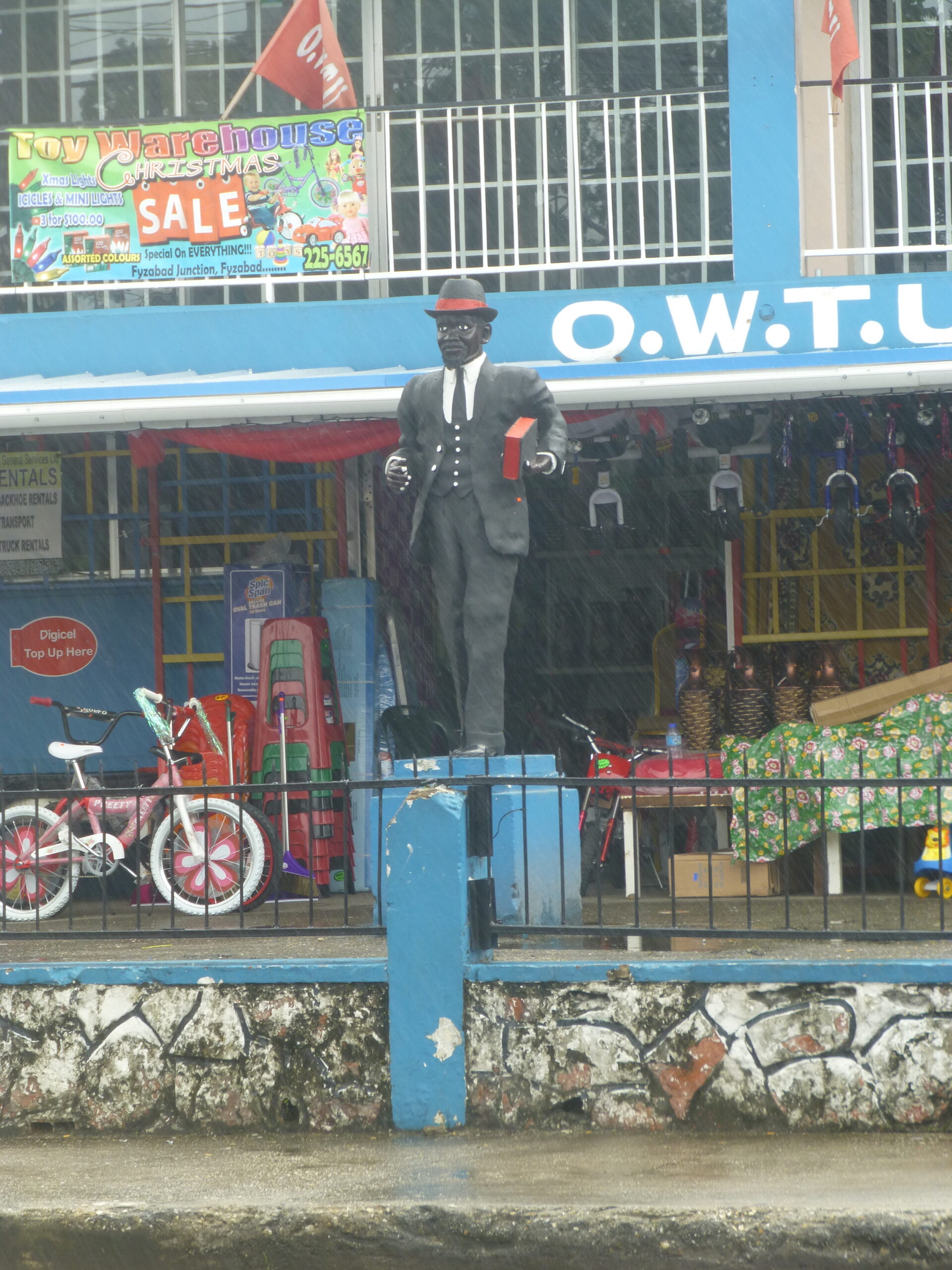
The commemorative landscape at Fyzabad preserves these connections. Charlie King Junction is associated with the June confrontation, and a statue of Butler stands outside the union’s building. Such sites are reminders of a struggle over the right to organise. Their modern appearance should not be mistaken for evidence of how the streets looked during the events themselves.5
Organising across racial divisions
Adrian Cola Rienzi was another important figure in the new union movement. Born Krishna Deonarine, the grandson of Indian indentured migrants, he had been active in the Trinidad Workingmen’s Association before studying law in Dublin and London. Reviewing Brinsley Samaroo’s biography, historian Bridget Brereton describes Rienzi’s service as the first president of both the Oilfields Workers’ Trade Union and the All Trinidad sugar workers’ union. The industrial struggle involved people of African and Indian descent, with different histories of migration and exploitation.6
Rienzi’s later campaign for adult suffrage without an English-language test linked labour rights to political inclusion. Such a test would have excluded many older Indo-Trinidadians. Representation therefore involved more than gaining a place for a recognised leader: it required arguments over which ordinary people could exercise political rights and on what terms.6
Barbados: a confrontation in July 1937
In Barbados, Clement Payne organised meetings at Golden Square in Bridgetown with fellow campaigners including Israel Lovell and Darnley Alleyne. A National Cultural Foundation history places these gatherings within a society marked by low wages, poor housing and limited political opportunity. Payne’s speeches gave public expression to grievances that were already widely felt. His deportation to Trinidad on 26 July 1937 precipitated a much larger confrontation, with unrest spreading from Bridgetown into rural parishes.7
The resulting violence brought deaths, injuries and hundreds of arrests. Deportation had removed an organiser, but it had not removed the conditions that sustained public anger. The episode also shows why an immediate trigger must be distinguished from underlying causes. A decision about one man’s presence in the island could become a crisis because workers and poor households recognised a broader refusal to listen. The rebellion belongs within the history of Barbadian collective action as well as Payne’s biography.7
Jamaica: the upheavals of 1938
Jamaica’s major wave came the following year. In May 1938, the confrontation at the Frome sugar factory became a central event in a wider series of strikes and protests. The National Library of Jamaica’s labour history stresses workers’ demands for better wages and draws attention to St William Grant, a labour activist, Black nationalist and Garveyite who was arrested during the unrest. His involvement challenges a version of the story in which the movement appears only when its most celebrated leaders arrive.8
The unrest also became a reference point for later public memory. In 1961, Jamaica replaced Empire Day with Labour Day on 23 May, commemorating the struggles of 1938. The choice shifted attention from a celebration associated with monarchy and empire towards the actions of working people. Subsequent union and party celebrations could nevertheless reveal rivalries within the movement as well as solidarity.8
Practical support extended across the Atlantic. The Jamaica Progressive League, founded in New York, had established a local branch by 1937. The African Caribbean Institute of Jamaica records its efforts, with Alexander Bustamante’s assistance, to secure legal representation for people arrested after the unrest. Defending prisoners was part of organising: detention could otherwise remove activists and impose costs on households already living with little security.9
The League also helped assemble a deputation to address the royal commission investigating colonial conditions. Its partners included citizens’ associations, the Women’s Liberal Club and the Jamaica Union of Teachers, associated with Amy Bailey. This brought workplace grievances into conversation with wider civic demands. It illustrates how a rebellion could generate committees, legal assistance and submissions, alongside the more visible activities of marches and strikes.9
Women within the struggle
Reddock’s research identifies women as organisers in their own right. Elma Francois, a domestic worker who had migrated from St Vincent to Trinidad, helped build the Negro Welfare Cultural and Social Association. The organisation worked among African urban workers and Indian estate workers; Christina King was among its activists. These connections challenge the assumption that labour activism belonged to male industrial workers alone. Reddock also argues that formal union structures could later marginalise women whose participation had been central to the broader movement.1
The official response and its limits
When Britain announced the Moyne Commission in July 1938, its mandate covered social and economic conditions. In Parliament, Arthur Creech Jones asked whether political disadvantages were excluded. Colonial Secretary Malcolm MacDonald replied that they fell within the inquiry where connected to those conditions. The exchange reveals the difficulty of separating welfare from power: investigating poverty also raised questions about whose interests colonial government represented.12
On 20 February 1940, MacDonald announced publication of the commission’s recommendations while withholding its full report. The government accepted in principle a special organisation for West Indian social services and funding of roughly £1 million annually. MPs challenged the refusal to publish the complete findings. This was a change in official willingness to discuss and fund social provision, but an announcement of intention was not the same as transformed living conditions. Implementation, priorities and public accountability still required scrutiny.11
The workers’ own perspectives remain essential to assessing what changed. Patrick Bryan and Karl Watson’s Not for Wages Alone draws on interviews about Jamaica’s social conditions, the rebellion and the movement towards self-government. Their oral-history project preserves recollections that official correspondence could miss. It also encourages a different set of questions: what did people think they were demanding, how did they understand events around them, and which changes mattered within their households and communities? Memory must be examined carefully, but it widens the historical record.10
The rebellions helped create new possibilities for unions and political organisation without giving every participant the same programme. Reviewing Jerome Teelucksingh’s study of Trinidadian labour, Matthew Quest cautions against treating the achievements of union officials and parliamentary spokespeople as identical to the aspirations of all workers. That distinction matters when remembering the 1930s. The movement’s history includes negotiation, leadership and institution-building, but also disagreement over who would speak, who would benefit and how far change should go. Its participants made colonial poverty and exclusion matters of urgent public conflict.13
Sources and further reading
1. University of the West Indies; Rhoda Reddock: Forever Indebted to Women: The Contribution of Women in the Development of the Caribbean Labour Movement, 22 October 2008.
2. Socialist History Society and Caribbean Labour Solidarity; Richard Hart: Labour Rebellions of the 1930s in the British Caribbean Region Colonies.
3. National Archives, St Kitts and Nevis: Buckley’s Strike: 28 January 1935, a timeline.
4. National Archives of Trinidad and Tobago: Tubal Uriah “Buzz” Butler: The Man and His Times.
5. National Trust of Trinidad and Tobago; Maya Doyle: Locales of the 1937 Labour Revolution.
6. University of the West Indies; Bridget Brereton: Life and times of a labour pioneer: review of Brinsley Samaroo’s biography of Adrian Cola Rienzi.
7. National Cultural Foundation, Barbados: Nineteen Thirty-Seven.
8. National Library of Jamaica: Origins of Modern Labour Day.
9. African Caribbean Institute of Jamaica / Jamaica Memory Bank, Institute of Jamaica: The Jamaica Progressive League and the 1938 Labour Strikes.
10. University of the West Indies, Mona, Social History Project; Patrick E. Bryan and Karl Watson: Not for Wages Alone: eyewitness summaries of the 1938 Labour rebellion in Jamaica.
11. UK Parliament, Hansard: West Indies: Royal Commission’s Report, 20 February 1940.
12. UK Parliament, Hansard: Social and Economic Conditions: Royal Commission, 28 July 1938.
13. University of the West Indies; Matthew Quest: Review of Labour and the Decolonization Struggle in Trinidad and Tobago by Jerome Teelucksingh.
Photograph
The statue of Tubal Uriah Butler outside the Oilfields Workers’ Trade Union building in Fyzabad, Trinidad and Tobago, photographed in December 2016. The memorial marks a place associated with the labour struggles of 1937. Photo: Grueslayer @Wikipedia, TnT Fyzabad Uriah Butler Statue.jpg, CC BY-SA 4.0. Original photograph; no changes.






Join the conversation
Comments 0
Share a memory, ask a question or add to this story.
There are no published comments on this article.
Comments are closed for this article.