At Christmas in 1831, enslaved people in western Jamaica prepared to challenge the rule that their work belonged to somebody else. The plan associated with Sam Sharpe was to refuse to return to labour unless they received wages. For people legally treated as property, that demand reached beyond the amount of a payment. It asserted that they could decide whether to work, negotiate their terms and act together. Plantation owners depended on precisely the obedience that this collective refusal threatened.1
Sharpe was an enslaved man in the parish of St James and a Baptist deacon. The University of Southampton’s research project on slavery and revolution places his literacy, relative mobility and religious leadership at the centre of his organising. These advantages did not make him free. They enabled him to gather information and communicate within a society that denied enslaved people an authorised political voice. His importance lies in what he did with those opportunities, alongside others whose names are much less familiar.2
A church network with political possibilities
Christian teaching could be used to demand obedience, but enslaved believers could also read it as a challenge to bondage. In her Black History Month UK feature on Black abolitionists, Linda Ali highlights Sharpe’s use of religious meetings and his conviction that slavery contradicted spiritual equality. His organising therefore grew within an argument over who had the right to interpret Christianity. A person regarded as another man’s possession could nevertheless claim the authority to judge the morality of the entire relationship.3
Religious communities also offered practical relationships through which ideas travelled. Sharpe’s preaching brought him into contact with people beyond one workplace. Trust, repeated meetings and shared beliefs could support collective decisions. Ali’s account helps explain why Black religious leadership belongs within the history of abolition itself: it furnished ways to organise, as well as words with which to describe freedom. Enslaved congregations were participants in political life, even when colonial institutions refused to recognise them as such.3
The Southampton account also places Sharpe within a wider circulation of political news. Discussions about slavery in Britain were not confined to Parliament or the drawing rooms of abolitionists. An enslaved reader could follow those arguments and consider what they meant locally. That connection complicates the familiar division between Britain making policy and Jamaica merely receiving it. People living under slavery watched imperial politics while developing their own demands, expectations and methods of pressure.2
The decision to withhold labour
According to the National Library of Jamaica’s account, Sharpe and his fellow organisers planned a stoppage after the Christmas holidays. Support extended through St James into neighbouring parishes, including Trelawny and Westmoreland. Sharpe’s position within the Baptist congregation associated with Thomas Burchell in Montego Bay gave him an established network through which to develop support. This required communication between people whose daily movements were constrained by enslavement. The intention to demand payment also exposed the central conflict: workers were attempting to bargain over labour which owners claimed an unrestricted right to command. Even a peaceful stoppage would challenge the plantation’s governing authority.1
On 27 December 1831 the confrontation widened into the uprising commonly called the Baptist War. Research presented by Southampton describes work refusals across St James and surrounding districts, attacks on plantation property and clashes with local militia. White inhabitants sought safety in Montego Bay. Participants did not simply remain where they had first stopped working; the rebellion developed through movement, local decisions and armed encounters. The initial strategy and the subsequent course of events cannot be treated as identical.4
The destruction made the vulnerability of plantation society visible. Enslavers held legal power, but their estates depended on the cooperation they extracted from a much larger enslaved population. Once that obedience broke down, military intervention became essential to restoring their control. The arrival of regular British troops in January 1832 helped crush the uprising. Hundreds of enslaved people were killed during the repression and through subsequent executions. The scale of punishment demonstrates how force sustained an economic order often defended in the language of property and stability.4
What the trial record reveals
Sharpe appeared before a Special Slave Court in Montego Bay on 19 April 1832. The surviving proceedings, transcribed by Southampton from records held at The National Archives, show a court embedded in slaveholding society. White men with plantation interests presided, and slaveholders examined the witnesses. This was an institution judging a challenge to the system from which its officers benefited. Its testimony remains valuable, but it must be read with that imbalance of power in view.5
The witnesses did not supply one simple picture. Robert Rose described meetings, Bible oaths and instructions to stop work peaceably, without burning or fighting. Other testimony associated Sharpe with armed groups and attacks. These differences matter: the record does not justify reducing the rebellion to either an entirely peaceful protest or an uncomplicated military campaign. The court found Sharpe guilty and sentenced him to death. It also recorded a monetary valuation of him, placing the machinery of punishment beside the accounting practices of enslavement. The figure was £16 10s in Jamaican currency: a valuation entered in the proceedings, not evidence that this amount was actually paid to his enslaver.5
Sharpe was executed on 23 May 1832. His death removed a central organiser but could not resolve the conflict that his movement had exposed. The authorities had restored control through punishment; they had not established that enslaved people accepted their condition or that coercion could make slavery politically secure.10
Repression and the struggle over the story
Suspicion also fell on white Baptist missionaries. The National Library of Jamaica’s biography of William Knibb records that he was arrested after the insurrection and faced accusations in court, although its account says he had learned of the planned rebellion only shortly before it began. He escaped conviction but continued to face harassment. The episode shows how colonial authorities could regard religious connections themselves as dangerous. It also cautions against assuming that missionaries directed Black congregations’ political choices: Sharpe’s movement had its own leadership and purposes.7
Accounts of the rebellion were themselves part of the conflict. The National Library’s collection brings together official returns, missionary publications, a defence of Colonel Grignon’s conduct, maps of affected estates and prints depicting destruction. These materials preserve different priorities: military reputation, religious persecution, damaged property and the justification of repression. They help reconstruct events, but none provides an unfiltered view from every participant. Reading them together means asking whose experience was recorded, who controlled publication, and which losses were made most visible. The archive is evidence of a struggle over public interpretation as well as a record of the uprising. Prints by Adolphe Duperly, for example, direct attention towards burning estates and the landscape of confrontation, offering a visual perspective that must be interpreted alongside written testimony.6
The question Britain could no longer evade
The relationship between slavery and military force entered parliamentary debate directly. On 14 May 1833, Lord Howick argued in the House of Commons that slavery depended on continuing British military support. He challenged proposals that would preserve control over people’s labour through another complicated compulsory system. His speech also contained assumptions about land, production and what emancipated people would choose to do. It therefore reveals both criticism of slavery and the continuing desire of British politicians to manage the society that followed it.8
This debate helps explain why the rebellion mattered without making it the sole cause of emancipation. Abolition involved organised campaigning, parliamentary struggles and choices about the future of colonial production. The argument over freedom was also an argument over whether the state would continue enforcing plantation labour. Sharpe and his fellow rebels had confronted that issue in practice. Parliament now had to decide what authority an owner should retain when the legal status of slavery ended.8
The Slavery Abolition Act passed in 1833, and emancipation began on 1 August 1834 in Jamaica and most of Britain’s slave colonies. Yet the law did not immediately deliver the full freedom for which enslaved people had struggled. Most formerly enslaved adults entered the apprenticeship system, which required continuing unpaid labour. The British government provided £20 million in compensation to slaveholders, rather than to the people who had endured enslavement. The settlement preserved powerful concessions to property owners even as it abolished their former legal ownership of human beings.9
Apprenticeship ended in 1838. Keeping these dates separate is essential: the 1833 legislation, the changes of 1834 and the ending of compulsory apprenticeship were connected stages, not a single event. Nor did legal freedom automatically settle questions of land, wages or political power. Sharpe did not live to experience any of these changes. His rebellion belongs to the pressure that made slavery increasingly difficult to sustain, while the terms of emancipation show how strongly owners’ interests continued to shape its aftermath.9
Remembering more than one hero
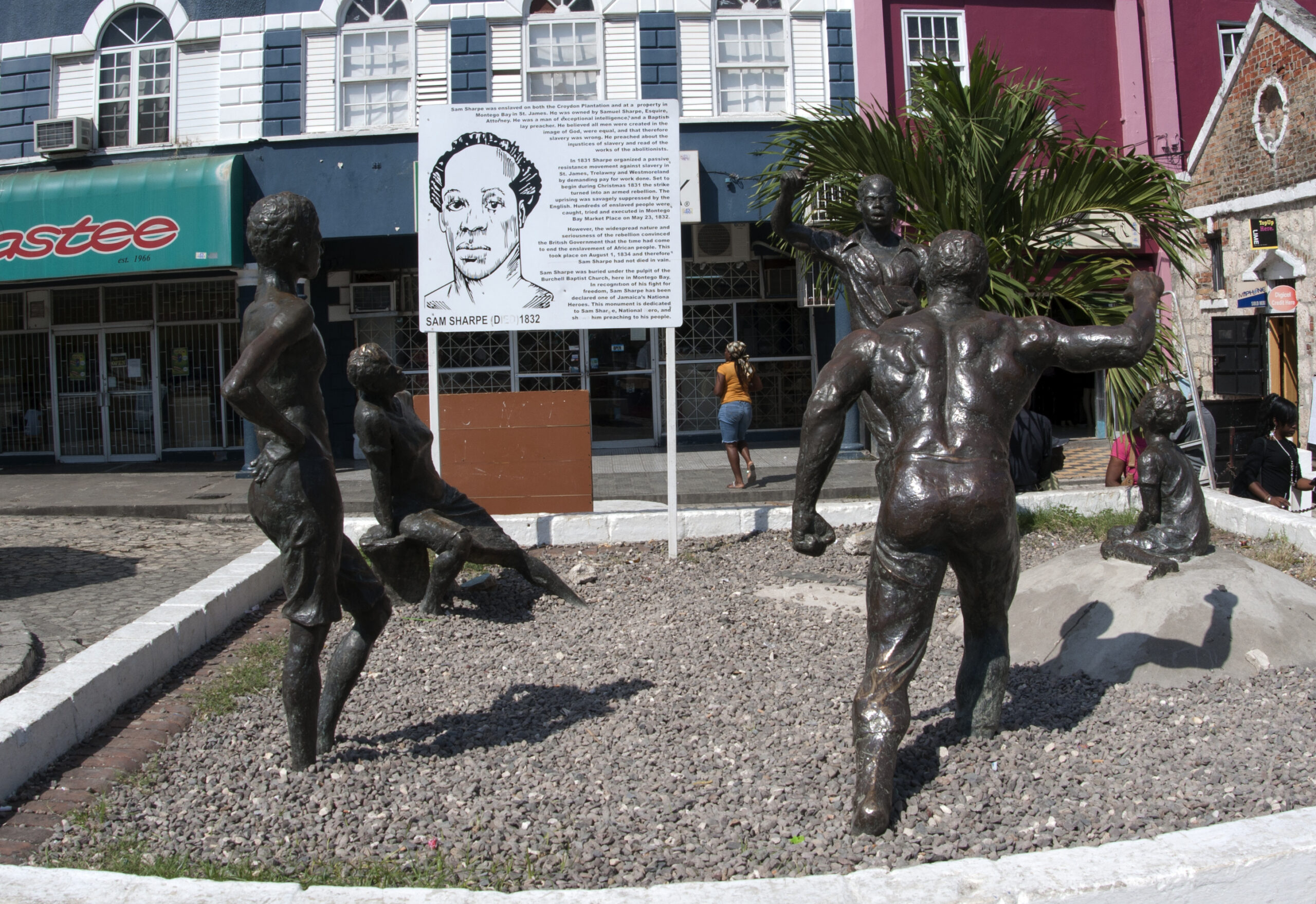
Montego Bay’s public landscape now gives Sharpe a very different place from the one assigned to him by the colonial court. Charles Square was renamed Sam Sharpe Square in 1976. Kay Sullivan’s bronze group, unveiled in 1983, presents him with a Bible, addressing four other figures. The Jamaica National Heritage Trust identifies the square with both his trial and execution. The memorial gathers speaker and listeners together, reminding visitors that his leadership depended on relationships with other people. It is a modern interpretation, not a portrait produced during his lifetime.10
His name also became part of educational life. The institution that opened as Granville Teachers’ College in September 1975 was renamed Sam Sharpe Teachers’ College the following month. Located near Montego Bay, it was established to expand opportunities for teacher training and community development. That association connects remembrance with the education of later generations. It carries the name of an enslaved organiser into an institution where knowledge is acquired, examined and passed on, rather than confining his history to a statue or an anniversary.11
The Sam Sharpe Project, whose partners include centres at Regent’s Park College, Oxford, emphasises the participation of oppressed people in making their own freedom. Its work also includes attention to women in Sharpe’s movement. This offers a useful way to read his story: a recognised leader can help us see a wider community rather than stand in for it. The rebellion’s deepest challenge was the insistence that people whom the law treated as possessions could think politically, organise collectively and demand authority over their lives.12
Sources and further reading
1. National Library of Jamaica: Sam Sharpe: Labour Day exhibition.
2. University of Southampton, Slavery and Revolution project: Samuel Sharpe.
3. Black History Month UK; Linda Ali: Black Abolitionists and the end of the transatlantic slave trade.
4. University of Southampton, Slavery and Revolution project: The Baptist War.
5. University of Southampton; transcription of The National Archives CO137, vol. 182, f.373: The Trial of Samuel Sharpe, 19 April 1832.
6. National Library of Jamaica: Riots and Rebellions: documents, maps and illustrations.
7. National Library of Jamaica: William Knibb (1803–1845).
8. UK Parliament, Hansard: Ministerial Proposition for the Emancipation of Slaves, 14 May 1833.
9. UK Parliament: The West Indian colonies and emancipation.
10. Jamaica National Heritage Trust: Sam Sharpe Square.
11. Sam Sharpe Teachers’ College: Our History.
12. Regent’s Park College, University of Oxford: Sam Sharpe Project.
Photograph
The Sam Sharpe monument in Montego Bay, photographed in February 2013. Kay Sullivan’s bronze group depicts Sharpe addressing fellow enslaved people; it is a modern memorial, not a portrait made during his lifetime. Photo: Don Ramey Logan, Montego Bay Sam Sharpe Photo Don Ramey Logan.jpg, CC BY-SA 3.0. Original photograph; no changes.





Join the conversation
Comments 0
Share a memory, ask a question or add to this story.
No comments yet. Add your perspective.
Add your voice
Create a free account and verify your email to leave a comment.
All comments are reviewed before publication.