For four years, the political map of the Caribbean contained the possibility of a country that never reached independence. The West Indies Federation began on 3 January 1958 and formally ended on 31 May 1962. Its ambition was to bring British Caribbean territories together in a state capable of governing itself. The overview published by Black History Month UK places this short experiment within the region’s passage out of colonial rule. Its brevity should not make it a historical footnote. Federation required Caribbean people to decide where democratic authority would sit, how resources would be shared and whether independence should be pursued collectively. Those questions were substantial even though the proposed country did not survive to answer them.1
Negotiating a different political future
Its advocates belonged to several territories and political traditions. Sir Shridath Ramphal’s later recollection named Grenada’s T. A. Marryshow, Dominica’s Cecil Rawle and Trinidad’s Uriah Butler among the figures who had pursued Caribbean federation over decades.2
Federation emerged through years of conferences, proposals and argument. A British parliamentary debate in July 1957 described the constitutional plan agreed in 1953, its modification at a London conference in 1956, and the work of a committee of West Indian representatives. The British Caribbean Federation Act of 1956 supplied the enabling legislation, but the constitution was also the product of Caribbean negotiations. Independence remained a further objective rather than something automatically delivered by the Act. This distinction matters: creating a federal structure within an empire was not the same as transferring complete sovereignty. Caribbean politicians were negotiating both with Britain and with one another. They had to establish a workable relationship between the new government and territories with their own political institutions, ambitions and electorates.3
The ten members were Antigua and Barbuda, Barbados, Dominica, Grenada, Jamaica, Montserrat, St Kitts–Nevis–Anguilla, St Lucia, St Vincent, and Trinidad and Tobago. These were the territorial units of the period, not a list of ten present-day independent countries. British Guiana and British Honduras, subsequently Guyana and Belize, participated as observers rather than members. UNESCO’s account of the federal archives emphasises an awkward inheritance: these societies had long been connected more directly to Britain than to one another. Sea journeys separated their populations, while plantation economies, slavery, indenture and different local histories had shaped their social worlds. A shared colonial language and administration could support cooperation, but could not eliminate these differences. Federation therefore involved building relationships that colonial rule had never made its central purpose.4
A government with limited powers
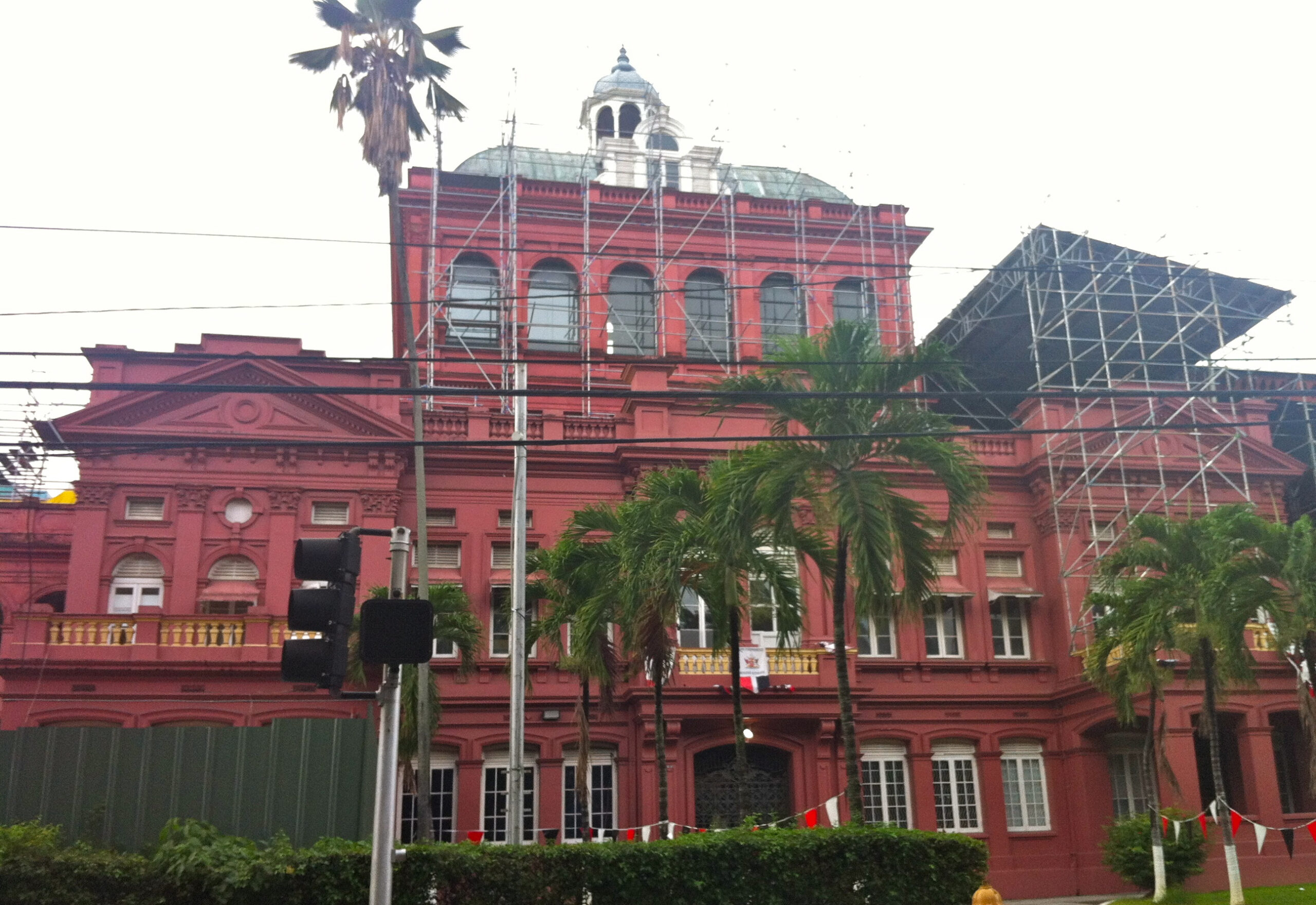
The federal capital was in Trinidad and Tobago, and Sir Grantley Adams of Barbados became prime minister. Lord Hailes, appointed by Britain, served as governor-general. The legislature included a forty-five-member elected House of Representatives and a nominated Senate. This was a substantial political apparatus, but its authority was constrained. The federal government could not impose income tax during at least its first five years, making arguments about revenue especially consequential. Territorial governments were reluctant to surrender powers they had worked to obtain. Nevertheless, administrators began constructing shared services. In 1962, the West Indies Shipping Service operated the Federal Maple and Federal Palm, ships donated by Canada. Their purpose made the federal idea tangible: a regional government might connect people and goods across waters that separated individual territories.5
The argument over resources was inseparable from the region’s uneven economy. A United States policy assessment from 1960 described Trinidad’s petroleum industry, Jamaica’s bauxite production, the importance of agriculture and the growth of tourism. Different sources of income meant different interests in taxation and development. Debates about a customs union, migration and the distribution of political power were therefore more than constitutional technicalities. They concerned who would finance common projects and who would benefit from them. The American assessment also reveals the international setting: US officials considered investment, military facilities and Cold War influence alongside the federation’s prospects. Their document must be read as a statement of American priorities, but it shows that Caribbean self-government was being negotiated in a world of powerful external interests.6
Sovereignty at the military bases
Military bases exposed the limits of freedom especially clearly. In February 1961, Colonial Secretary Iain Macleod reported to Parliament on negotiations over American defence facilities in the federation. The resulting agreement replaced earlier arrangements, including the relevant provisions of the 1941 leased-bases agreement. The United States surrendered its rights in most of the areas leased under that arrangement, while retaining some facilities, including part of Chaguaramas in Trinidad. West Indian representatives had played a leading role, and the federal government signed the agreement after receiving authority from Britain to do so. That combination captures the federation’s intermediate position. It was developing a diplomatic voice and negotiating changes to the use of Caribbean territory, while still operating within a constitutional framework in which Britain controlled its authority to act.7
Making unity visible
Political institutions also needed a public life. The formal inauguration took place in Trinidad on 22 April 1958, with Princess Margaret attending. Federation Day, marked on 23 February, encouraged people to recognise the new political community. At the University College of the West Indies, staff and students were among those who argued for federation, and the economist Arthur Lewis was deeply concerned by its eventual collapse. Material preserved by the university’s museum records these hopes alongside the later disappointment. Such evidence complicates a history told entirely through premiers and constitutional conferences. Unity was also discussed on campuses and expressed through public occasions. A celebration could not settle a revenue dispute, but it could offer participants a way of imagining themselves as members of a larger Caribbean community.8
Jamaica’s decision
The decisive electoral test came in Jamaica on 19 September 1961. Voters were asked whether Jamaica should remain in the federation. The Electoral Commission’s constituency table records approximately 256,000 votes against remaining and 217,000 in favour. The majority supported departure, but those figures also show a divided electorate rather than unanimous rejection. Support varied across constituencies. The result gave withdrawal a democratic mandate while leaving a large body of Jamaicans who had chosen continued membership. Remembering both sides prevents the referendum from becoming merely a convenient date in a story whose ending appears inevitable. It was a choice between competing political futures, made when the consequences of either route could not be known with the certainty that hindsight sometimes assumes.9, 10
After the referendum, Premier Norman Manley redirected his efforts towards Jamaica’s separate independence. By October 1961, a bipartisan parliamentary committee was preparing constitutional proposals. Manley and Alexander Bustamante took a draft to London, while an independence celebration committee organised preparations at home. The Institute of Jamaica’s account describes public involvement in choosing a flag, motto and national song. It also records requests for financial assistance from Jamaicans overseas who wanted to return for the celebrations. These details reveal independence as a family and public event as well as a constitutional change. They also expose expectations that political freedom would quickly bring material improvement. Jamaica’s new direction required another act of collective imagination, now organised around a national future outside the federal structure.11
Trinidad and Tobago takes its own path
Jamaica’s departure changed the balance for Trinidad and Tobago, whose government also chose to seek separate independence. The country’s parliamentary history places that decision within its own developing institutions. A bicameral parliament, comprising a House of Representatives and Senate, first assembled on 29 December 1961, and independence followed on 31 August 1962. The sequence illustrates why federation could not be sustained by an abstract appeal to solidarity alone. Its members were simultaneously constructing national systems of government, with leaders accountable to territorial political constituencies. As the common project weakened, those institutions supplied an alternative route. The decision in Trinidad and Tobago was therefore crucial: losing another major member transformed Jamaica’s withdrawal from a serious federal crisis into a fundamental break in the project’s political foundations.12
Premier Eric Williams expressed his conclusion in the phrase “one from ten leaves nought”. With Jamaica absent, he was questioning whether the remaining union could work. The statement became shorthand for the ending, although disputes over taxation and the sharing of power had troubled the federal project before the referendum brought those tensions to a decisive point.5
The ending and the argument it left behind
Formal dissolution came on 31 May 1962. Sir Shridath Ramphal, who had been involved in drafting a federal constitution, later recalled the day as the moment when an anticipated independent West Indies disappeared. Writing in 2013, he placed the immediate decisions by Jamaica and Trinidad and Tobago within a longer failure of leadership and political agreement. His testimony is valuable precisely because it is an argument from someone committed to the project, rather than a neutral verdict delivered from outside it. Ramphal continued to believe that cooperation could strengthen Caribbean societies against powerful governments and companies. His reflections preserve the sense of a future lost, while reminding readers that judgments about federation have always involved different assessments of sovereignty, security and the possibilities of regional power.2
Cooperation beyond the federation
The federation’s end did not dissolve every regional institution. The University College of the West Indies had begun before federation, and its development continued afterwards. Following a new royal charter in April 1962, the University of the West Indies came into being in its own right on 1 July. It ceased to be a university college awarding degrees through its relationship with the University of London. The timing is striking: as one common political structure ended, a regional educational institution acquired greater independence. The university’s history cautions against treating cooperation as a single enterprise that either succeeded everywhere or failed completely. Educational networks had their own foundations and supporters. Their survival demonstrated that shared institutions could cross new national boundaries even when governments rejected a shared state.13
Other forms of cooperation followed. A 1963 conference brought together the leaders of Barbados, British Guiana, Jamaica, and Trinidad and Tobago. The Caribbean Free Trade Association developed through the 1965 Dickenson Bay Agreement, and the Caribbean Community was established in 1973. These were different arrangements from the federation, built around cooperation among governments rather than the same proposed federal state. British Guiana’s involvement also underlines that regional relationships could extend beyond the federation’s original membership. The history is therefore neither an uncomplicated march towards unity nor a complete abandonment of it. Between 1958 and 1962, Caribbean leaders and voters tested one institutional answer to the problem of collective strength. Its collapse changed the route, while leaving the practical need for negotiation, shared services and regional cooperation firmly in place.14
Sources and further reading
1. Black History Month UK: West Indies Federation.
2. Sir Shridath Ramphal / UWI Today: Lecture on Caribbean integration, International Week 2013.
3. UK Parliament, Hansard: British Caribbean Federation, 26 July 1957.
4. UNESCO, Memory of the World: Federal Archives Fonds, 1958–1962.
5. CARICOM Secretariat: The West Indies Federation.
6. US Department of State, Office of the Historian: US Policy Toward the West Indies, 1960: Foreign Relations of the United States, document 129.
7. UK Parliament, Hansard: United States Military Bases (Agreement), 21 February 1961.
8. The University of the West Indies Museum: Relics of Federation.
9. Electoral Commission of Jamaica: Referendum: 19 September 1961.
10. Electoral Commission of Jamaica: Should Jamaica Remain in the Federation of the West Indies? Constituency results.
11. African Caribbean Institute of Jamaica / Jamaica Memory Bank, Institute of Jamaica: After Federation… Plans for an Independence Celebration.
12. Parliament of Trinidad and Tobago: History of Parliament.
13. The University of the West Indies Museum: UWI Emerged from UCWI.
14. CARICOM Secretariat: History of the Caribbean Community.
Photograph
The Red House in Port of Spain in 2011, with scaffolding around its central tower. Port of Spain was the seat of the West Indies federal government. Photo: James Roberts, The Red House – panoramio, CC BY-SA 3.0. Original photograph; no changes.

Join the conversation
Comments 0
Share a memory, ask a question or add to this story.
No comments yet. Add your perspective.
Add your voice
Create a free account and verify your email to leave a comment.
All comments are reviewed before publication.