A printed cloth in the Smithsonian’s National Museum of African Art carries Kwame Nkrumah’s portrait, the symbols of a new state and the date 6 March 1957. It marks the moment when the British colony known as the Gold Coast became independent Ghana. Cloth could carry political news into ordinary settings, making a constitutional change something people could see and wear. The object also suggests how closely national independence became associated with one leader. Nkrumah mattered enormously, but the country that emerged in 1957 was made through the labour, arguments and expectations of many people whose faces do not appear on commemorative designs.1
The long argument over representation
British colonial rule had allowed selected forms of African representation while keeping decisive authority in the governor’s hands. A legislative council established in 1850 advised the colonial administration. Elections introduced in 1925 did not remove that imbalance, and further constitutional changes followed in 1946. Ghana’s parliamentary history records this gradual enlargement of representation, but it also shows why elections alone did not satisfy nationalists. Participation in an institution was different from control over government. The large elections of 1951 and the creation of a more representative legislature would bring another stage of change. By then, organised pressure beyond the council chamber had made the question of who possessed political authority impossible to contain within colonial arrangements.2
A movement with international connections
The struggle belonged to a wider exchange of ideas about freedom. In October 1945, Nkrumah helped organise the Fifth Pan-African Congress in Manchester. Nigel Thompson’s account for Black History Month UK places him alongside George Padmore, Amy Ashwood Garvey and other campaigners who connected African independence with struggles across the Black Atlantic. Manchester was a meeting place for people whose experiences of empire differed, but who increasingly demanded that colonial subjects should govern themselves. For British readers, this is a significant connection: the history of Ghana’s independence also passed through British cities, student networks and political meetings. Organising abroad gave Nkrumah contacts and a language of continental liberation that he carried into the Gold Coast’s much more immediate political contests.6
Nkrumah returned to the Gold Coast in December 1947 to become general secretary of the United Gold Coast Convention. He had studied in the United States and worked politically in Britain, but he entered an existing movement with its own established leaders. Relations within the convention deteriorated over strategy and the pace of change. In June 1949 he formed the Convention People’s Party, or CPP. His newspaper, the Accra Evening News, helped communicate his position. This was a contest over organisation as well as personality: nationalists disagreed about how to mobilise supporters, what constitutional compromises to accept and how quickly complete self-government could be obtained.5
The crisis of 1948
On 28 February 1948, former soldiers marched towards Christiansborg Castle to present grievances about their treatment after wartime service. They had served in the Gold Coast Regiment and wanted promises of benefits and support honoured. The Public Records and Archives Administration Department preserves this episode as a decisive turning point. Their action connected imperial military service to demands for fair treatment at home. Men who had been expected to serve the British war effort were now asking the colonial state to answer for what followed their return.3
Police fire killed Sergeant Adjetey, Corporal Attipoe and Private Odartey-Lamptey. Rioting spread in Accra and other towns, and the colonial government detained six nationalist leaders, later remembered as the Big Six. Historian Jennifer Hart’s research into the subsequent Watson Commission warns against treating the disturbances simply as a chapter in those leaders’ careers. The commission’s papers contain the grievances of workers, traders, craftspeople and others whose complaints did not always fit a party programme. Living costs, working conditions and administrative interference helped shape the crisis. Those records widen the story: independence emerged within a society already arguing over everyday injustices, with many participants whose aims overlapped without being identical.4
Women doing the work of politics
Hannah Kudjoe was one of the organisers who translated nationalist ambition into sustained public activity. A seamstress based in Tarkwa, she became involved in campaigning for the release of detained leaders and travelled to build support for the independence movement. Her work included speaking, recruiting and mobilising people through relationships formed beyond formal office. Historian Jean Allman has shown how a woman remembered by contemporaries as an important nationalist could subsequently become difficult to find in familiar national histories. Kudjoe’s career challenges the assumption that women merely accompanied a movement directed elsewhere. Political movements require people who persuade neighbours, maintain connections and keep a campaign present between its most dramatic events. Recognising that work changes our understanding of leadership itself. It also makes the absence of women from many celebrated photographs a question to investigate, rather than evidence that they were absent from the struggle.7
From imprisonment to government
The CPP’s Positive Action campaign of 1950 brought imprisonment for Nkrumah. Yet the party continued organising, and its victory in the 1951 elections transformed his position. Released from prison, he was invited to form a government under the developing constitutional arrangements. The sequence matters because it shows the movement combining different methods: protest, party organisation and participation in elections. Colonial authority did not disappear immediately after the vote, and nationalist leaders still had to operate inside institutions whose powers were being renegotiated. A figure imprisoned for challenging the government had become central to its administration. The remaining struggle concerned how that growing African authority would become full national sovereignty.8
The arguments also involved the shape of the future country. Opposition to the CPP included demands for a federal arrangement, particularly associated with the National Liberation Movement in Asante. The 1956 election strengthened Nkrumah’s mandate to seek independence, but its result did not mean that every community shared one view of how power should be distributed.5
Making a country and its symbols
Another decision concerned British-administered Togoland, a United Nations trust territory. A plebiscite produced a majority for union with an independent Gold Coast. In December 1956, the United Nations General Assembly approved that outcome and the ending of the trusteeship when independence took effect. Ghana’s territory therefore emerged through international arrangements as well as anticolonial campaigning. The majority decision should not be mistaken for unanimity: the wording of the UN resolution itself records a choice between competing futures. Following these decisions helps explain why nation-building involved questions of boundaries and belonging alongside the more visible transfer of political office. Independence created a sovereign state, but the work of accommodating different regional attachments continued within it.9
Theodosia Okoh designed the new flag. Its red, gold and green carried meanings connected with sacrifice, mineral wealth and the country’s vegetation and natural resources. The black star represented African emancipation. Ghana’s Permanent Mission to the United Nations also links that star to Marcus Garvey’s Black Star Line. These symbols placed the new nation within a wider history of African aspiration. Okoh’s contribution deserves recognition as creative and political work: she gave a changing constitutional order a public form that could be reproduced on buildings, cloth and documents. A flag cannot settle a country’s disagreements, but it can provide a shared object through which people express hopes for its future.10
An independence watched across the Atlantic
In January 1957, Nkrumah invited Martin Luther King Jr. to attend the independence celebrations. The letter, preserved by Stanford University’s King Institute, offered hospitality during the visit while explaining that the invitation could not cover travel costs. King accepted and travelled with Coretta Scott King. This practical correspondence gives the international significance of Ghana’s independence a human scale. A movement against racial inequality in the United States and a movement against colonial rule in West Africa were exchanging recognition and encouragement. Their circumstances were different, but the invitation treated events in Ghana as something that could matter to people pursuing freedom elsewhere. International solidarity required journeys, correspondence and personal encounters as well as declarations.11
The attention also carried diplomatic tensions. Research published by the United States National Archives shows American officials worrying about the damage racial discrimination at home did to their country’s standing in Ghana. Ghanaian newspapers could compare American claims about freedom with the treatment of Black Americans. Cultural visits by African American performers and other public figures consequently had several meanings: artistic exchange, connections across the diaspora and efforts to improve the United States’ reputation. Ghana’s new international position gave its public debate an audience abroad. Independence changed who could speak as a sovereign government, while also creating another place from which global inequalities could be examined.12
The promises and costs of a new state
Economic development was meant to give political freedom material substance. The Volta River project and its resettlement towns became major expressions of that ambition. Anthropologist Thomas Yarrow’s research follows the afterlife of plans that promised modern housing, reorganised agriculture and a different future for communities displaced by the hydroelectric scheme. His work shows how residents continued to judge those promises long after the initial construction. Electricity and infrastructure could serve national purposes while imposing profound disruption on particular households. Looking at resettlement brings development down to the level of home, work and remembered expectations. It asks who bore the cost of transformation and who could decide whether the promised future had arrived. Such questions belonged to the meaning of independence, not merely to a separate technical debate about planning.13
At independence, Nkrumah became Ghana’s first prime minister. The country remained within the Commonwealth, and the presidency followed when Ghana became a republic three years later. These successive arrangements show that the transfer of power continued to develop after the ceremony. Nkrumah’s government expanded education and infrastructure, but it also concentrated political power. The Preventive Detention Act of 1958 permitted imprisonment without trial. Ghana became a republic in 1960 and a one-party state in 1964. On 24 February 1966, an army and police coup removed Nkrumah while he was abroad. These developments complicate any account that ends with the celebrations of 1957. Freedom from colonial government did not automatically guarantee freedom to oppose the government that succeeded it. Ghana’s independence remains a major achievement, rooted in popular organisation and carrying significance far beyond its borders. Its history becomes more valuable when the hopes of organisers, workers, women and voters remain in view alongside the record of the state. The question they left was enduring: how would national sovereignty become a better, freer everyday life?14
Sources and further reading
1. Smithsonian National Museum of African Art: “Heroes”: Principles of African Greatness, Part 7—Free Africa Faces Forward.
2. Parliament of Ghana: History of Parliament.
3. Public Records and Archives Administration Department, Ghana: The Riots of 28th February, 1948.
4. Jennifer Hart, Journal of British Studies: One British Archive, Archives of Dissent: Complicating Anticolonial Histories through the Watson Commission (Gold Coast/Ghana).
5. R. Addo-Fening, Encyclopaedia Africana: Nkrumah, Kwame.
6. Nigel Thompson, Black History Month UK: Kwame Nkrumah: The Voice of Manchester, the Dream of Africa.
7. Jean Allman, Journal of Women’s History: The Disappearing of Hannah Kudjoe: Nationalism, Feminism, and the Tyrannies of History.
8. Kwame Nkrumah University of Science and Technology: Kwame Nkrumah.
9. United Nations General Assembly, via UNHCR Refworld: The Future of Togoland under British Administration, Resolution 1044 (XI), 13 December 1956.
10. Permanent Mission of Ghana to the United Nations: Ghana Flag.
11. Martin Luther King, Jr. Research and Education Institute, Stanford University: From Kwame Nkrumah, 22 January 1957.
12. Kenneth W. Heger, United States National Archives: The United States and Ghana, 1957–1966.
13. Thomas Yarrow, Cultural Anthropology: Remains of the Future: Rethinking the Space and Time of Ruination through the Volta Resettlement Project, Ghana.
14. Kwame Nkrumah Memorial Park: Biography of Osagyefo Dr. Kwame Nkrumah.
Photograph
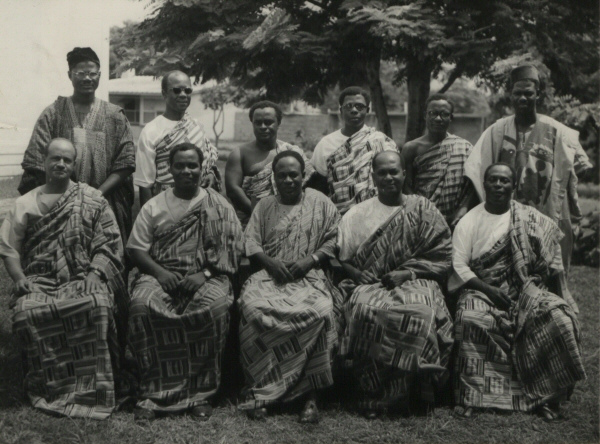
Kwame Nkrumah, seated at the centre of the front row, with members of the cabinet on 6 March 1957, the day Ghana became independent. Photo: The National Archives UK, The Gold Coast Cabinet on 6 March 1957, CO 1069/43, Open Government Licence v1.0. Downloaded Commons version; no further changes. The source records an earlier lossless crop of the border.





Join the conversation
Comments 0
Share a memory, ask a question or add to this story.
No comments yet. Add your perspective.
Add your voice
Create a free account and verify your email to leave a comment.
All comments are reviewed before publication.