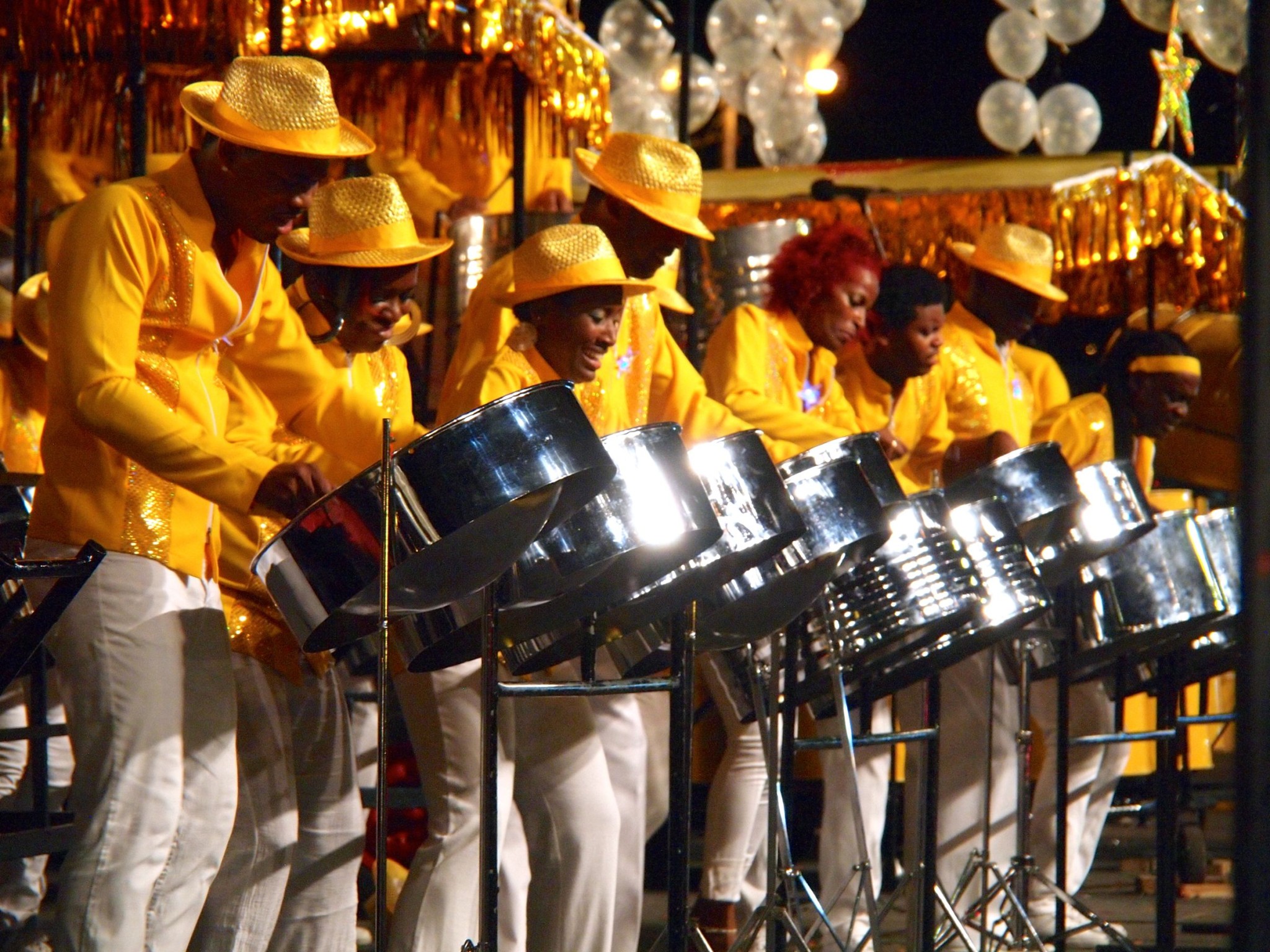
The steelpan is both a musical instrument and evidence of a remarkable process of invention. Developed in Trinidad during the 1930s and 1940s, it emerged from Carnival music, neighbourhood experimentation and the search for new sounds from available materials. Metal containers became instruments capable of melody and harmony. Different pans took on different roles, forming ensembles with high voices, middle registers and powerful bass sections. The familiar image of an oil drum captures only the starting material. What made the steelpan possible was the knowledge needed to reshape, tune and play it. Its history belongs to musicians and makers whose collective work transformed how an industrial object could sound.1
Before the steelpan
The earlier musical world included tamboo bamboo: ensembles using hollow bamboo lengths to produce contrasting sounds. Musicians stamped or struck the bamboo, combining parts into interlocking rhythms. Smithsonian Folkways’ documentation places this practice within African-derived traditions in Trinidad and the response to colonial restrictions on drumming. Its archive preserves tamboo bamboo alongside bongo and belair performances, showing a musical landscape with several related but distinct practices. These traditions supplied experience in rhythm, ensemble playing and the adaptation of materials. The movement towards metal should therefore be understood as an extension of existing knowledge. People were already making sophisticated decisions about how different sounds fitted together. The steelpan’s development changed the instruments available to them while continuing a long history of communal music making.2
Making a surface sing
Ellie Mannette’s recollections make the experimentation tangible. As a child he encountered bamboo, paint containers and biscuit drums used in music. Later, his training as a machinist helped him explore what metal could do. He shaped the playing surface inward, worked on the separation and tuning of notes, and developed techniques involving heat and close attention to the relationship between sounds. The instrument required both manual skill and a trained ear. Mannette’s oral history also describes learning and problem solving with other musicians, including the challenge of building bass instruments. His career demonstrates why the steelpan belongs in histories of technology as well as performance. Repeated trials, adjustments and listening turned a promising sound into something another musician could use with confidence. The workshop and the rehearsal space were closely connected. Mannette’s later work in the United States carried that knowledge into schools and community programmes. After settling there in 1967, he built instruments and taught their use, helping establish ensembles whose players benefited from his practical understanding of the material.3
Bertie Marshall pursued different parts of the same challenge. Growing up in Laventille, he watched tuners at work and encountered Winston ‘Spree’ Simon. Marshall later developed the high tenor and double tenor, extending the sounds available to performers. His interest reached beyond individual notes to the balance of the ensemble, including experiments with low-pitched instruments. He also explored amplification, developing the Bertphone in 1971, and contributed to research at the Caribbean Industrial Research Institute during the 1970s. These projects show that innovation continued after the steelpan had become recognisable. Makers kept asking how its range, projection and tonal character could change. Describing the instrument as a single discovery by one inventor would conceal the many people who worked on different musical and technical problems.4
A player’s touch matters too. In a 2021 Horniman Museum account, musician Dougie Swizz Dallaway explained the use of sticks with rubber at the striking end. The amount and thickness of rubber affect the contact with the metal and therefore the character of the sound. The museum’s tenor pan, acquired in 1955, also presented him with an unfamiliar arrangement of notes. Playing an older instrument required learning its particular layout. This is a useful reminder that a steelpan is a made object with a history, rather than an interchangeable container. Tuning, note placement, the player’s movement and the choice of sticks all contribute to the result. Looking closely at the instrument helps explain the expertise behind a sound that can seem effortless to an audience.5
TASPO and a wider public
The years after the Second World War brought access to more large oil drums and rapid experimentation with instrument families. A decisive public moment came in 1951, when the Trinidad All Steel Percussion Orchestra, known as TASPO, travelled to the Festival of Britain. Under Joseph Nathaniel Griffith, musicians and tuners from different bands worked towards a coordinated ensemble. The project used instruments tuned to concert pitch and capable of playing the full chromatic scale, with parts distributed across several pans where necessary. This demanded practical cooperation as well as musical preparation. The tour brought their work to a prominent international stage and encouraged further development when the musicians returned. Britain was encountering an instrument shaped by Caribbean expertise, while the makers were testing what their collaboration could achieve in a new setting.6
The resulting orchestra had its own architecture. High pans could carry melodies; mid-range instruments supplied harmony; bass sets anchored the music. Alongside them, the percussion section often called the ‘engine room’ maintained rhythmic drive. A steelband’s sound depends on the relationship between these parts, so arranging for it requires attention to the entire group.1
Competition, arranging and ambition
Anthony Williams helped develop both the instruments and their musical possibilities. His North Stars won the first Panorama competition in 1963 with an arrangement of Mighty Sparrow’s Dan is the Man, then won again in 1964 with Lord Kitchener’s Mama Dis is Mas. Panorama gave steelbands an arena in which interpretation and ensemble performance could be publicly compared. Williams’s career also crossed into other concert settings: North Stars appeared with the pianist Winifred Atwell in the Ivory and Steel collaboration of 1968. These achievements show the range of ambitions within pan music. A band could transform a popular song, compete at Carnival and work with a piano soloist. The arranger’s task was to make the resources of the ensemble speak, finding colour, movement and contrast within a shared musical idea.7
Women in the movement
The history also includes women whose participation challenges the picture of an exclusively male world. Music teacher Hazel Henley helped establish Girl Pat Steel Orchestra in 1951. Von Martin’s account, drawing on participants’ recollections, names Marjorie Boothman and the Maurice sisters among its early members and describes the social gatherings from which the band developed. Women’s involvement crossed expectations about gender and class. Some families regarded steelbands with suspicion, making participation a question of social respectability as well as musical interest. The testimony also acknowledges less visible work by mothers, partners and other women who supported musicians. Remembering that labour broadens the history beyond the names most often printed on concert programmes. Ensembles needed instruments and players, but they also depended on homes, encouragement and people who helped make continued involvement possible.8
Recorded evidence allows this story to be heard and studied alongside written recollections. Emory Cook’s 1957 album The Champion Steelbands of Trinidad includes Girl Pat performing Grey Clouds, among recordings of Katzenjammers, Invaders, Fascinators, Southern All Stars and Highlanders. The track list moves between popular tunes and different dance styles. It demonstrates the breadth of repertoire already available to steelbands during that decade. Girl Pat appears within this wider musical field, as a performing ensemble with a named contribution. The record is especially useful because it provides a contemporary trace of women’s participation, rather than leaving their presence entirely dependent on later accounts. It also identifies particular bands, helping listeners move beyond the idea of a single anonymous Caribbean sound.9
Teaching and further invention
As the steelpan travelled, education became another means of sustaining it. Northern Illinois University established its steelband programme in 1973 under G. Allan O’Connor. Trinidadian maker, tuner and arranger Clifford Alexis became central to its development. The programme linked the construction and maintenance of instruments with rehearsal, performance and teaching. Liam Teague later helped carry that work forward, and graduates took their experience into other institutions. NIU’s recognition of Anthony Williams in 2021 also highlighted his arrangement of notes in fourths and fifths, a contribution that shaped instrument design. Such connections show how knowledge can move between a Caribbean musical community and a university abroad. The international history of pan includes people teaching others how to listen, play, arrange and care for the instruments.10
Research continued in Trinidad and Tobago itself. In 2008, the University of the West Indies reported on the Percussive Harmonic Instrument, or PHI, developed by a team including Keith Maynard, Brian Copeland, Earl Phillips and Marcel Byron. Drawing on a pan-like playing layout, the electronic instrument allowed performers to use configurable notes and electronic sounds. It represented a different technical approach from an acoustic steelpan, whose metal surface produces the sound directly. The project is valuable as evidence of continuing experimentation: knowledge associated with pan could inform new designs, materials and performance possibilities. The history did not stop with an accepted instrument shape. Musicians, engineers and designers continued to explore what the relationship between a player’s gestures and an instrument’s sound might become.11
Recognition and responsibility
International recognition acquired a new form in July 2023, when the United Nations General Assembly adopted the proposal for World Steelpan Day. Observed on 11 August, the day calls attention to the instrument’s cultural and historical significance. Trinidad and Tobago’s presentation also pointed to its place in education and international cultural life. Such recognition gives schools, performers and cultural organisations an opportunity to explain where the instrument came from and identify the people who developed it. A celebration becomes more useful when it encourages learning about the makers and musical communities behind the sound.12
In July 2024, Trinidad and Tobago’s National Musical Instrument Act formally declared the steelpan the country’s national musical instrument, giving legal expression to a status long recognised in policy. The Act also provided for regular reporting to Parliament on its recognition, promotion, development and impact. The distinction between honouring an instrument and supporting its future is important. Instruments need to be made and maintained; younger players need opportunities to learn; experienced practitioners need places to pass on their knowledge. The steelpan’s history shows what becomes possible when those skills can develop. Its international sound remains connected to the people of Trinidad and Tobago who made music, tested metal and built institutions through which others could continue their work.13
Sources and further reading
1. National Library and Information System Authority, Trinidad and Tobago: Steelband: historical development, instruments and the modern steelband.
2. Smithsonian Folkways Recordings: Bamboo-Tamboo, Bongo and the Belair: recording and historical documentation.
3. National Endowment for the Arts: Elliott “Ellie” Mannette: biography and oral history.
4. National Institute of Higher Education, Research, Science and Technology, Trinidad and Tobago: Bertie Marshall: Trinidad and Tobago Icons.
5. Horniman Museum and Gardens: The Horniman’s Tenor Steel Pan, 2021.
6. Anthony Pierre / National Library and Information System Authority: A Concise History of the Steelpan.
7. Kim Johnson / The University of the West Indies: A Genius of Our Time: Anthony Williams, UWI Today, November 2016.
8. Von Martin / When Steel Talks: Girl Pat — Beryl, Pat and Pat, from Voices of Pan Pioneers of Trinidad & Tobago.
9. Smithsonian Folkways Recordings: The Champion Steelbands of Trinidad, 1957.
10. Northern Illinois University: NIU awards steelpan innovator Anthony Williams an honorary doctorate in humane letters, 2021.
11. The University of the West Indies: The Percussive Harmonic Instrument, UWI Today, April 2008.
12. United Nations General Assembly meeting coverage: Adoption of World Steelpan Day, 24 July 2023.
13. Parliament of Trinidad and Tobago: National Musical Instrument Act, 2024, Act No. 13.
Photograph
Steelpan musicians at Trinidad and Tobago Carnival, photographed on 10 February 2013. Photo: Kip1234, Steelpan Instruments at Trinidad and Tobago Carnival, CC BY-SA 4.0. Original Commons image bytes; no further edits made.
