Queen Njinga’s life connects the history of African government with the violence of Atlantic expansion. Ruling in the seventeenth century, she negotiated with Portuguese officials, commanded forces and built alliances that helped her survive repeated attempts to remove her. Her name also appears as Nzinga, reflecting different conventions for writing African names in European languages. Black History Month UK’s account introduces her as a significant figure in resistance to Portuguese power. That reputation is deserved, but the complete history is more demanding. Njinga sought to protect her authority and her kingdom in a world where conquest, captivity and the sale of people were deeply entangled with political survival.1
A royal family in a changing region
Born in the early 1580s, Njinga belonged to the royal family of Ndongo, in territory that is now part of Angola. Her family’s position drew on an established African political order, rather than on authority created by Europeans. Portuguese intervention intensified competition over land, people and allegiance. Linda Heywood’s biography places Njinga within these intersecting struggles: royal relatives and officeholders pursued their own interests, while Portuguese governors sought military and commercial advantage. The ruler’s challenge was therefore larger than confronting an external enemy. Holding followers together, maintaining a claim to legitimate government and finding resources for resistance were essential parts of the same struggle. Ndongo was a society with its own institutions and political arguments, not an empty stage for European expansion.2
The embassy to Luanda
In 1622, Njinga travelled to Luanda as an envoy for her brother, Ngola Mbandi. The mission followed devastating Portuguese campaigns and a crisis for Ndongo’s government. She negotiated with Governor João Correia de Sousa and accepted baptism, taking the Christian name Ana de Sousa. Heywood’s account for the Dictionary of African Christian Biography shows how diplomacy and religion operated together. Christianity could offer political standing within Portuguese and wider Catholic networks, while African religious practices remained important to local authority. Njinga’s engagement with different traditions cannot be reduced to a simple choice between an unchanged African world and a European one. She was exploring ways to preserve political room for manoeuvre in a region where religious language could influence negotiations and claims to sovereignty.3
One famous story describes the governor offering Njinga only a floor covering while he occupied a chair. She is said to have seated herself on an attendant’s back, insisting through her posture that she represented an equal power. Historian Joseph Miller noted that colourful accounts of this early embassy were recorded much later. The episode should therefore be presented as a transmitted story, not as a securely documented conversation. It remains revealing about how people remembered her: a dispute over seating becomes an argument about recognition, status and the refusal to accept subordination.4
A 1732 engraving held in Harvard’s collections and presented by the Smithsonian illustrates this encounter. Its date matters: it was produced long after the embassy and after Njinga’s death. Such an image records the circulation of a story rather than providing a photograph-like view of the meeting. Looking carefully at its origin allows the scene to remain useful without treating every gesture in it as verified fact. The image shows how diplomatic resistance acquired a memorable visual form that later audiences could readily understand.5
Claiming authority and building support
Njinga assumed power after her brother’s death in 1624, but her legitimacy was contested. The arguments involved royal descent, competing claims and the support of influential officials. Historian John Thornton challenges the idea that a single fixed constitutional rule automatically disqualified her. Political authority rested on precedents that rivals could interpret differently, and Njinga secured backing through her relationships with important military and political figures. Gender formed part of these disputes, but describing her simply as a woman who broke an otherwise universal ban obscures the particular institutions involved. Her position had to be made and defended through alliances. Understanding those negotiations gives her political achievements substance: she operated within an African constitutional world whose rules mattered, even when opponents disagreed about what they required. Thornton also links her rule to precedents that later supported women’s claims to government. Political tradition could change through the exercise of power. Njinga’s importance therefore includes the consequences of a long reign for those who came after her, as well as the circumstances that allowed her to become ruler.6
Portuguese attacks and African opposition repeatedly threatened her position. After losing effective control over much of Ndongo, she established herself in Matamba in the early 1630s through conquest. The change gave her another territorial base while she continued claiming authority over Ndongo. It also complicates the language of resistance. From the perspective of those she fought in Matamba, Njinga could be an invading ruler herself. Her political survival did not mean that everyone around her experienced liberation. Regional history contains several centres of power, and the ambitions of one African ruler could collide with those of another.7
War, captivity and Atlantic alliances
The armies involved were more complex than a simple confrontation between Europeans with firearms and Africans with older weapons. Thornton’s research on warfare in Angola explains how military practices developed through prolonged contact. Portuguese success depended heavily on African forces and knowledge, while African rulers adapted to the weapons and tactics they encountered. Njinga’s campaigns therefore belonged to a changing military environment in which cooperation, recruitment and strategic judgement mattered alongside equipment. Neither side could assume that one technology would settle the struggle. This helps explain why campaigns continued over decades and why negotiations repeatedly resumed. Sustaining a state required preserving an army and its connections, not merely winning a dramatic encounter that later retellings could turn into a decisive scene.8
Slavery was central to this world. Njinga sheltered people escaping Portuguese-controlled territories, but she also participated in the trade in captives. In an interview about her research, Heywood emphasised that acknowledging the queen’s strength must include her involvement in African enslavement. Resistance to Portuguese domination did not amount to a programme to abolish slavery. A ruler could defend the freedom of her polity while treating other people as resources to be exchanged. Keeping these experiences together prevents the suffering of captives from disappearing beneath the language of national heroism.9
The Dutch seizure of Luanda in 1641 created a new opportunity, and Njinga allied with them against the Portuguese. Cooperation with another European power was a means of pursuing her own objectives. Its limits became clear in 1648, when Portuguese forces arriving from Brazil recovered Luanda and the Dutch withdrew. Njinga returned to Matamba, having to reconsider a strategy that depended on partners whose priorities she could not control.7
Peace as another form of statecraft
By the later 1650s, peace and Catholic connections offered a different route to security. Heywood describes Njinga’s final years as a period of consolidation, including efforts to arrange the succession of her sister Barbara. Reconciliation was an active political project after decades of warfare. Protecting a surviving kingdom required decisions about what to preserve, what to concede and how authority could continue after the ruler’s death.2
The agreement reached in 1656 linked the release of Barbara from Portuguese captivity with Njinga’s renewed commitment to Catholicism and the admission of missionaries. It also included a payment of enslaved people. Even the settlement that helped preserve her kingdom depended on the coerced transfer of others, a stark reminder of whose freedom could be negotiated away.3
Written diplomacy helped make that project possible. Research by Celina Cavalcanti-Bennett examines twelve letters associated with Njinga and preserved through the missionary Giovanni Antonio Cavazzi’s narrative. The letters present a ruler seeking peace and employing Catholic language in pursuit of political relationships. They cannot simply be treated as an unfiltered transcript of her thoughts: their survival depends on another writer’s selection and presentation. Yet they help shift attention from the familiar image of a warrior queen towards the work of government. Negotiation required messages, intermediaries and repeated attempts to make another party recognise a claim. Njinga’s political voice survives partly through those exchanges, even when the record demands caution about how directly we are hearing her.10
The court beyond the battlefield
Cavazzi also made a watercolour showing Njinga seated with women attendants while a drummer performs. The image, dated to the 1660s and catalogued by Slavery Images, depicts a courtly setting with a pipe and ceremonial seating. It offers another perspective on a life often reduced to battles. Music, attendance and the arrangement of a gathering could express rank and authority. This is an artist’s representation, with its own conventions, but it preserves evidence of court life that would be lost if the queen were considered only through military campaigns.11
Thornton’s introduction to Cavazzi’s manuscript explains the problems involved in using it. The missionary knew Njinga during her later years, but he revised his writing, and speeches were not necessarily recorded when they occurred. His account must be examined for when information was gathered and how it was subsequently shaped. Njinga died on 17 December 1663. The surviving narrative carries valuable testimony, but also the concerns of a writer constructing her story after crucial events had already passed.12
Reading a powerful and difficult legacy
Recent research by Marcelo José Cabarcas Ortega examines the moral structure of missionary accounts. Cavazzi could admire Njinga’s political abilities while arranging her life around Christian ideas of error, conversion and redemption. That framework influenced what he emphasised and how he judged behaviour. Recognising it does not require discarding the source. It means comparing accounts and asking whose purposes a description serves. A hostile label should not automatically become the historian’s verdict, just as a celebratory modern portrait should not erase evidence of coercion. Njinga’s history rewards this care because the archive preserves both formidable African agency and European attempts to interpret and contain it within familiar religious categories.13
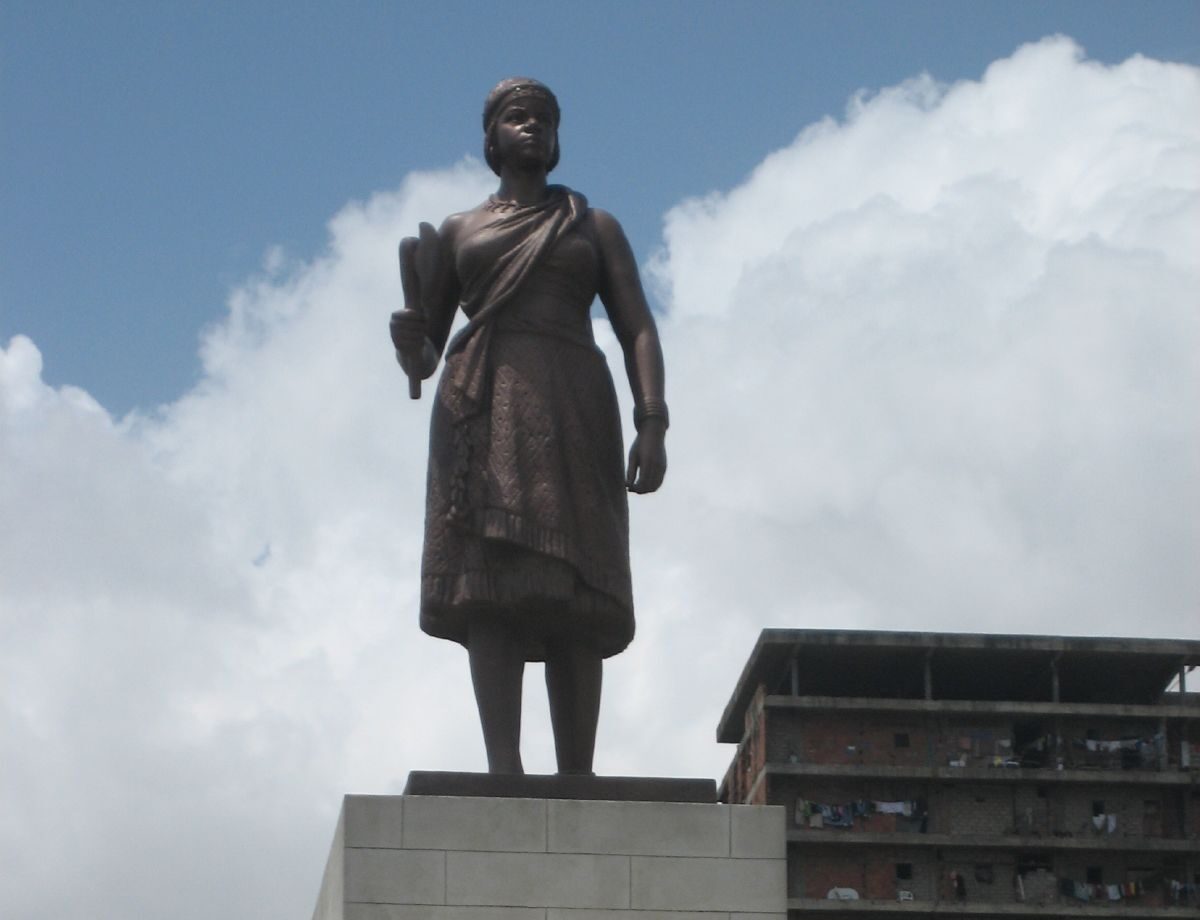
Her later reputation travelled beyond Angola. Heywood’s research traces her presence in Brazilian Black religious and cultural traditions, while commemorations in Angola have made her a public symbol of strength. The modern statue in Luanda belongs to that history of remembrance; it is not a likeness made during her lifetime. Remembering Njinga responsibly allows room for both admiration and difficult questions. Her endurance, diplomacy and command were substantial achievements. The choices and losses of people living under, alongside or against her authority were also essential to the world she helped shape.9
Sources and further reading
1. Black History Month UK: Queen Nzinga Mbande: The Unyielding Beacon of Resistance and Sovereignty.
2. Linda M. Heywood, Harvard University Press: Njinga of Angola: Africa’s Warrior Queen (chapter previews).
3. Linda M. Heywood, Dictionary of African Christian Biography: Njinga.
4. Joseph C. Miller, The Journal of African History: Nzinga of Matamba in a New Perspective.
5. Smithsonian National Museum of African Art, via Google Arts & Culture: Ana Njinga Meets the Portuguese Governor, 1732.
6. John K. Thornton, The Journal of African History: Legitimacy and Political Power: Queen Njinga, 1624–1663.
7. South African History Online: Njinga Ana de Sousa.
8. John K. Thornton, Comparative Studies in Society and History: The Art of War in Angola, 1575–1680.
9. Susan Seligson, Boston University: The Enduring Power of Queen Njinga.
10. Celina Cavalcanti-Bennett, University of New Mexico: The Penetration of European Ideology in the Atlantic World: “Othering” and “Deforming” the Image of the African Queen Njinga of Matamba in the Narrative of Capuchin Monk Fra. Cavazzi da Montecúccolo.
11. Slavery Images, with catalogue interpretation by Joseph Miller: Untitled Image (Queen Nzinga and a Drummer in the Kingdom of Matamba), 1660s.
12. John K. Thornton, Boston University: Cavazzi, Missione Evangelica: General Introduction.
13. Marcelo José Cabarcas Ortega, Journal of Early Modern Studies: Mapping Sovereignty: Njinga, Missionary Writing and the Ambivalences of African Legibility.
Photograph
A modern statue commemorating Queen Njinga in Luanda, Angola, photographed on 11 April 2006. It is a later representation of the ruler. Photo: Erik Cleves Kristensen, Queen Njinga Mbande statue, Luanda, CC BY 2.0. Original photograph; no changes.





Join the conversation
Comments 0
Share a memory, ask a question or add to this story.
No comments yet. Add your perspective.
Add your voice
Create a free account and verify your email to leave a comment.
All comments are reviewed before publication.