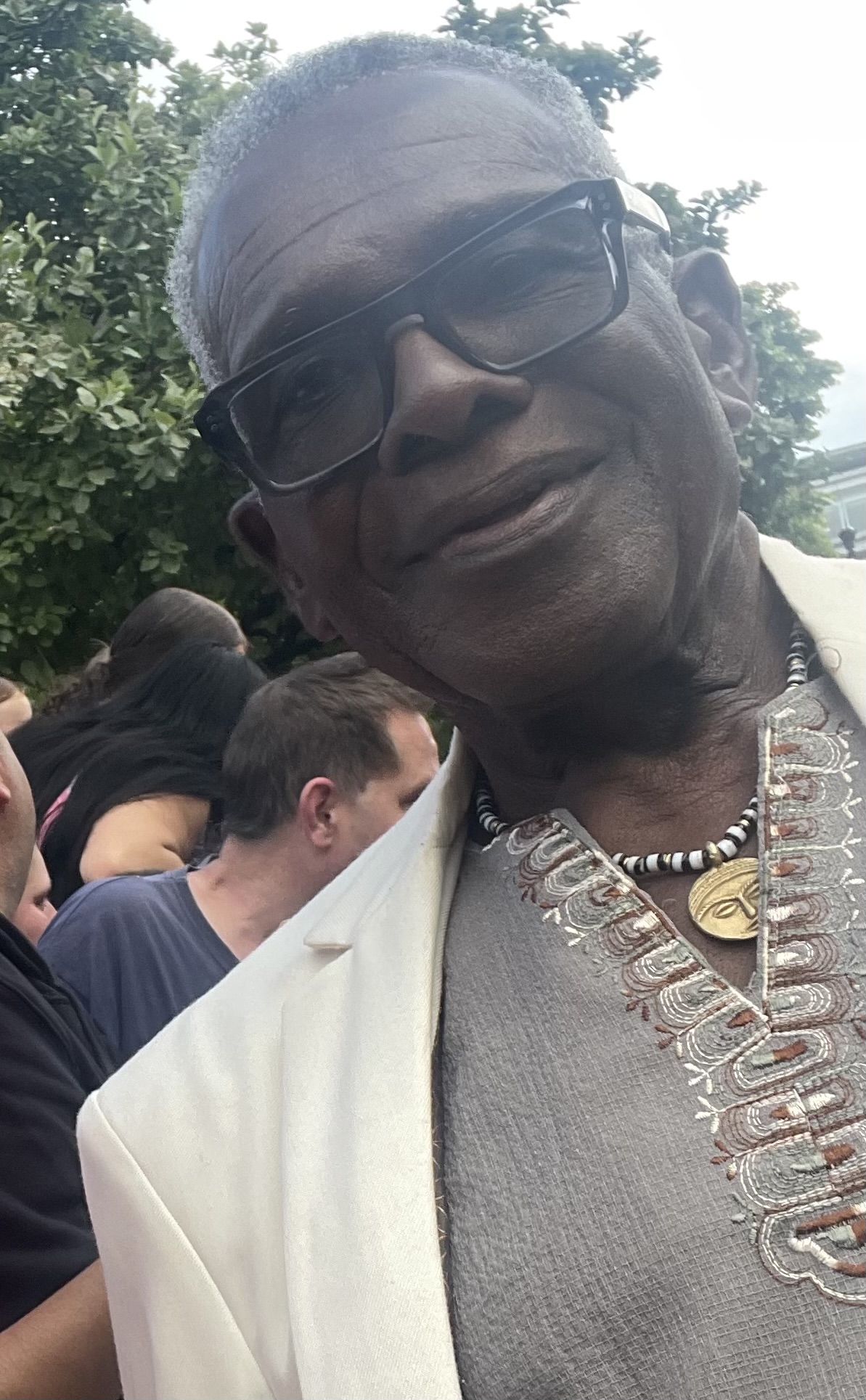
Rudolph Walker’s career reaches across several generations of British television. There is Bill Reynolds in Love Thy Neighbour, the comedy of The Thin Blue Line and, from 2001, Patrick Trueman in EastEnders. Alongside those performances, he has built a foundation that brings professional actors into work with young people. Its beginnings in 2009 belong to the same life as his theatre and television roles. 1
Growing up in Trinidad
Walker was born on 28 September 1939 in Trinidad and Tobago. In his own account of his childhood, he remembers cricket, his earliest acting experiences and a family led by his mother, Carmen, and four aunts: Ada, Margery, Millicent and Merle. His website’s family photographs also recall a government printing job, bicycles and carnival. These were the people and activities of a life already well established before he crossed the Atlantic to pursue acting. 2
He was the eldest of three children and his mother’s only son. The foundation’s account describes a strict upbringing and a boy who developed a sense of responsibility early. His enthusiasm for the stage began when he was eight, giving him an interest that he would continue to pursue as a young adult. 3
In Trinidad, Walker joined Derek Walcott’s Trinidad Theatre Workshop. Another actor, Errol John, helped persuade him to seek opportunities in Britain. Walker left in 1960, aged twenty. John’s advice was significant because Walker had initially considered the United States, where he had connections. Instead, he chose Britain and attended evening classes at City Lit in Holborn. His move combined a change of country with the practical business of finding training and work. 2, 4
Finding work on the British stage
Walker later discussed those early London years with fellow actor David Harewood. His foundation’s account of their 2025 conversation at the V&A recalls City Lit and an early performance at St Pancras Town Hall. It also records his experiences of approaching theatre and television companies only to be told that parts had not been written for Black actors. He described weighing potential roles carefully, with dignity an important consideration in deciding what to accept. 5
The University of Warwick’s British Black and Asian Shakespeare database preserves evidence of the stage work he secured. He played Othello at the Malvern Festival Theatre in 1966 and Caliban in The Tempest at London’s Mermaid Theatre in 1970. In 1972 he appeared in An Othello at the Open Space Theatre. These were substantial Shakespearean roles during the years before, and around, his breakthrough in television comedy. He returned to Caliban at Bristol Old Vic in 1980. 6
A later recollection shows how uncertain television opportunities could be. Speaking at Senate House Library in 2024, Walker remembered appearing in the opening episode of On the Buses, The Early Shift. He said he had expected a continuing role, only for the arrangement to be dropped without an explanation at the time. According to the university’s account of his remarks, he subsequently learned that the production company believed a Black character would damage the ratings. 7
The arguments around Love Thy Neighbour
Love Thy Neighbour, which ran from 1972 to 1976, placed Walker at the centre of a sitcom about racially antagonistic neighbours. Its principal cast included Jack Smethurst as Eddie Booth, Kate Williams as Joan Booth, Walker as Bill Reynolds and Nina Baden-Semper as Barbara Reynolds. 9
Writers Vince Powell and Harry Driver made Bill a Conservative voter and Eddie a socialist, so the neighbours’ quarrels crossed party politics as well as race. The BFI’s account records the programme’s strong ratings while describing its comic premise as dated and precarious. That combination helps explain why it occupies such a disputed position in British television history. Its popularity is part of the record; so is the difficulty of finding comedy in repeated racial antagonism. 8
In 2024, Walker defended the programme as an exposure of racism’s absurdity, while acknowledging its critics and its importance to his career. 10
Shakespeare, legal drama and television comedy
Walker continued to work with Caribbean writers and across different kinds of drama. He appeared in the original production of Mustapha Matura’s Play Mas at the Royal Court Theatre in 1974. Later came Black Silk, the television legal drama created by Matura and Rudy Narayan. In the V&A conversation, Walker discussed that work alongside his approaches to choosing roles. Matura’s presence in both his theatre and television career is a reminder of the writers whose work provided substantial parts for Black performers. 5
Shakespeare remained a recurring part of his career. In 1984 he played Othello at the Young Vic; in 1987 he was Friar Laurence in that theatre’s Romeo and Juliet. He returned to Caliban in The Tempest at the Old Vic in 1988, then played Gower in the Royal Shakespeare Company’s Pericles at the Swan Theatre in 1989. The Warwick record also lists him as Flavius in the Young Vic’s Timon of Athens in 1991. 6
His comedy credits were equally varied. British Comedy Guide records him as Sonny in The Lenny Henry Show in 1987 and as the invigilator in the opening episode of Mr. Bean in 1990. He appeared in The All-New Alexei Sayle Show before playing PC Gladstone in both series of The Thin Blue Line, broadcast in 1995 and 1996. The same record includes a guest part in The Fosters and appearances as Mr Valentino in Bodger & Badger. Younger viewers could therefore encounter him in quite different programmes from those their parents remembered. 11
Patrick Trueman and the work behind a storyline
In 2001, Walker began playing Patrick Trueman in EastEnders. The role brought him another long period in a regular television ensemble, and in 2018 the British Soap Awards recognised him with its Outstanding Achievement award. The ceremony took place at the Hackney Empire in east London. By then his time as Patrick already amounted to seventeen years, following the substantial stage and screen career he had built before joining the programme. 13
One demanding Patrick storyline involved a stroke in 2014. The Stroke Association worked with EastEnders as the production researched the character’s symptoms, the stroke itself and its consequences. Producers also consulted stroke survivors and other specialists. The story was planned to continue through the remainder of the year, including its effects on the people closest to Patrick. Walker said he hoped the work would improve awareness of a condition that affected people in many different ways. 12
The charity’s contemporary announcement also records the thinking of executive producer Dominic Treadwell-Collins. He wanted the storyline to explore both warning signs and the difficulties of caring for an older person. Joe Korner, speaking for the Stroke Association, confirmed that the organisation had advised on the plot. Walker’s performance was therefore supported by a wider process of consultation: the production team and people with experience of stroke helped shape the story he was being asked to carry. 12
Young people creating work for the stage
Walker established the Rudolph Walker Foundation in 2009, on his seventieth birthday. It uses performing arts projects, professional mentors and acting coaches to support young people, particularly those facing disadvantage. School drama competitions became one of its activities, alongside other creative projects. Its account of the work emphasises young people making performances together, supported by adults with professional experience, and developing relationships with both mentors and fellow participants. 1
The inter-School Drama Awards began in 2011. In the format described by the foundation, pupils aged eleven to eighteen submit a short video explaining why they want to participate. Selected schools work with an actor or mentor to create a ten-minute play on a subject of their choice, then perform before an audience. Awards recognise writing, acting and production. Pupils do not have to be studying drama already: willingness to participate is the starting point. 14
The 2023 results put names to that process. FreshSteps Independent School won Best Production with Expectations, supported by mentor Simone Lahbib. Other participating mentors included Tanya Franks, Delroy Atkinson and Ellen Thomas. The foundation’s record also credits producer Sarah Eckert Moore and project manager Lucy Vandi. Those details show the collective effort behind an event carrying Walker’s name: school groups wrote and performed the work, while actors, educators and a production team helped bring it to an audience. 14
Working with schools and across generations
The foundation also contributed drama to Enfield’s REACH project, an eight-session programme for secondary pupils who had been excluded from school or were at risk of exclusion. Alongside academic subjects, participants worked with professional performers to create drama or poetry for an audience. The foundation subsequently developed REACH & Beyond in schools, with weekly workshops over a term and a performance at the end. Its 2024 account describes groups of up to sixteen young people and work tailored to each group. 15
At Oasis Academy Enfield, the work included a contemporary Romeo and Juliet. Anthony Williams, an education director with Oasis Community Learning, praised the students’ commitment and confidence in a testimony published by the foundation. Teachers from Chace Community School and St Anne’s Catholic High School for Girls also described pupils’ engagement in the workshops. Their accounts describe the rehearsals and performances through which the foundation seeks to support young people. 15
Bridging the Gap takes a different approach. Its pilot paired young people from a Newham secondary school with older people, whom they interviewed before writing about their lives. Students from Kingsford Community School met pensioners at a local library before lockdown interrupted the project’s wider development. Here the starting material was a conversation with another person, rather than a part already written for the stage. The project invited young writers to listen, ask questions and decide how to present someone else’s story. 16
A Windrush edition followed in Enfield in 2023. Young people and elders met at tea parties, and their conversations contributed to a short film. A screening at the Dugdale Centre on Windrush Day included live entertainment, with singer Lurine Cato hosting and young participants reading poems based on their discussions. The foundation’s account records an event in which older people supplied memories and younger people created work from them, giving both generations a part in telling the story. 16
Telling his own story
Walker’s autobiography, Walking with Dignity, was published in 2024. Chronos Publishing describes a book that follows his Caribbean childhood, migration to Britain and experiences of racism during his working life, as well as his television career. A memoir gives him space to place the familiar screen characters within the much longer account of the person who played them. 17, 18
He continued to discuss that history in public. His July 2025 conversation with David Harewood at the V&A brought together two actors to examine his journey from Trinidad, his peers and changes in British acting. The museum presented a career encompassing theatre, film, comedy and long-running serials. Walker’s work could be considered across those forms, with room for the stage performances and earlier television appearances that might be unfamiliar to an audience who knew him chiefly as Patrick. 18
His appearance at Senate House Library had placed personal recollection alongside an archive of Caribbean history. At the October 2024 launch of In the Grip of Change: the Caribbean and its British Diaspora, he spoke about an exhibit that brought back memories of the colour bar, and met readers of his autobiography. The exhibition joined individual stories with histories of migration, independence and resistance. Walker contributed the experience of an actor who had lived through some of the changes it examined. 7
At his CBE investiture in June 2021, Walker looked back to leaving Trinidad in 1960 and told reporters that he had never imagined receiving such an honour. He addressed his message to young people in both Britain and the Caribbean, encouraging their ambitions while also acknowledging that there was further to go. The award recognised his services to drama and charity. 4
Sources
1. Rudolph Walker Foundation — About.
2. Rudolph Walker — My journey.
3. Rudolph Walker Foundation — Rudolph Walker CBE.
4. CNC3 / Guardian Media — Trini-born British actor awarded CBE from Prince Charles (24 June 2021).
5. Rudolph Walker Foundation — Rudolph Walker in Conversation with David Harewood (12 August 2025).
6. University of Warwick — British Black and Asian Shakespeare: Rudolph Walker.
8. BFI Screenonline — Love Thy Neighbour (1972–76).
9. BFI Screenonline — Love Thy Neighbour: credits.
10. The Guardian — Rudolph Walker on equality for Black actors (24 September 2024).
11. British Comedy Guide — Rudolph Walker: credits.
12. Stroke Association — EastEnders to feature stroke storyline (17 June 2014).
13. ITV News — British Soap Awards (3 June 2018).
14. Rudolph Walker Foundation — inter-School Drama Awards.
15. Rudolph Walker Foundation — REACH & Beyond.
16. Rudolph Walker Foundation — Bridging the Gap.
17. Chronos Publishing — Rudolph Walker CBE and Walking with Dignity.
18. Victoria and Albert Museum — Rudolph Walker in conversation with David Harewood (19 July 2025).
Image credit
Rudolph Walker in May 2025. Photograph: Meena, via Wikimedia Commons. Image source; CC0 1.0.





Join the conversation
Comments 0
Share a memory, ask a question or add to this story.
No comments yet. Add your perspective.
Add your voice
Create a free account and verify your email to leave a comment.
All comments are reviewed before publication.