A job and a place to live were closely connected in post-war Britain. People arriving from Commonwealth countries entered a society rebuilding after war, with employers seeking workers and families struggling to secure accommodation. Black newcomers encountered an additional barrier. A room could become unavailable when the prospective tenant arrived. Understanding that housing colour bar means following the discrimination people faced and the ways they made homes, supported relatives and organised for change.1
The experience was recorded at the time. In A West Indian in England, a booklet associated with H. D. Carberry and Dudley Thompson and held in the Colonial Office records, housing shortages and racial prejudice appear together. Its account describes rooms offered by telephone or letter being refused when a Black applicant appeared in person. Some proprietors invoked the anticipated objections of neighbours. Exclusion could therefore operate without a notice in a window: it happened through conversations, excuses and decisions that were difficult for a rejected applicant to challenge.2
A shortage made unequal
The booklet matters because it separates two problems that were often collapsed into one. War damage and insufficient accommodation affected a wide population. Racial discrimination narrowed the options available to particular people within that shortage. A Black worker could possess the money for rent and still be refused. The consequences extended beyond an uncomfortable encounter: each rejection meant more searching and greater dependence on whichever accommodation remained open. The colour bar helped determine who could choose a home and who had to accept one.2
A report by John Baker in Wolverhampton’s Express and Star in August 1956 gives this problem a specific setting. A Citizens Advice Bureau official described a West Indian man who had returned repeatedly for help finding lodgings. The eventual suggestion was an already overcrowded house. The report illustrates how discrimination could funnel people into poor conditions and then allow those conditions to be discussed as though they were simply the habits of the residents.3
The Wolverhampton article mixes observations about exclusion with assumptions about the people it describes, revealing contemporary attitudes as well as the housing search itself. Its most telling detail is the repeated return for assistance: repeated searching and an official helping hand had not secured suitable accommodation. That detail challenges explanations which place the responsibility for overcrowding entirely on the families living in it.3
When a bed was tied to work
Hostels offered another form of accommodation, particularly for workers who had arrived without a family home to join. They could also become sites of racial conflict. After violence at Causeway Green hostel in Oldbury in 1949, resident Horace Halliburton wrote in the Birmingham Gazette. Having lived there for eight months, he challenged the idea that the trouble could be explained as a dispute between individuals. He connected what had happened to the wider colour bar.4
Halliburton’s article is valuable because it preserves a resident’s interpretation alongside the official records. A hostel might be described administratively as a place to house labour, but its occupants needed safety, dignity and the ability to live alongside others. Reading their testimony changes the questions we ask. Finding an available bed was only one part of settlement; being able to remain there without intimidation was another. This history belongs to industrial towns as well as to London.4
Saving together
Community savings helped some Caribbean families move beyond the choices offered by landlords and lenders. Catherine Ross and Lynda Burrell of Museumand describe the pardner hand, a system in which participants make regular contributions to a common fund. Each person receives the accumulated money in turn, with a trusted organiser administering the arrangement. Its strength depends on relationships and on the expectation that people will continue contributing after they have received their own share.5
These arrangements were especially useful where formal banking demanded an established financial record, capital or other conditions a newcomer could struggle to meet. Racial prejudice could create further obstacles. A pooled payment made a larger purchase possible sooner than individual saving alone. The significance lies in the financial knowledge already present within communities: participants brought methods of managing money, evaluating reliability and meeting collective obligations. They adapted those methods to the costs of establishing a life in Britain.5
In a second account, Ross and Burrell connect these savings practices to house purchases and small businesses. Their family photographs and examples show how money circulated through everyday relationships. A home could provide somewhere to raise children and also somewhere to earn: hairdressing and other services might begin within domestic rooms. The boundary between housing history and business history was consequently porous. Property, work and mutual assistance could form parts of the same family plan.6
The system required regular payments and continuing trust. Its historical importance is that families were actively organising resources under difficult conditions. The contribution collected, the purchase made possible and the household income supplemented all belong in an account of settlement. They help explain how people created security while access to other financial routes remained uneven.6
Making discrimination a public question
The law changed gradually. The Race Relations Act 1965 addressed discrimination in specified public places but did not establish the later protections in housing and employment. The Race Relations Act 1968 extended the legal framework into those areas, receiving royal assent on 25 October. For housing in Great Britain, this was a substantial change: conduct that had repeatedly been treated as an owner’s personal preference was brought within a national system intended to challenge racial discrimination.7
Parliamentary recognition followed years of rejected applications and insecure accommodation documented by residents, advisers and campaigners. The people affected had already identified the problem. Changing the rules governing discrimination was necessary, while the availability, affordability and condition of accommodation remained separate questions. A successful complaint could challenge unfair treatment without automatically providing a suitable home for the person who had been excluded.7
A House of Lords Library review of the 1968 Act describes pressure from campaigners, including the Campaign Against Racial Discrimination, and the weaknesses of the earlier arrangements. The new legislation widened the Race Relations Board’s responsibilities and introduced additional enforcement machinery. It made discrimination in services and other parts of everyday life a matter for public institutions. Housing campaigners could now frame exclusion as an issue requiring an institutional response rather than an endless succession of private disappointments.8
Further reform followed in 1976, including the recognition of indirect discrimination and the creation of the Commission for Racial Equality. This development matters because an apparently general practice can disadvantage a racial group even when no openly racist statement accompanies it. The history of housing equality therefore includes arguments about how decisions are made, what evidence demonstrates unfair treatment and which institutions can act. Passing a law marked a stage in that work rather than its completion.8
Olive Morris and the politics of empty buildings
Community action also challenged the gap between empty property and unmet housing need. Writing for Black History Month UK, Marsha de Cordova places Olive Morris’s housing activism within a wider commitment to education, employment and Black women’s organising. Morris participated in the occupation of 121 Railton Road in Brixton. The address became associated with community activity and a bookshop, showing how a building could support political education as well as provide space otherwise denied to local people.9
Morris’s example connects the domestic and the political. Campaigns about accommodation existed alongside the work of the Brixton Black Women’s Group and broader organising by women of African and Asian descent. These were overlapping demands concerning the conditions in which people lived, worked and raised children. De Cordova’s account helps recover an activist whose contribution cannot be confined to one celebrated confrontation. Housing was part of a sustained effort to change the distribution of power in everyday life.9
Creating housing organisations
Another response was to build organisations able to provide accommodation directly. Odu-Dua Housing Association traces its beginnings to 1986, when it was established to meet the needs of single homeless Black men. Its early work used short-life properties in Camden: buildings available for temporary occupation rather than a permanent housing supply. The association’s account records a later move towards permanent accommodation, including properties in other north London boroughs.10
That development shows a different scale of community action. Knowledge of unmet need could be turned into an organisation negotiating for buildings and managing homes. It also broadens the familiar picture of post-war settlement beyond the family purchasing a terrace. Single people, including those without relatives able to accommodate them, needed routes into secure housing too. Organisations formed around those needs became part of the infrastructure through which Black communities sought lasting improvements.10
Inside the home
The Museum of the Home’s A Front Room in 1979, curated by Michael McMillan, offers another way into this history. It reconstructs a British Caribbean domestic setting associated with a home on Hackney’s De Beauvoir Estate. The display brings together furniture, a radiogram and carefully chosen decoration. These objects shift attention towards what people made within their rooms: spaces of welcome, family identity, entertainment and respectability, shaped by both Caribbean experience and life in Britain.11
The installation is a museum interpretation, rather than a record of every Caribbean household. Its crochet work nevertheless carries particular makers’ histories, including that of McMillan’s mother, Letha. Such details make domestic creativity visible. A history concerned only with rejection at the front door would miss the decisions made after someone entered a home: what to display, what to listen to, how to receive guests and how to express care through the arrangement of a room.11
Keeping the evidence of belonging
The Migration Museum’s Room to Breathe exhibition assembled personal objects, recordings and stories around the making of a new life. Its approach brings housing into conversation with work, friendship and community. That is a useful model for preserving family histories. An official file can record a complaint or a policy, while a photograph, remembered address or account of sharing a room can reveal what the same period meant to the people living through it.12
These different kinds of evidence should be read together. No single household can stand for every Black experience of Britain, and no account of discrimination explains everything people valued about their homes. The housing colour bar shaped choices, but residents also made choices within and against it. Their savings, campaigns, organisations and domestic creativity belong within the history of British housing itself. They show how the search for accommodation became the work of establishing belonging.12
Sources and further reading
1. The National Archives: Commonwealth migration since 1945.
2. H. D. Carberry and Dudley Thompson / The National Archives: A West Indian in England (Colonial Office records, CO 875/59/1).
3. John Baker, Express and Star / The National Archives: Express and Star, 9 August 1956 (AST 7/1125).
4. Horace Halliburton, Birmingham Gazette / The National Archives: No Future in This Colour Bar, 10 August 1949 (LAB 26/198).
5. Catherine Ross and Lynda Burrell, Museumand / Bank of England Museum: Community savings and the Pardner Hand.
6. Catherine Ross and Lynda Burrell, Museumand / Bank of England Museum: The Pardner Hand and Black entrepreneurship in the UK.
7. UK Parliament: 1968 Race Relations Act.
8. Amritpal Bachu / House of Lords Library: Race Relations Act 1968: 50 Years.
9. Marsha de Cordova / Black History Month UK: Saluting a Pioneer Voice: Olive Morris.
10. Odu-Dua Housing Association / Communities that Work: Odu-Dua Housing Association.
11. Museum of the Home: A Front Room in 1979.
12. Migration Museum: Room to Breathe.
Photograph
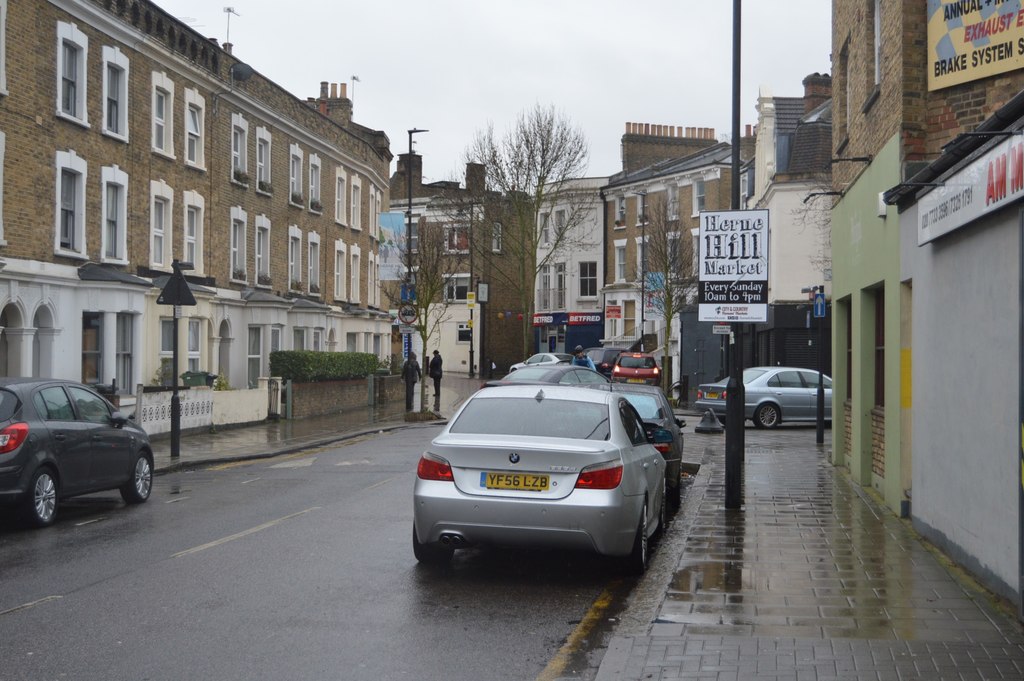
Railton Road in Lambeth, photographed in February 2018. A modern view of a street associated with Brixton’s wider community history. Photo: N Chadwick, Railton Rd, 3 February 2018, CC BY-SA 2.0. Original photograph; no changes.





Join the conversation
Comments 0
Share a memory, ask a question or add to this story.
No comments yet. Add your perspective.
Add your voice
Create a free account and verify your email to leave a comment.
All comments are reviewed before publication.