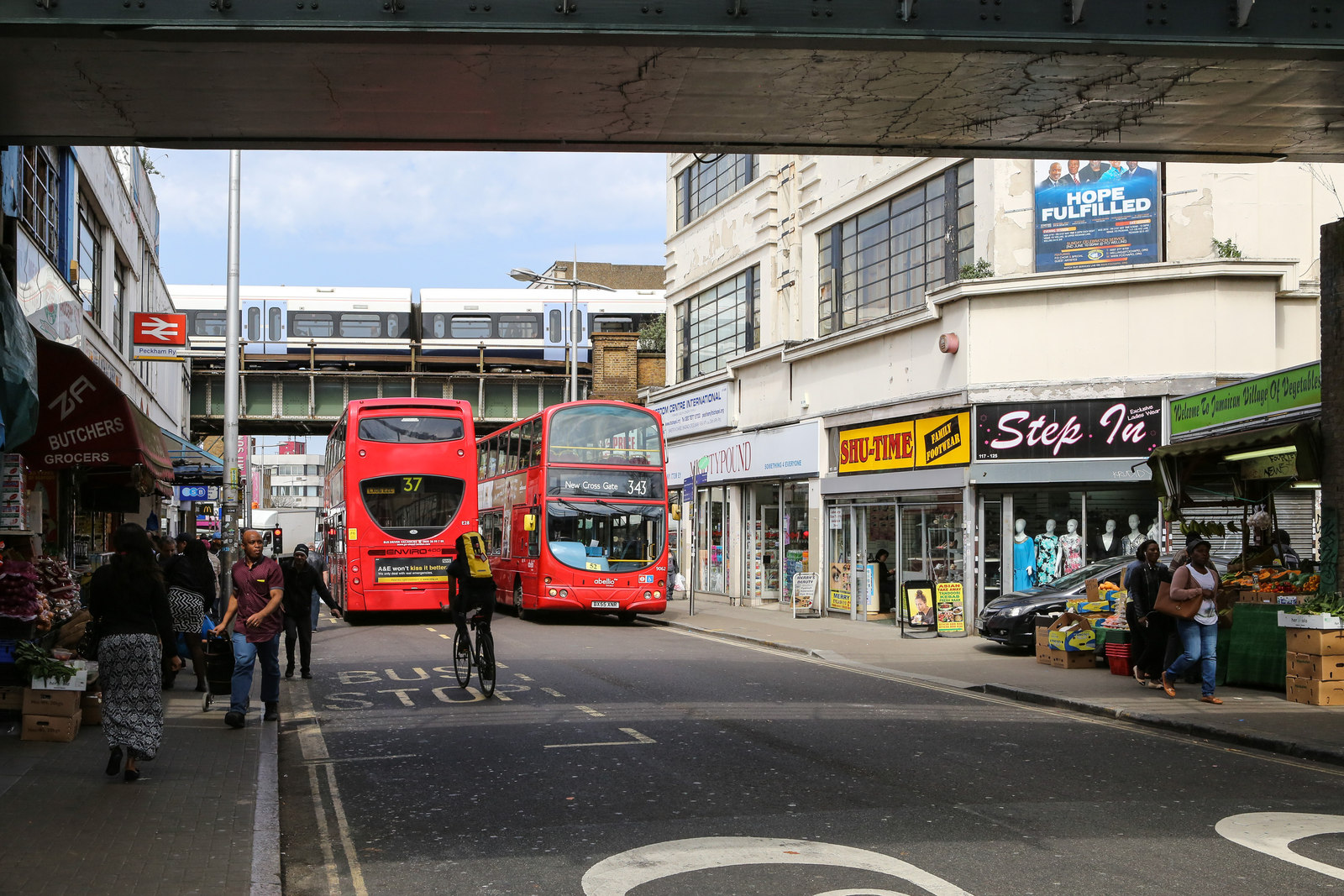
An African history of Britain can begin on an ordinary street: at a food shop, a money-transfer counter, a church or a hall hired for a family celebration. Writing for Black History Month UK in 2022, Jimi Famurewa described this everyday geography across London, from Dalston’s market stalls to social gatherings in Thamesmead. His account draws attention to lives that are visible in neighbourhoods but less consistently represented in public histories. Following those connections leads beyond a single arrival date or a single community. The story includes people who intended to stay briefly, people building permanent homes, and children for whom Britain was home from birth. It also requires attention to the work through which families made an unfamiliar place habitable.1
Seafaring lives before the post-war migrations
Somali seafarer Ibrahim Ismaa’il offers one route into the earlier history. His account describes work aboard merchant ships and life in Cardiff before the Second World War. In 1919, he helped defend a Somali boarding house during the city’s racist violence. The building provided meals, received letters and kept money for men who went to sea: it was part of the infrastructure that made mobile working lives possible. In 1922, Ismaa’il met the Belgian traveller Eugene Gaspard-Marin at a Cardiff mosque and later stayed at the Whiteway community in the Cotswolds. Gaspard-Marin wrote down his recollections, extracts of which historian Richard Pankhurst published in 1977. The account therefore reaches readers through other people’s recording and editing, but preserves a rare African perspective on work, friendship and danger in early twentieth-century Britain. It also takes this history beyond the capital and beyond the familiar image of a single post-war arrival.2
Students building their own institutions
Education created another set of connections. Founded in 1925 by Ladipo Solanke and Herbert R. Bankole-Bright, the West African Students’ Union supported students while becoming a forum for political debate. Its journal circulated in Europe and Africa from 1926. A January 1933 edition preserved by the National Archives contains essays, news, advertisements and appeals for the union’s hostel fund. These pages join intellectual life to practical necessity: a student needed somewhere to sleep as well as access to lectures. Racial discrimination made accommodation difficult, and the union opened a hostel on Camden Road in 1933. Its activities brought together mutual support, anti-racist organising and discussion of colonial rule. The journal was consequently more than a record of examination successes or student sociability. The 1933 contents included Ladipo Solanke’s discussion of Yoruba constitutional law, placing African political knowledge within the union’s intellectual world. It helped people communicate across borders and create institutions whose priorities they could define themselves.3
Different reasons for making a home
Individual lives resist a simple division between migrants who came to study and those who came to work. Rosemary Williams’s feature African London, published by Black History Month UK in 2015, includes a woman identified as Ms Kamara, who had been a teacher and civil servant in Sierra Leone. She visited Britain during the 1970s, moved to London for medical reasons in 1987 and settled in Hackney in 1989. The sequence matters. A first visit was not identical to a later move, and the reasons for settlement developed over time. Her professional life also began long before her arrival in Britain. Such an account invites a fuller set of questions about migration: what people brought with them, what circumstances changed their plans, and how a particular neighbourhood became the setting for the next part of a life.4
Other journeys were shaped by war and the search for safety. Museum Wales’s material on Somali communities connects the seafaring settlements established in Cardiff from the nineteenth century with people arriving during conflict in the Horn of Africa in the 1980s. These were related histories, but not identical experiences. A longstanding community could include descendants of merchant seamen alongside people displaced much more recently. The collection also preserves the voice of Faisal Mohamed Hashi, discussing his Somali-speaking background in Newport and a father who had served with the British Merchant Navy. Language and family memory help connect these different periods. They also remind us that Somali Welsh life cannot be reduced to refugee arrival, just as refugee experiences should not disappear within a general account of migration for employment.5
Community work beyond the front door
Settlement required institutions able to respond when existing provision fell short. In his retrospective on Ghana Union, community organiser Ade Sawyerr describes how support associated with students and the Ghanaian High Commission developed alongside the needs of a wider population. Religious networks and the work of Reverend Ben Tettey contributed to that process. The union’s charitable registration in 1980 marked one stage in a much larger history of voluntary effort. Sawyerr recalls immigration advice involving volunteer lawyers, youth training, publishing activities and links with other African organisations. A printing press used donated equipment, and Greater London Council funding supported training for unemployed young people. The Islington African Project extended this work through English-language teaching and other training, demonstrating how an organisation rooted in one national community could serve a wider neighbourhood. His account is a participant’s memory, valuable for the practical detail it preserves. Community building involved meetings, funds, referrals and people giving their time. It connected private problems to collective action without requiring every Ghanaian resident to have the same background, beliefs or reason for coming to Britain.6
What population figures can tell us
Statistics establish scale, but they need careful reading. In the 2021 Census of England and Wales, approximately 1.5 million people identified within the African category of the wider Black ethnic-group heading, representing 2.5 per cent of the population. That was an ethnic identification question, not a count of people born in African countries or of recent immigrants. It included people born in Britain, while African-born residents could identify in other ethnic categories. The figures also cover England and Wales, rather than the whole United Kingdom. The Office for National Statistics explains that changes between censuses reflect births, deaths, migration and changes in identification. A population total can therefore introduce questions about community life, but cannot answer them on its own. It does not reveal the language spoken at a particular dinner table, a family’s migration route or an individual’s sense of belonging.7
Skills, employment and recognition
Work could offer opportunity while placing skilled people in difficult positions. A 2023 synthesis by Jonathan Bayuo and colleagues examined nine qualitative studies of African migrant nurses, including Ghanaian and Nigerian participants working in Britain and the United States. The researchers identified adjustment to unfamiliar workplaces, questions about recognition of previous experience, discrimination and barriers to progression, alongside learning, support and professional growth. Because the review combined different settings, its findings should not be treated as a description of every African nurse or every British hospital. Its broader historical importance is the attention it gives to workers’ own accounts. Moving a qualification across a border does not automatically move its holder into an equivalent position of authority. Employment histories need to consider the knowledge people brought, the standards they navigated and the recognition they sought from colleagues and employers.8
Care across more than one country
Earnings could sustain households in more than one place. Nicola Yeates and Freda Owusu-Sekyere’s research on people in Britain sending money to Ghana and Nigeria examined this work of family care through twenty qualitative interviews. Transfers could maintain relationships and help relatives meet needs, but the senders also described obligations, emotional pressure and financial strain. The study does not establish a single pattern for all Ghanaian or Nigerian families. It shows why remittances should be understood through the circumstances of those providing them, as well as through the amounts received. Money sent overseas is often discussed as an economic flow; for the person earning it, it may involve balancing rent, everyday spending and responsibilities to relatives. Distance changes how care is organised without necessarily reducing the expectation that family members will provide it.9
Children’s education could also connect households across borders in unexpected directions. Pamela Kea and Katrin Maier’s study, published in 2017, examined British Nigerian families who sent children from Britain to Nigeria for secondary schooling. Their interviews explored parental hopes about education, conduct and opportunity, alongside children’s experiences of the move. Those experiences differed: some welcomed the change, while others described painful separation or harsh treatment. The research challenges the assumption that educational movement always runs towards Britain, or that parents and children necessarily understand a journey in the same way. It also gives young people an active place in migration history. Their lives cannot be reconstructed only through the plans adults made for them. Consent, relationships and the meaning attached to different places help explain why similar arrangements could produce very different memories.10
Making culture in a British neighbourhood
Neighbourhood life generated new practices as well as maintaining existing ones. Researcher Funmi Alakija’s account of Nigerians in Peckham, based on interviews and observation, follows food, clothing, music and religious gatherings across generations. One example concerns a Church of England minister adapting a service to accommodate a naming ceremony important to Nigerian parishioners. Another considers musical forms in which African rhythms met Jamaican influences in Britain. These are encounters within a changing social environment, not evidence of a culture carried intact from one country to another. Alakija’s work also distinguishes the experiences of parents and their British-born children. Shared connections with Nigeria did not produce identical identities. Peckham became a place where people could recognise familiar practices, alter them and participate in cultural life that belonged to London as well as to wider networks.11
The South London Gallery exhibition Lagos, Peckham, Repeat brought some of these connections into public view in 2023. It presented work by thirteen Nigerian and British Nigerian artists through photography, sculpture, sound and film, with research and exchange involving both cities. The project treated the relationship as a source of artistic inquiry rather than a simple story of departure and arrival. Its setting also matters: a gallery can help neighbourhood experience enter the historical and cultural record, while the streets around it remain places of work, shopping and daily negotiation. Read alongside personal testimony and community archives, such projects expand what counts as evidence. African migration to Britain becomes a history of people creating relationships and institutions, raising children and interpreting their surroundings, across generations and across places that remained connected.12
Sources and further reading
1. Jimi Famurewa / Black History Month UK: Where Is Black African Life in London?.
2. Our Migration Story: Somali Seafarer Ibrahim Ismaa’il: From Cardiff to the Cotswolds.
3. The National Archives: The WASU Journal.
4. Rosemary Williams / Black History Month UK: African London.
5. Amgueddfa Cymru – Museum Wales / People’s Collection Wales: Somali.
6. Ade Sawyerr: Look How Far We Have Come: Ghana Union in Retrospect, 40 Years On.
7. Office for National Statistics: Ethnic Group, England and Wales: Census 2021.
8. Jonathan Bayuo, Mary Abboah-Offei, Precious Adade Duodu and Yakubu Salifu / BMC Nursing: A Meta-synthesis of the Transitioning Experiences and Career Progression of Migrant African Nurses.
9. Nicola Yeates and Freda Owusu-Sekyere / Journal of International and Comparative Social Policy: The Financialisation of Transnational Family Care: A Study of UK-based Senders of Remittances to Ghana and Nigeria.
10. Pamela Kea and Katrin Maier / Comparative Studies in Society and History: Challenging Global Geographies of Power: Sending Children Back to Nigeria from the United Kingdom for Education.
11. Funmi Alakija / ASAP/Review: Diasporic Creativity: ‘Little Lagos’ and the Diasporic Experience of First and Second Generations Nigerian Migrants in Peckham, London.
12. South London Gallery: Lagos, Peckham, Repeat: Pilgrimage to the Lakes.
Photograph
Rye Lane, Peckham, in 2015. Peckham’s connections with Nigeria form one part of the wider history of African communities in Britain. Photo: Martin Addison, Rye Lane, CC BY-SA 2.0. Original photograph; no changes.

Join the conversation
Comments 0
Share a memory, ask a question or add to this story.
No comments yet. Add your perspective.
Add your voice
Create a free account and verify your email to leave a comment.
All comments are reviewed before publication.