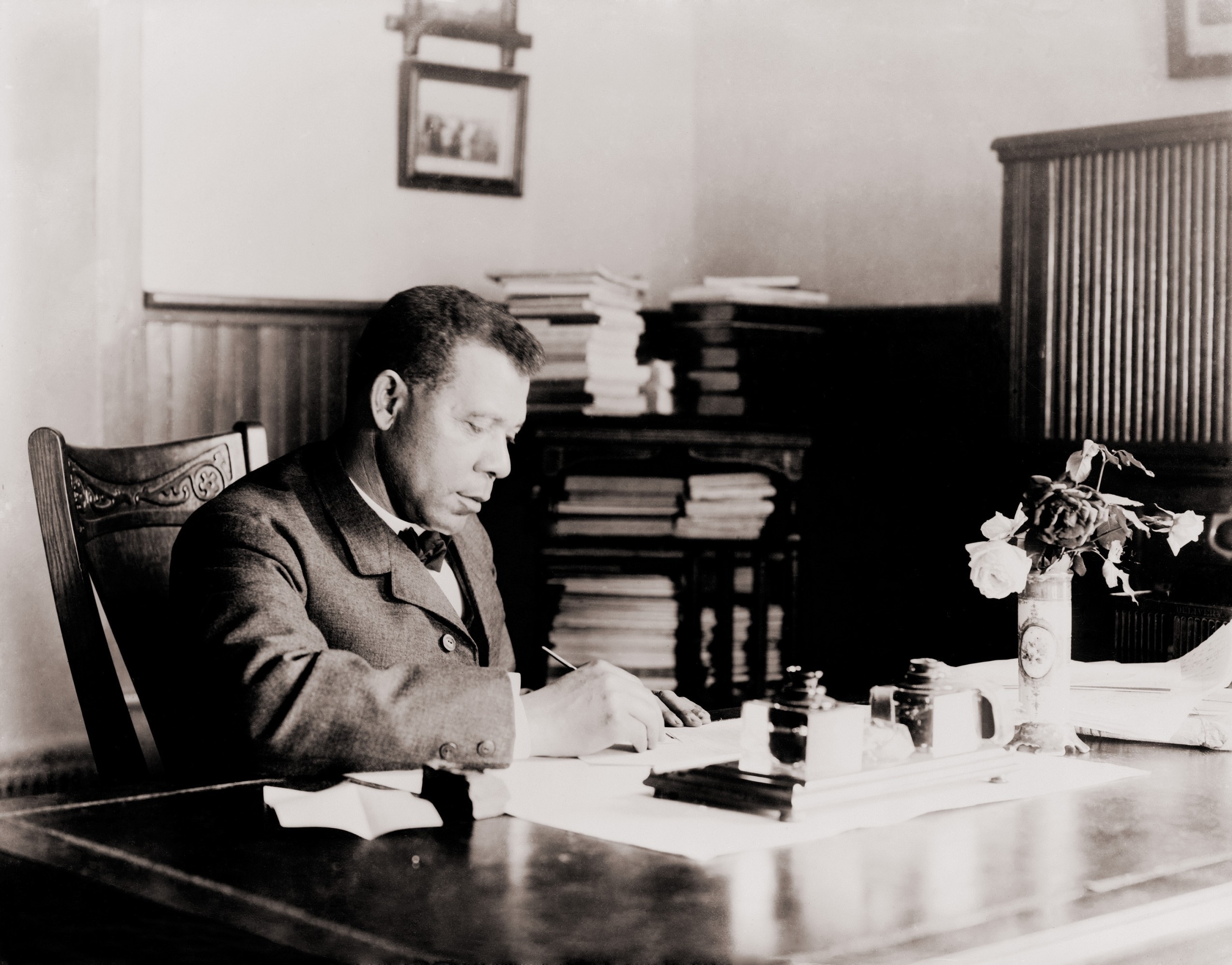
When Science Hall was completed at Tuskegee Institute in 1893, the building embodied an educational argument. Students had made its bricks and carried out the construction under architect Robert Robinson Taylor’s supervision. Classrooms and laboratories stood alongside accommodation for teachers and students. For Booker T. Washington, Tuskegee’s principal, building the school was itself a form of education. The work demonstrated Black students’ skills to potential supporters while giving those students practical experience in the trades through which he believed they could gain greater independence. 1
Childhood and the pursuit of education
Washington was born on 5 April 1856 in Franklin County, Virginia. His mother, Jane, was an enslaved cook on James Burroughs’s farm, where Booker spent his first nine years. In 1865, after emancipation, she took her children to Malden, West Virginia, to join her husband, Washington Ferguson. Booker worked packing salt and later in a coal mine, attending school alongside this labour. The possibility of learning existed within a childhood still shaped by the family’s need to earn a living. 2
In Up from Slavery, he remembered asking his mother to find him a book. She obtained a copy of Webster’s spelling book, and he began working out the alphabet. Jane could not read, but supported his determination to learn. His account also describes the enthusiasm for schooling around him: adults attended evening classes, and older people wanted to read the Bible for themselves. Education appears in these recollections as a shared demand among people newly free, extending well beyond one ambitious child. 3
He entered Hampton Normal and Agricultural Institute in Virginia in 1872. Its founder, Samuel Chapman Armstrong, promoted practical training, discipline and work as routes towards economic advancement. Armstrong’s approach also reflected paternalistic assumptions about freed people’s readiness for political participation. Washington adopted much of this educational model, combining preparation for employment with instruction about conduct and responsibility. After studying at Hampton until 1875, he eventually returned as an instructor in 1879, before the opportunity arose to lead the new school at Tuskegee. 4
A school rooted in local organising
The demand for a Black school in Tuskegee preceded his arrival. Lewis Adams, a formerly enslaved tradesman, his wife Sarah, known as Sallie, and members of Butler Chapel AME Zion Church had already attempted to organise education locally. Adams taught tinsmithing, harness-making and shoemaking; Sallie taught sewing and cooking. Their earlier school struggled to find qualified teachers. Adams nevertheless continued advocating an institution that could offer vocational instruction and prepare teachers, bringing local knowledge and political influence to the project. 5
A political bargain involving Adams and state politicians helped secure Alabama’s support. Legislation provided an annual $2,000 for teachers’ salaries, with free tuition for students who agreed to teach in Alabama’s public schools for at least two years. Adams and George W. Campbell were among the first commissioners overseeing the institution. Armstrong recommended Washington as its principal. The school opened on 4 July 1881, using a building belonging to Butler Chapel, with public funding for salaries but no ready-made campus. 6, 7
A permanent site required another kind of negotiation. Washington arranged to buy a hundred-acre former cotton plantation for $500. Hampton’s treasurer, James Marshall, lent him the $200 down payment from his own funds. The property’s surviving buildings included a cabin, kitchen, stable and hen house. Within months, Washington could write to Marshall that the purchase had been paid off. 6
Olivia Davidson joined the undertaking in 1881 as a teacher and assistant principal. Already an experienced educator, she had studied at Hampton and graduated from Framingham Normal School in Massachusetts. Davidson organised local fundraising events that accepted contributions including food and animals, as well as money. She also travelled north to approach supporters, among them the philanthropist Mary Hemenway. Her teaching, administration and fundraising helped establish the school’s foundations. Davidson later married Washington, but her place in Tuskegee’s history began as an educational partner. 8
Learning through building, science and community work
Washington recruited Taylor after his graduation in architecture from the Massachusetts Institute of Technology in 1892. The architect gave Tuskegee an increasingly substantial physical presence, while students gained experience making and using building materials. Even the campus laundry received a carefully composed classical façade. Architectural historian Ellen Weiss describes its design as giving prestige to work often considered lowly. 1
George Washington Carver joined Tuskegee as director of agriculture in 1896, after completing postgraduate study at Iowa State. His work extended the institution’s teaching beyond its enrolled students. In 1906, Carver and Thomas Monroe Campbell helped launch the Jesup Wagon, taking agricultural instruction into surrounding communities. Lessons covered subjects including crop rotation, nutrition and hygiene. The wagon carried this instruction to farmers in the places where they lived and worked. 9
Margaret Murray, who joined Tuskegee as an English teacher and became its lady principal, directed the education of female students. She married Washington in 1893 and developed her own community work, including Mothers’ Meetings about nutrition, childcare and household health. A visit to Swanley Horticultural College in England in 1899 helped broaden her plans for women’s training. After seeing women studying horticulture there, she introduced work involving gardens, orchards, beekeeping and greenhouse botany at Tuskegee. Her contribution connected the institution’s women to new areas of practical study. 10
Atlanta and the promise of economic progress
Tuskegee grew during a period of severe attacks on Black citizenship. After Reconstruction ended in 1877, political rights became increasingly insecure. Racial violence, lynching, restrictive court decisions and exploitative labour arrangements threatened the freedoms won after slavery. At the same time, Black education expanded, literacy increased and institutions of higher learning trained new generations. Washington’s programme developed within both realities: communities were building opportunities for themselves while facing efforts to deprive them of political power and protection under the law. 11
On 18 September 1895, he addressed the Cotton States and International Exposition in Atlanta. He urged Black Americans to develop opportunities in agriculture, trades, commerce and other occupations where they already lived. He also urged white employers to invest in Black workers, emphasising their contributions to the South’s farms, railways, towns and industries. His appeal presented Black advancement as necessary to the region’s prosperity. It sought a practical bargain in which education and employment would benefit both Black and white southerners. 12
That bargain carried a major concession. Washington accepted separation in social life while calling for cooperation in economic affairs. He dismissed agitation for social equality and placed preparation for legal privileges above their immediate exercise, even while acknowledging that those privileges rightly belonged to Black people. His speech offered white listeners reassurance that material progress could proceed without an immediate challenge to the racial order. 12
Business, books and access to power
In 1900, Washington and other Black business leaders established the National Negro Business League to promote enterprise and economic strength. It developed links between business people and encouraged associated organisations for bankers, funeral directors and the Black press. A federated structure, adopted in 1906, connected state and local leagues with the national organisation. Research by Adam Chamberlain and Alixandra B. Yanus shows how its growth drew on both urban Black populations and the value of Black-owned farms: agriculture remained an important part of this business world. 13
Up from Slavery, published in 1901, carried Washington’s account of his life to a wide readership. It grew from a series in The Outlook. In the preface, he explained that he had written while travelling, waiting at railway stations and finding time between Tuskegee commitments. He also acknowledged the assistance of Max Bennett Thrasher. The autobiography brought his recollections of enslavement, schooling and institution-building together into a public account of his educational beliefs, with his own experiences supplying many of its examples. 3, 14
His access to political power became especially visible on 16 October 1901, when President Theodore Roosevelt invited him to dinner at the White House. The discussion concerned Republican politics in the South, and Washington ate with the president’s family. Racist outrage followed among southern whites. Roosevelt continued consulting him despite that reaction. The episode exposed the hostility that could meet even a private social encounter between a Black leader and a white president, alongside Washington’s growing role as a political adviser. 15
The argument over citizenship
W.E.B. Du Bois gave one of the most substantial critiques of Washington in The Souls of Black Folk in 1903. He acknowledged what Washington had achieved, then argued that his programme asked Black Americans to postpone political power, civil rights and higher education. Du Bois wanted the right to vote, civic equality and educational opportunities suited to young people’s abilities. His objection was not that practical skills lacked value. He questioned whether economic progress could be secure while the people pursuing it were denied the means to defend their rights. 16
Du Bois made the connection explicit. Workers and property owners needed voting rights to protect their interests; vocational schools themselves depended on teachers educated in colleges. He also warned against making Black people solely responsible for overcoming conditions created by slavery and racial prejudice. The nation carried obligations that individual effort could not discharge. This was an argument about the relationship between economic resources and citizenship, including the danger that praising self-help could allow powerful institutions to avoid confronting their own responsibilities. 16
Washington also pursued rights through less visible channels. In 1901 he wrote to those working on Alabama’s constitution, arguing that Black people who paid taxes, worked and served their country should have a say in choosing their rulers. He secretly helped finance legal challenges involving voting and jury participation. These actions complicate any account that treats his public appeals as the whole of his politics. Alongside his language of patience and economic preparation, he supported efforts to contest particular forms of exclusion. 17
His influence also created its own tensions. Historian Raymond Gavins describes the network known as the Tuskegee Machine: allies in newspapers, businesses and educational institutions who advanced Washington’s approach. Through relationships with Republican politicians and white philanthropists, Washington could influence patronage and the allocation of support to Black education. The same network helped organise businesses and build institutions, while concentrating authority around him. Questions about his strategy were therefore also questions about who could speak for Black Americans and whose projects would receive backing. 18
Research and schools beyond Tuskegee
Tuskegee’s work included collecting evidence about Black life. Sociologist Monroe Nathan Work attracted Washington’s attention while teaching in Georgia and later developed his research at Tuskegee. In 1912 he began compiling the Negro Year Book, bringing together information and statistics about African American experience. He also documented lynchings, producing evidence useful to the campaign against racial violence. Such work gave the institution a role in recording the conditions Black communities faced, alongside its better-known teaching in trades and agriculture. 19
Washington’s partnership with Julius Rosenwald, president of Sears, Roebuck and Company, extended his educational programme into rural school building. In 1912, a grant supported an initial group of six schools in Alabama. Further funding followed, and the undertaking expanded beyond those first projects. Tuskegee staff and architects helped establish the early scheme. The aim was to provide buildings designed for education in communities where Black children often depended on unsuitable premises and severely underfunded provision, connecting philanthropy with local efforts to secure schooling. 20
An institution larger than its founder
By Tuskegee’s twenty-fifth anniversary in 1906, it offered training in thirty-seven industries to more than 1,500 students. Washington continued leading the institution until his death at Tuskegee on 14 November 1915, aged fifty-nine. His funeral took place in the institute’s chapel three days later, and he was buried on campus in a brick tomb made by students. 2
The rural school programme continued after him. By its conclusion in 1932, it had helped produce 4,977 schools, alongside teachers’ homes and other buildings. Black communities had contributed more than $4.7 million, as well as their labour and materials. Historian Mary S. Hoffschwelle emphasises that these contributions made local people central to the programme’s meaning and success. Washington and Rosenwald had helped establish the partnership, but families, teachers, builders and local organisers carried it into daily life. That collective history belongs beside the famous names: people investing in places where their children could learn, and making education a lasting presence in their communities. 21
Sources
2. Tuskegee University — Booker T. Washington.
3. Booker T. Washington — Up from Slavery: An Autobiography (Yale Law School, Avalon Project).
4. National Park Service — Virginia: Booker T. Washington.
5. National Park Service — Lewis Adams.
6. National Park Service — Tuskegee Institute’s Founding.
7. Hampton University — Booker T. Washington.
8. Framingham State University, Henry Whittemore Library — Olivia Davidson Washington (2018).
9. National Park Service — George Washington Carver.
10. National Park Service — Margaret Murray Washington.
11. Library of Congress — The Booker T. Washington Era, The African American Odyssey.
14. Library of Congress — Booker T. Washington: Topics in Chronicling America.
15. Theodore Roosevelt Center, Dickinson State University — Booker T. Washington.
18. Raymond Gavins — Tuskegee Machine, The Cambridge Guide to African American History (2016).
20. National Park Service — The Rosenwald Schools: Progressive Era Philanthropy in the Segregated South.






Join the conversation
Comments 0
Share a memory, ask a question or add to this story.
No comments yet. Add your perspective.
Add your voice
Create a free account and verify your email to leave a comment.
All comments are reviewed before publication.