After winning the Olympic 800 metres in Athens in 2004, Kelly Holmes told reporters that she had needed to watch the replay twice before believing the result. The finish was that close: five hundredths of a second separated her from the runners awarded silver and bronze. At thirty-four, after years of medals, injuries and interrupted preparations, she had finally become an Olympic champion. 1
A young runner in Kent
Kelly Holmes was born on 19 April 1970 and grew up in Kent. Recalling her childhood in a 2025 interview, she described being a mixed-race girl in a white family and a predominantly white school environment. She struggled to connect with classroom learning, but PE teacher Debbie Page recognised her ability in sport and encouraged her to believe in it. Holmes remembered that intervention as an important change in how she understood her own possibilities. 2, 3
Her progress soon became visible in national competition. She won the Junior Girls’ 1500 metres at the English Schools’ Championships in 1983, followed by second place the next year. She took bronze at intermediate level in 1986 and won the senior title in 1987. 4
Watching the 1984 Los Angeles Olympics added another influence. Sebastian Coe became a sporting hero; she admired the determination and aggressive racing she saw in him. Her own club background included Tonbridge Athletics Club, part of the local structure through which her talent developed. The distance she was learning to race was also the event in which British athletes were winning on the Olympic stage. 8
Army service and a return to the track
In 1988 Holmes joined the Women’s Royal Army Corps. She later transferred to the Adjutant General’s Corps when it was formed in 1992, remaining in the Army until 1997. During her service she became a physical training instructor and reached the rank of sergeant. The military gave her a professional life involving physical preparation and responsibility for others, while she continued to compete in service athletics. 5, 6
The 1992 Barcelona Olympics brought running back into sharper focus. Watching television, she recognised an athlete she had raced against and beaten when younger. Seeing that former opponent at the Games prompted Holmes to reconsider what she might still achieve herself. She returned to serious athletics. 7
By 1994 she was winning major medals. She took silver in the European Championships over 1500 metres and gold at the Commonwealth Games. At the 1995 World Championships in Gothenburg, she won silver in the 1500 metres and bronze in the 800 metres. The ability to succeed over both distances was already established. The Olympic double would eventually bring those two parts of her racing together at the highest level. 8
Her personal best for the 800 metres, 1 minute 56.21 seconds, dates from 9 September 1995. It remained her fastest time over the distance throughout her career, including the season in which she won the Olympic double. 2
Injuries that repeatedly interrupted the journey
At Atlanta in 1996, Holmes finished fourth in the Olympic 800 metres after discovering a stress fracture shortly before the Games. Recalling the experience while advising another athlete years later, she emphasised that she had completed the training and believed she could compete. Her first Olympics therefore ended with a place just outside the medals, achieved under physical circumstances that had threatened her participation before she reached the starting line. 9
The following year brought another severe setback. Favoured for the world 1500 metres title, she broke down in her heat with a torn Achilles tendon. 8
Before Sydney in 2000, a calf injury disrupted her preparations again. Holmes later explained that she managed only six weeks of track work, maintaining fitness through pool sessions and gym training. She still won bronze in the Olympic 800 metres. Her account gave the recovery its practical shape: different forms of work preserved fitness while running was limited, and experience helped her return to competition once she could train on the track. 9
Preparing for one more Olympic opportunity
The medals continued between Sydney and Athens. Holmes won another Commonwealth 1500 metres gold in Manchester in 2002, eight years after her first title in the event. In 2003 she added world outdoor silver over 800 metres. These results kept her among the leading middle-distance runners, even through the interruptions that repeatedly changed her plans. By the next Olympics she would have a decade of major championship experience behind her. 4, 21
In November 2002 she moved to Potchefstroom in South Africa to train with Mozambique’s Maria Mutola. The two athletes worked with American coach Margo Jennings, whose schedules reached them by fax and email. Mutola was an Olympic and world champion over 800 metres, offering Holmes an exceptionally demanding training partnership. Their preparation connected athletes from different countries, with shared daily work behind the individual contests spectators would eventually see. 10
Physiotherapist Alison Rose was another important member of the support around Holmes. Rose’s professional biography records her work helping Holmes remain fit for Athens and her later involvement with the young runners Holmes mentored. Physical treatment formed part of a continuing relationship, extending beyond a single championship. The familiar image of Holmes racing alone in a British vest belonged to a wider network of coaches, training partners and practitioners working with her. 11
There were also difficulties that results could not reveal. Holmes later spoke about a mental-health crisis and self-harm in 2003, the year before her greatest sporting success. In that account, athletics gave her an identity and a source of purpose while other parts of life remained painful. Her public explanation allows the medals and those struggles to be understood together, without assuming that a successful race settled everything happening away from the track. 3
The decision to race twice and the first gold
Entering both events in Athens was a late decision. The 800 metres came first, creating a risk that it could compromise her preferred 1500 metres. Jennings also coached Mutola, the defending 800 metres champion, making the choice especially delicate. After encouragingly fast training sessions, Holmes sought an opinion from Dave Arnold, the coach who had guided her when younger. His encouragement helped her commit to the double rather than concentrate on one event. 10
On 23 August she won the 800 metres in 1 minute 56.38 seconds. Morocco’s Hasna Benhassi and Slovenia’s Jolanda Čeplak both recorded 1:56.43, with Benhassi awarded silver and Čeplak bronze. Mutola finished fourth. Holmes’s hands went to her face as she absorbed the result. She had beaten a field containing the athlete with whom she had trained, in a finish so tight that her own sense of leading had not immediately convinced her she had won. 1
A second final and a British record
On 28 August Holmes returned for the 1500 metres final, her sixth race of the competition. She delivered a decisive finishing burst over the last 120 metres, winning in 3 minutes 57.90 seconds. Russia’s world champion Tatyana Tomashova took silver and Romania’s Maria Cioncan bronze. Holmes had improved her own British record by seventeen hundredths of a second. 12
She became the third woman to win the Olympic 800 and 1500 metres at the same Games, following Tatyana Kazankina in 1976 and Svetlana Masterkova in 1996. The achievement also recalled Albert Hill, the previous British athlete to complete that particular double, in 1920. Holmes’s two races placed her within both histories: an uncommon women’s Olympic accomplishment and a British middle-distance tradition stretching back more than eighty years. 6, 12
Recognition followed the racing. She was named BBC Sports Personality of the Year for 2004 and became a Dame in 2005, the year she retired from competitive athletics. Her Army connection also continued beyond her original service: she later served as honorary colonel of the Royal Armoured Corps Training Regiment from 2018 to 2024. 5, 13
Speaking openly about the life beyond the medals
In June 2022 Holmes came out publicly as gay. Speaking on ITV’s This Morning, she described relief at being able to share a part of her life that she had concealed from the public for decades. Her documentary Kelly Holmes: Being Me explored her experiences and included conversations with LGBTQ+ soldiers. The programme brought another history into view alongside the familiar footage of Athens: the personal effects of having served when gay people were barred from the armed forces. 15
Later that year, she encouraged veterans affected by the pre-2000 ban to contribute to the independent review chaired by Lord Etherton. In an interview with ITV News, she explained the fear that had accompanied her own service and the importance of hearing other people’s accounts. She had loved her military career while also feeling rejected by the institution’s rules. Supporting the review gave her public profile a specific purpose in a process examining that treatment. 17
She also joined the Loose Women panel in 2022. Announcing the appointment, ITV published her explanation that speaking openly had made her feel able to enter conversations she previously avoided. The new role involved discussing everyday subjects as part of a group, extending a broadcasting presence that many viewers had first known through sport. 16
Sharing experience with athletes and young people
Holmes had begun mentoring before the Athens medals. In a 2006 account for World Athletics, she dated the start of On Camp with Kelly to January 2004. The initiative selected promising young women from the UK athletics rankings and aimed to help them progress. By the World Junior Championships in 2006, participants were competing internationally. Holmes could draw on an active racing career when the scheme began, then continue sharing that experience after retirement. 14
By 2008 the programme had supported more than fifty young female middle-distance runners. Emma Pallant, one of its participants, won 1500 metres bronze at that year’s World Junior Championships in Poland. Support included access to doctors, physiotherapists and a sports psychologist, while athletes’ own coaches were also involved. Holmes covered practical matters that could unsettle inexperienced travellers: packing for competitions, sharing accommodation and keeping essential racing kit in hand luggage. The scheme combined athletic ambition with preparation for the ordinary complications of competing abroad. Its educational camps also began including young male athletes in 2008. 22
Her relationship with later British runners also became personal. Keely Hodgkinson exchanged messages with Holmes during her Olympic debut in Tokyo, where she won 800 metres silver and broke Holmes’s British record. Laura Muir had already lowered her national 1500 metres mark in 2016. Both spoke about the significance of achievements associated with Holmes. Records were passing to another generation while the athlete who had set them remained available for conversation and encouragement. 7
In 2008 Holmes founded the Dame Kelly Holmes Trust, using the experience and skills of athletes to support young people facing disadvantage. Its foundation extended her interest in mentoring into a wider setting. Athletes could bring knowledge of preparation, setbacks and changing careers to work with young people whose own goals might lie in education, employment or their communities. 18, 19
The charity’s formal objectives included personal, social and emotional development, alongside confidence, participation in community life and access to employment. They also emphasised partnerships with local and national organisations. 19
On 14 September 2026, Leadership Through Sport & Business, known as LTSB, announced the transfer of the Trust’s education programmes and Athlete Mentor model into its organisation. The arrangement brought that mentoring approach together with LTSB’s experience of employability and working with employers, allowing those programmes to continue within a new organisational home. The announcement also marked the beginning of the Trust’s wind-down. 20
Sources
1. Reuters, via Rediff — Holmes takes 800 metres gold, contemporary Olympic report (23–24 August 2004).
2. World Athletics — Kelly Holmes, athlete profile and performance record.
4. Kent Schools’ Athletic Association — ESAA Kent Roll of Honour (2024).
5. Adjutant General’s Corps Museum — Sport in the AGC, Kelly Holmes service and sporting record.
6. International Olympic Committee — Holmes hits the jackpot in Athens (2015).
7. Team GB — Team GB Trailblazers: Dame Kelly Holmes (2023).
8. England Athletics — Hall of Fame booklet: Dame Kelly Holmes (2010).
9. Team GB — Holmes maintains England can challenge, interview on recovery and racing (2012).
10. Steven Downes, World Athletics — Double glory for Kelly Holmes (2004).
11. CSPC Physiotherapy — Alison Rose, professional biography.
12. World Athletics — Women’s 1500m Final, contemporary Olympic report (28 August 2004).
13. Team GB — 125 years of British Olympians, part three (2021).
14. Kelly Holmes, World Athletics — On Camp with Kelly girls at the World Junior Championships (2006).
16. ITV Press Centre — Dame Kelly Holmes joins the Loose Women panel (7 September 2022).
18. Dame Kelly Holmes Trust — Dame Kelly Holmes, historical founder biography.
19. Charity Commission — Dame Kelly Holmes Trust, governing document and charitable objectives.
Image credit
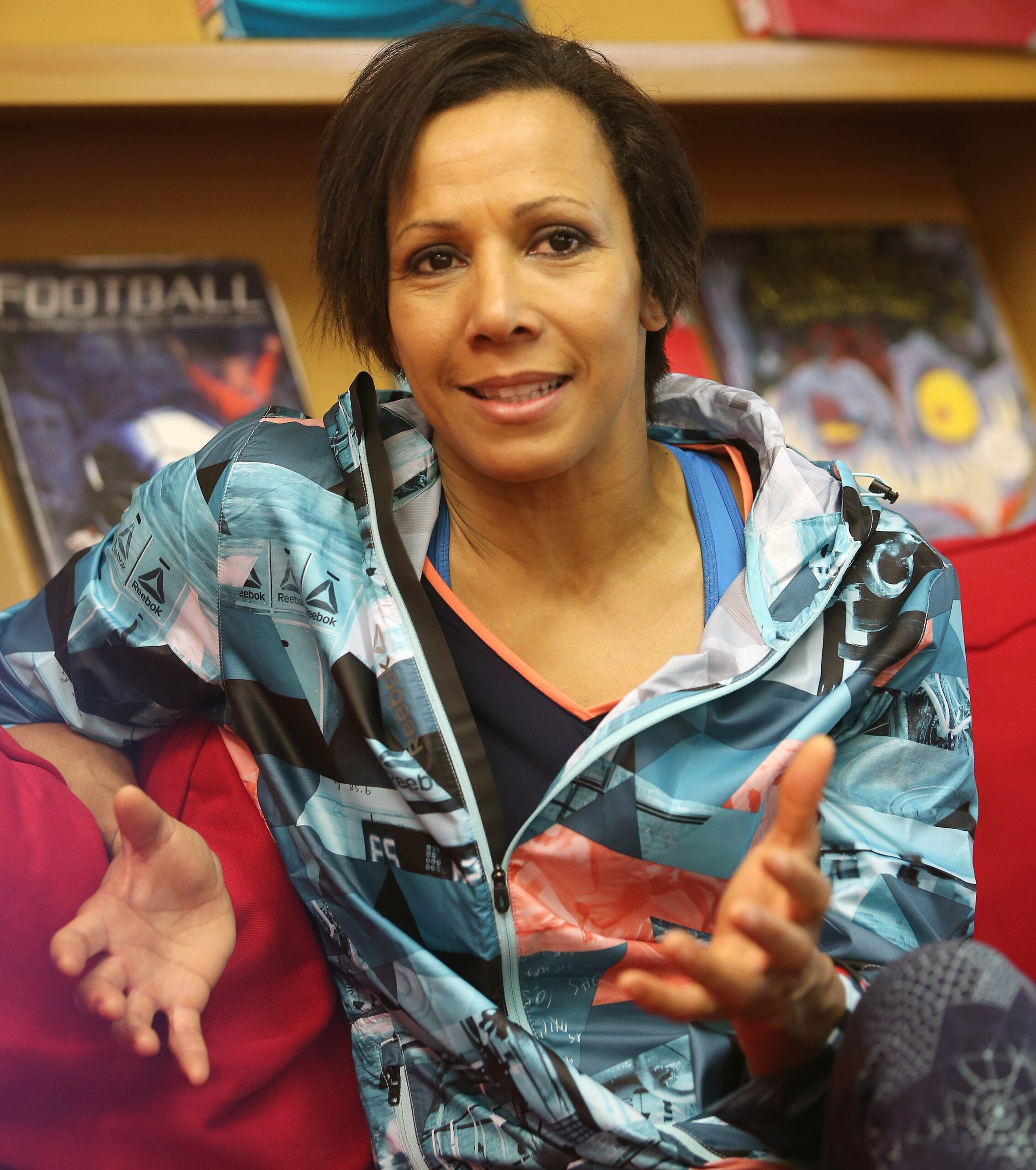
Kelly Holmes during a visit to Doha in 2015. Photograph: Mohan / Doha Stadium Plus Qatar, via Wikimedia Commons. Image source; CC BY 2.0.






Join the conversation
Comments 0
Share a memory, ask a question or add to this story.
No comments yet. Add your perspective.
Add your voice
Create a free account and verify your email to leave a comment.
All comments are reviewed before publication.