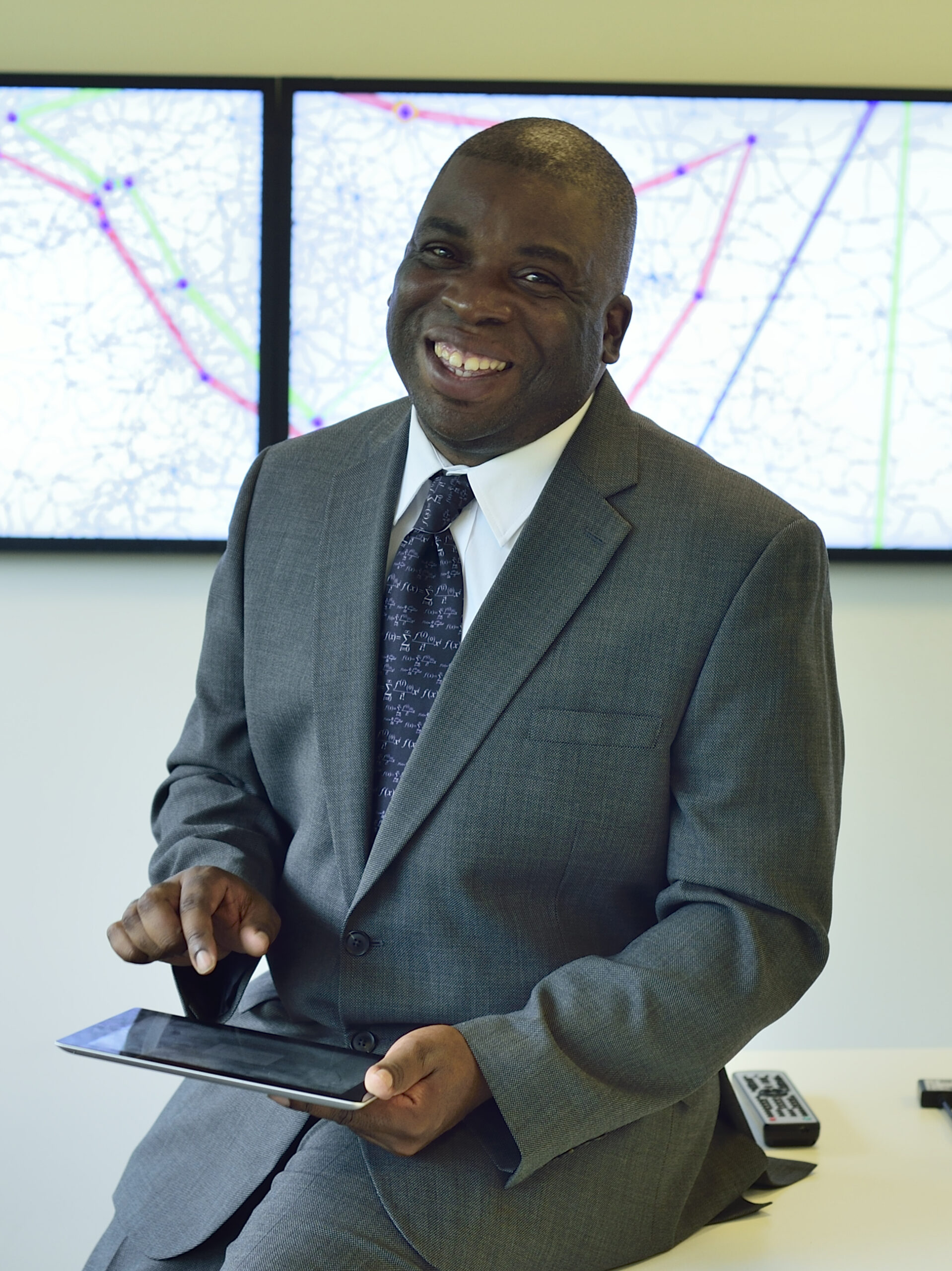
Before steel was cut for HMS Queen Elizabeth, Nira Chamberlain worked on a question that could not be answered by drawing the ship alone: how could its capabilities fit an affordable running budget? His mathematical model linked cost, capability and design, allowing different possibilities to be examined. In his account, it helped demonstrate an affordable option. 1
Birmingham, family and a mathematical ambition
Chamberlain was born in Birmingham to parents from Jamaica. When the University of Bath honoured him in 2022, the mathematician Chris Budd described a career spanning industry and academic mathematics, alongside sustained efforts to encourage Black students. 2
Writing for the London Mathematical Society, Chamberlain recalled that mathematics was his strongest subject, although he did not initially describe himself as passionate about it. He imagined becoming a mathematician, yet a careers teacher suggested boxing. He also remembered racial teasing from classmates when he excelled. These are his recollections of the expectations surrounding him: he could see Black entertainers and sporting celebrities, but had little access to Black mathematical role models. 3
His parents offered a different response when, later, an application to begin doctoral research was rejected. As Chamberlain tells it, they urged him to stop treating someone else’s approval as a condition of becoming a mathematician. He kept studying and found that his particular strength lay in solving practical modelling problems outside examination conditions. The distinction helped him recognise a route into the subject through industry. 3
Learning to model the real world
After his undergraduate mathematics degree, Chamberlain chose Loughborough’s master’s course in Industrial Mathematical Modelling because it combined theory with industrial placement. He completed the MSc in 1993. In an interview with the university, he explained that he already wanted to specialise in modelling: translating a practical situation into mathematics, then using the resulting analysis to investigate it. The course offered a way to develop that interest in contact with working problems. 4
His earlier four-year degree at Coventry Polytechnic had included an unusual introduction to applied mathematics. During a placement at an RAF base, he worked on a simulation concerned with kitchen refurbishment. His master’s dissertation subsequently took him to a materials-science start-up at Aston Science Park, where he investigated impacts on an adhesive joint. Kitchens and bonded materials were early opportunities to work out which features of a real situation a mathematical model needed to capture. 1
Loughborough also offered a community beyond the course. Chamberlain played football for its African-Caribbean Society and later recalled enjoying both the university’s sporting life and mixing with teammates and opponents. His subsequent work took him to France, the Netherlands, Germany and Israel. The industrial training he had sought would become the basis of a career moving among different engineering sectors, rather than remaining attached to a single product. 4
Inside engines, aircraft and engineering teams
At the automotive company T&N, Chamberlain worked on piston movement, engine noise and related problems. In a 2007 interview with Plus, he described being the only mathematician in a department of mechanical and fluid-dynamics engineers, whose knowledge helped him understand the machinery. A period in Poitiers, France, involved investigating whether piston-design changes could reduce diesel-engine noise. The equations depended on learning from colleagues who understood how the physical components behaved. 5
He subsequently joined the IT company EDS and worked on its Rolls-Royce account, maintaining and improving computer simulations of aircraft engines. At Advantica Technologies, formerly British Gas Research, he combined statistical and mechanical modelling to investigate failure risks. A pipeline might be corroded, damaged or imperfectly shaped; a useful calculation had to accommodate those conditions. The challenge was to bring uncertainty and evidence about actual components into the model. 5
By the time of a Maths Careers interview first published in 2014, he was a principal consultant in data science and mathematical modelling at Babcock International. He described writing algorithms for complex industrial problems and looking for patterns in data with many dimensions. His account traced the work through automotive research, aircraft-engine simulation and energy research. Mathematics gave continuity to these changes of employer and sector, while each setting required him to learn new technical details. 6
A doctorate alongside a working life
Chamberlain also undertook doctoral research while continuing his professional work. Portsmouth records his part-time study from 2005 to 2013 and his graduation ceremony in 2014. His research doctorate was separate from the honorary Doctor of the University degree Portsmouth later recognised him with in 2024. 7
His thesis, Extension of the Gambler’s Ruin Problem Played over Networks, was supervised by Andrew Osbaldestin and Andrew Burbanks. It extended a probability problem by allowing players to compete against others to whom they were connected in a network. Players could leave after going bankrupt or reaching a target; successful players could generate new participants. He investigated how the pattern of connections affected the game, and how the game changed the network itself. 8
The research examined networks that could shrink, stay fixed or evolve, and compared rules for forming connections. One new rule, which he named kudos, produced a change in the network’s behaviour as the target set for players varied. This was an abstract investigation of relationships between a game’s rules and the structure in which it was played, pursued through simulation. It extended the mathematical question beyond a simple contest between two players. 8
There was encouragement from beyond his immediate workplace. In a Royal Society interview, Chamberlain recalled reading the American mathematician Edray Goins’s blog while combining consultancy with doctoral study. Goins worked in pure mathematics, while Chamberlain’s professional practice was applied, but he found the accounts of mathematical work sustaining. Years later, organising a conference brought him into direct contact with Goins. A connection first made through reading developed into collaboration and friendship. 9
Making mathematical ideas entertaining
In 2018, Chamberlain entered the Big Internet Math-Off, an online competition organised by The Aperiodical. Sixteen invited participants presented mathematical ideas, with readers voting between their pitches. He reached the final against Matt Parker and won. The organisers awarded him the deliberately playful title of the world’s most interesting mathematician. The result recognised his ability to interest that competition’s audience, bringing his applied mathematics to people outside his professional networks. 10
Looking back on the competition, he explained that he had deliberately chosen three applied-mathematics presentations alongside one on Black mathematical history. He had seen school audiences respond to applications, and these were the problems he enjoyed discussing. His Black Heroes of Mathematics pitch, he said, generated particularly positive feedback. The contest allowed him to place accounts of Black achievement beside technical ideas, making both part of the same public conversation about mathematics. 10
Chamberlain later credited his wife and two sons with helping him choose the presentations. In his account, they encouraged him to reserve a model inspired by the Black Panther suit for the final. He also described combining music with mathematics in outreach presentations, using changes in the soundtrack to support an explanation. Preparing a mathematical talk involved decisions about sequence, mood and audience as well as deciding which calculations to show. 11
A profession worth naming
Chamberlain served as president of the Institute of Mathematics and its Applications in 2020–2021. He had joined in 1997 and attended its first Younger Mathematicians’ Conference in 2004. His presidential theme encouraged a stronger mathematical identity. Graduates might become data scientists, financiers or project managers, he argued, without ceasing to be mathematicians. He wanted them to explain the value of their training to the employers, clients and wider public who relied on their work. 11
Professional societies had provided practical support in his own development. He told Maths Careers that he originally joined the IMA while working towards chartered status, and valued the networking, encouragement and professional development it offered. He particularly remembered introducing himself as organiser and chair of an international mathematical-modelling symposium. Participating in a professional community created opportunities to meet other practitioners and eventually take responsibility for bringing them together. 6
That professional work continued alongside the public lectures. A 2023 Management Consultancies Association profile described Chamberlain’s contribution to developing data-science capability at Atkins and to work with learned bodies and companies on professional standards. The Academy for the Mathematical Sciences subsequently listed him as a mathematical-modelling technical fellow at AtkinsRéalis and a visiting professor at Loughborough. His public profile remained connected to a working practice in engineering and commercial problems. 12, 13
Bringing Black mathematical histories together
The first Black Heroes of Mathematics conference took place online on 26–27 October 2020. Chamberlain worked with the London Mathematical Society, the IMA, the British Society for the History of Mathematics and the International Centre for Mathematical Sciences. The programme brought together speakers including Angela Tabiri, Tannie Liverpool, Nkechi Agwu and Edray Goins. Research subjects ranged from financial risk to collective motion, while career accounts and discussions gave participants space to speak about their experiences. 14
In a later interview for Mathematics Teacher Training Scholarships, Chamberlain emphasised that organising the conference was a collective effort. By 2024, eight mathematical organisations were involved. He wanted technical research, personal testimony and education to sit alongside one another. Teachers could encounter working Black mathematicians at different career stages, while students could see a variety of possible futures. Recorded talks and online attendance also opened the programme to people unable to travel. 15
His advice to scientific leaders was correspondingly practical. In the Royal Society interview, he asked them to examine whom they mentored, encouraged, sponsored and included in their networks. That attention to opportunities within institutions accompanied the conference’s public visibility and his own willingness to discuss the people who had encouraged him. 9
The next generation, from Wolverhampton to Edinburgh
A 2021 Speakers for Schools account recorded 31 talks by Chamberlain since 2014. It also followed Tom, a former pupil at Codsall Community High School near Wolverhampton, who heard him speak in January 2017. Tom later credited the talk with influencing his decision to continue mathematics beyond GCSE, and secured a place to study the subject at Oxford. The account also recorded Chamberlain’s insistence on recognising the parents and teachers supporting young people’s progress. 16
Chamberlain appeared as keynote speaker at Black Mathematics at Cambridge in October 2019. The university’s programme also featured Khyla Kadeena-Miller, Spencer Becker-Kahn and Ron Reid-Edwards, with accounts of studying and working in mathematics. Such events allowed prospective students to encounter several different routes through the subject. Industrial consultancy could be discussed alongside research, further study and work beyond a university, helping turn the broad idea of a mathematical career into recognisable possibilities. 17
As Mathematical Association president, Chamberlain continued asking what mathematics education should prepare people to do. In his February 2024 article The Mathematics of Tomorrow, he reflected on a video series gathering views from teachers, specialists and other participants. He urged educators to consider the mathematics pupils would need later in adult life, as technology changed. His concern included whether people would understand automated decisions affecting them, rather than merely receive their results. 18
The 2026 Black Heroes of Mathematics programme carried that discussion to Edinburgh. Its October conference at the International Centre for Mathematical Sciences listed Chamberlain speaking on mathematical modelling and large language models, alongside talks on health, finance and quantum mathematics. A virtual youth festival for UK schools accompanied the conference. The programme brought together two continuing parts of his work: investigating new technical questions and making encounters with practising Black mathematicians available to another generation. 19
Sources
2. Chris Budd, ‘Professor Nira Chamberlain OBE: oration’, University of Bath, June 2022.
3. Nira Chamberlain, first-person career profile, London Mathematical Society.
4. ‘Dr Nira Chamberlain’, alumni interview, Loughborough University.
5. Marianne Freiberger, ‘Career interview: Mathematical modelling consultant’, Plus, 1 December 2007.
7. ‘Nira Chamberlain OBE: Doctor of the University’, University of Portsmouth, 3 June 2024.
9. Nira Chamberlain, ‘Meeting my heroes’, Royal Society, 11 October 2021.
10. Christian Lawson-Perfect, ‘The Big Internet Math-Off – The end’, The Aperiodical, 3 August 2018.
11. ‘Interview with Dr Nira Chamberlain CMath CSci FIMA’, Mathematics Today, February 2020.
12. ‘Professor Nira Chamberlain OBE, AtkinsRéalis’, Management Consultancies Association, 11 May 2023.
13. ‘Professor Nira Chamberlain OBE’, Academy for the Mathematical Sciences.
17. Black Mathematics at Cambridge, speaker biographies, 26 October 2019, University of Cambridge.
18. Nira Chamberlain, ‘The Mathematics of Tomorrow’, Mathematical Angles, February 2024, pages 6–7.
Image credit
Nira Chamberlain photographed in Birmingham in 2015. Photograph: Jesswade88; cropped version via Wikimedia Commons. Image source; CC BY-SA 4.0.







Join the conversation
Comments 0
Share a memory, ask a question or add to this story.
No comments yet. Add your perspective.
Add your voice
Create a free account and verify your email to leave a comment.
All comments are reviewed before publication.