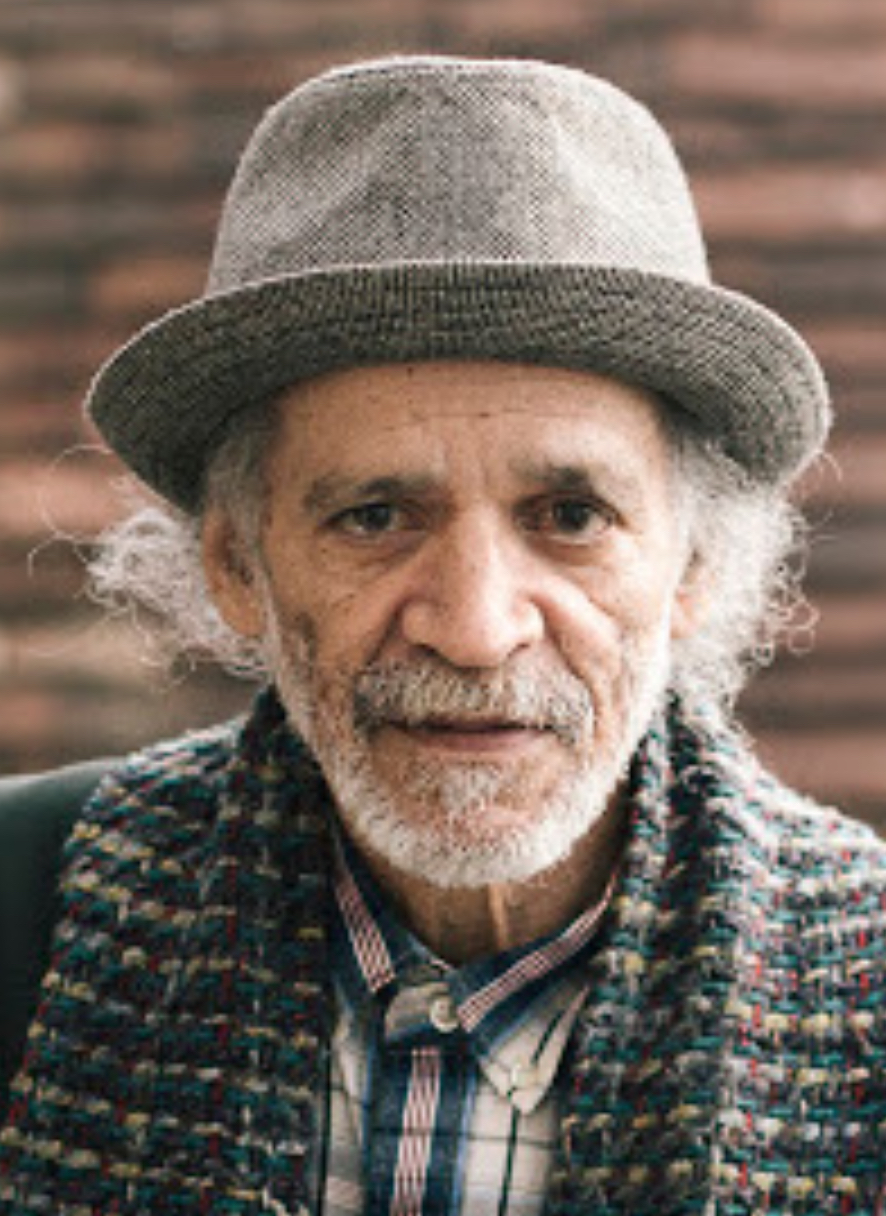
John Agard can turn an insult into an interrogation and a history lesson into an argument about who has been allowed to speak. His poems move between laughter and anger, finding political consequences in the way people describe one another. His range also includes religion, love, science, childhood and the pleasures of nonsense. Across that writing, a recognisable invitation emerges: listen closely to familiar words, because they may contain something stranger, funnier or more troubling than their everyday use suggests. 1
Growing up among different voices
Born in 1949, Agard grew up in Georgetown, Guyana. He began writing poems as a teenager and, after leaving school, taught English and French. Work as a writer and editor for the Guyana Sunday Chronicle gave him another professional relationship with language. Teaching, journalism and poetry asked for different kinds of communication: explaining something, shaping an account for readers, or discovering what an arrangement of words might make possible. These activities belonged to his life before he moved to Britain. He arrived with experience as a working writer, alongside ambitions still developing. 2
Performance was another early interest. Recalling his childhood in a 2026 interview, Agard described imaginary courtroom speeches and joining a junior amateur theatre company at fourteen. His roles included Captain Hook, the White Rabbit and Bottom in A Midsummer Night’s Dream. He also remembered teachers who encouraged his enthusiasm for language. These recollections help explain the ease with which his later poems create a speaker and an audience. A voice can adopt a role, alter its manner and make listeners reconsider the person they thought they were hearing. 3
Agard’s education also left questions that he would revisit. In a 2016 interview, he recalled a school history textbook presenting Caribbean history as beginning with Columbus’s arrival. He remembered appreciating his education while later recognising the arrogance of that starting point. The problem was a choice about where the story began: entire peoples and histories were pushed outside its frame. That remembered sentence helps explain why the authority of a history lesson became such fertile material for his poetry. 5
A writing life in Britain
Agard moved to England in 1977 with the poet Grace Nichols, initially settling in Ironbridge, Shropshire. Their careers developed alongside one another, and they later made their home in East Sussex. Both brought substantial Caribbean literary interests to their British work. For Agard, the move opened a long period of publishing, performing and making books for different generations. His collection Man to Pan won the Casa de las Américas Prize in 1982, establishing international recognition alongside the audience he was building in Britain. 2
School visits became an important part of that working life. As a touring speaker for the Commonwealth Institute, he introduced audiences to Caribbean culture through readings and conversation. Such work placed a poet in direct contact with pupils and teachers across Britain. The classroom offered an encounter with a particular speaker, his language and his imaginative choices. Agard’s subsequent educational influence grew from these practical meetings as well as from the inclusion of his poems in books. 11
Making a racial label answer for itself
Half-caste begins with a deliberately absurd physical image: its speaker stands on one leg, as though the racial label meant possessing only half a body. The poem then demands an explanation from the person using the term. Its examples move through painting, weather and music. Picasso’s mixed colours and a piano’s black and white keys become evidence against the assumption that mixture produces an incomplete result. Agard’s humour draws strength from this patient pursuit of a bad idea. Once the label is applied consistently to other things, its logic becomes difficult to defend. 6
The poem also changes who must account for themselves. Its speaker asks the questions and determines the terms of the exchange. Near the end, the imagined fractions extend to seeing, listening, dreaming and casting a shadow. The listener is eventually invited to return with their full attention. This makes recognition an active obligation: understanding another person requires more than supplying a category. The argument is carried by repetition, accumulating examples and comic exaggeration, giving readers several ways to feel the pressure of the question. 6
The language of authority
Listen Mr Oxford Don stages another encounter with a figure of authority. Its immigrant speaker addresses an academic representative of correct English, treating grammatical disobedience as if it were a criminal offence. The poem repeatedly brings linguistic terms into contact with accusations, weapons and punishment. A sentence can belong to grammar or to a court; a verbal assault can be an act of imaginative rearrangement. These connections make the joke work while exposing how readily judgements about language become judgements about the person using it. 7
Agard’s speaker is a constructed voice, and the poem should not be read as a literal account of its author’s education or conduct. The character’s command of wordplay steadily undermines any assumption of linguistic inadequacy. His breath and verbal ingenuity are the resources with which he answers the don. Caribbean speech has rhythm, precision and argumentative force here. Readers meet a poem that challenges the distribution of authority within English while demonstrating how much the language can do when a writer refuses to keep it within familiar expectations. 7
Checking whose history is being taught
Checking Out Me History gives that challenge an explicitly historical shape. A repeated account of what the speaker has been taught is interrupted by figures who received no comparable attention. Toussaint L’Ouverture, Nanny of the Maroons and Mary Seacole enter passages with a different pace and imaginative intensity. The movement matters: the poem changes its manner when it makes room for these lives. Nursery rhymes and familiar British historical references sit beside the omissions, raising questions about the apparent naturalness of what a curriculum contains. 8
Agard uses images of obstructed sight to connect historical knowledge with the possibility of understanding oneself. By the ending, the speaker has begun an independent search. The poem’s historical portraits are compressed, celebratory poetic accounts; their function is to interrupt a narrow inheritance and encourage further attention. They give listeners names to pursue beyond the poem. Its force comes from the combination of structure and subject: an imposed lesson keeps returning, but it can no longer contain the speaker’s growing determination to investigate and describe a history of their own. 8
Flags, performance and the wider imagination
Agard’s questions extend to national symbols. In Flag, repeated questions identify an object through what it persuades people to do. The material is ordinary cloth, yet the feelings gathered around it can produce obedience, courage and bloodshed. The repeated three-line stanzas give the exchange an almost instructional neatness, making its implications increasingly unsettling. By the final stanza, the desire to possess a flag is tied to a failure of conscience. The poem asks how an object comes to acquire authority over a human life. 9
That economy is part of its effectiveness. Agard names no particular country or war, leaving readers to consider the relationship between national allegiance and personal judgement across different settings. The familiar question-and-answer pattern makes the argument easy to follow, while each return adds pressure. Its warning concerns what people may permit themselves to do when a symbol supplies their moral instructions. 9
The scale expands in Roll Over Atlantic, the one-person show Agard performed at the Southbank Centre’s London Literature Festival in 2016. Christopher Columbus shares the imagined world with a shaman, mosquitoes and the Atlantic Ocean itself. Different voices unsettle the explorer’s account of his enterprise. Explaining the production, Agard described humour as a means of awakening attention without alienating an audience through preaching. Theatre allowed him to embody competing perspectives and make historical argument through changes of character, sound and tone. The remembered textbook’s narrow beginning had become material for a much wider conversation. 5
The 2009 selection Alternative Anthem offers another way into his range. It draws on books including We Brits, Weblines and From the Devil’s Pulpit, bringing British institutions into contact with Caribbean transformation stories and religious irreverence. Steel drums, limbo and the spider trickster Anansi belong to its imaginative inheritance. He repeatedly finds situations in which an unexpected speaker can examine an established order from a revealing angle. 10
The selection also appeared with Pamela Robertson-Pearce’s films of live performances. Its recorded settings include London’s Soho Theatre and Havant Arts Centre, where Agard worked with the flautist Keith Waithe. This publishing choice makes the spoken and written dimensions of his work available together. A printed poem offers arrangements of lines and spaces that readers can explore at their own pace; a performance gives them an encounter shaped by a particular occasion. Agard’s career has made sustained room for both experiences and for collaboration with other artists. 10
Children as adventurous readers
Agard’s collaborations with Nichols include A Caribbean Dozen and Under the Moon and Over the Sea, bringing Caribbean writers to young readers. The latter anthology also includes traditional rhyme and song and won the inaugural CLPE Poetry Award. Editing extends his contribution through the selection and presentation of other voices. 11
The Young Inferno demonstrates his ambition for children. Reimagining Dante, Agard retained the interlocking rhyme form known as terza rima while introducing contemporary language. Aesop replaces Virgil as the guide, and Satoshi Kitamura supplies the illustrations. The adaptation offers an approach to an inherited literary form through altered voices and references. 11
My Name Is Book, illustrated by Neil Packer, gives the act of reading a different history. Book becomes a speaking character, recalling oral storytelling, clay tablets, scrolls, manuscripts and printing. Reflections on alphabets, libraries and book burning interrupt the progress through changing forms. The playful premise makes an object familiar to children an entry into the material and cultural history of writing. Pages, spines and technologies acquire interest because they belong to the narrator’s changing existence. This is a book’s imagined autobiography. Its range also shows Agard’s interest in how knowledge travels: the words readers encounter depend on people, materials and decisions that can otherwise disappear behind the finished volume. 12
Readers across generations
Recognition has acknowledged the breadth of this work. The Queen’s Gold Medal for Poetry for 2012 honoured Agard’s writing over several years, with particular attention to Alternative Anthem and the children’s collection Goldilocks on CCTV. In the announcement, Poet Laureate Carol Ann Duffy connected his verbal and theatrical gifts with his educational influence. That pairing was significant: the adult collections, performances and books for younger readers were being considered as parts of an achievement that had changed how people encountered poetry. 4
In 2021, Agard became the first poet to receive BookTrust’s Lifetime Achievement Award. Piers Torday, one of the judges, emphasised his long commitment to poetry in schools and his ability to invite readers into inventive writing. The award recognised a career in children’s literature as substantial literary work, acknowledging the books and school visits through which he had helped young people discover poetry. 13
The Poetry World of John Agard, published in 2025 with illustrations by Shirley Hottier, brought together eighty poems reaching back to the 1970s. Such a selection lets different generations encounter work produced across a long career. Familiar poems sit within a larger body of writing, and younger readers can approach the poet through more than the pieces that have become classroom favourites. 14
Agard offered a revealing account of this relationship in his 2026 interview with Books for Keeps. A teacher had approached him with an old copy of I Din Do Nuttin, remembering uncertainty about reading Caribbean-inflected poetry without a Caribbean accent. Agard’s encouragement was to use his own voice and enter the spirit of the work. That recollection suggests a generous understanding of performance. The sounds of a poem deserve attention, but a reader can begin through engagement and curiosity, without impersonating its author. 3
Agard’s poetry rewards that kind of attention. Its wit can attract a listener before an uncomfortable question comes fully into view, while its characters make abstract disputes immediate. Across his writing, language remains available for revision and imaginative use. A label can be challenged, an official voice answered and a familiar story reopened. The reader’s pleasure in those possibilities is part of the work’s intellectual force: laughter becomes one way of noticing more. 1
Sources
1. Poetry Archive — John Agard: biography and authorised recordings.
2. The Adrian Brinkerhoff Poetry Foundation — John Agard.
3. Books for Keeps — The magic of words: the poetry world of John Agard, interview, 15 July 2026.
4. The Royal Family — The Queen’s Gold Medal for Poetry 2012.
5. Prospect — Felicity Capon interviews John Agard about Roll Over Atlantic, 19 October 2016.
6. John Agard / Amnesty International UK — Half-caste: poem text.
7. John Agard / Index on Censorship — Listen Mr Oxford Don, 2006 republication.
8. John Agard / Poetry Archive — Checking Out Me History: authorised poem text.
9. John Agard / Poetry Archive — Flag: authorised poem text.
10. Bloodaxe Books — Alternative Anthem: Selected Poems, publication and performance details.
11. IBBY UK — John Agard: Hans Christian Andersen Award nomination dossier, 2019.
12. Walker Books — My Name Is Book.
13. Piers Torday — BookTrust Lifetime Achievement Award announced, judge’s account, 9 November 2021.
14. Otter-Barry Books — The Poetry World of John Agard.
Image credit
John Agard. Photograph by ILIV.YX, via Wikimedia Commons. CC BY 4.0. Image source; licence.






Join the conversation
Comments 0
Share a memory, ask a question or add to this story.
No comments yet. Add your perspective.
Add your voice
Create a free account and verify your email to leave a comment.
All comments are reviewed before publication.