A dog trainer, a shoemaker, a musician: the people in Lubaina Himid’s Naming the Money have skills and identities that extend beyond the service demanded of them. Painted on life-size cut-outs, they occupy the gallery floor, where visitors can move among them. The installation gives physical presence to a question running through her career: what happens to our understanding of history when the people pushed towards its edges become the main subjects? 1
From Zanzibar to art school
Himid was born in Zanzibar in 1954. After her father’s death, she moved to Britain with her mother when she was four months old. Her mother worked as a textile designer and encouraged her interest in art. Her subsequent work would often return to the experience of being seen as different while remaining absent from recognised histories of culture. In her account of that problem, visibility alone offers little: a person can be made conspicuous without their life or contribution being understood. Her paintings would repeatedly attend to what such representations leave out. 2
She chose theatre design partly because of its possibilities for radical and Black politics. The attraction was to an art form that could address an audience and organise a public encounter. Her later installations would allow painted characters to enter the space occupied by the people looking at them. 2
She graduated from Wimbledon College of Art in 1976 and completed an MA in Cultural History at the Royal College of Art in 1984. These two areas of study brought together practical image-making and questions about how societies record and interpret their past. Much of her subsequent career developed in Preston, Lancashire. Her work has examined the authority of museums and the discrimination confronting Black women artists, while celebrating Black creativity. These concerns also informed her involvement in the Black British Arts Movement. 3
Making exhibitions for Black women
During the 1980s, Himid helped create opportunities for other artists through curating. Five Black Women at the Africa Centre in 1983 and Black Woman Time Now at Battersea Arts Centre in 1983–84 preceded The Thin Black Line at London’s Institute of Contemporary Arts in 1985. The ICA exhibition brought together eleven Black and Asian women, including Sonia Boyce, Claudette Johnson, Ingrid Pollard and Maud Sulter. It made space for different practices and positions within a field too often treated as though it could be represented by a single artist. 4
The practical work behind such exhibitions matters to Himid’s biography. Selecting work, corresponding with artists and institutions, and bringing people into a shared programme helped build relationships through which art could reach an audience. The ICA’s later presentation of letters and photographs from these projects records that work. Her curating also gave the artists an opportunity to be seen together, making the extent of their activity harder to overlook. It established an exhibition history to which later researchers and curators could return. 4
Recasting Hogarth’s fashionable society
William Hogarth’s The Toilette, the fourth scene in Marriage A-la-Mode, shows a countess receiving visitors while she finishes dressing. Dating from about 1743, the painting includes her lover, who occupies a privileged position beside her. Musicians perform, a servant offers chocolate and a page handles a recently acquired ornament. The room’s expensive objects, social rituals and crowded relationships make wealth visible as behaviour. Its inhabitants arrange themselves around the countess, while Hogarth invites the viewer to judge their pretensions. 5
In A Fashionable Marriage, made in 1986, Himid rebuilt this social theatre using cut-outs, painting and drawing. The countess and her lover became Margaret Thatcher and Ronald Reagan. An opera singer became an art critic, and another figure represented an indecisive funding body. These substitutions drew the management of artistic reputation into the same room as political power. 6
She also transformed the Black male servant into a Black woman artist, with movable arms and a dress bearing painted wooden fish. This figure brought the artist’s labour into a scene concerned with taste and status. Himid’s satire asks who provides the energy of cultural life, who distributes its rewards and who is expected to remain useful to somebody else. 6
Her Wing Museum series pursued a related argument about cultural authority. An imaginary touring exhibition of Black artists’ objects formed part of The Ballad of the Wing, shown at Chisenhale Gallery in 1989. By inventing a collection, Himid could examine the decisions through which museums recognise ownership and authorship. The series celebrated Black creativity while confronting the theft and denial embedded in some collecting histories. It also made the museum itself available as material for an artist to reshape. 3
One hundred people, one hundred stories
Naming the Money, first exhibited at Newcastle’s Hatton Gallery in 2004, greatly expanded her use of the cut-out figure. It contains one hundred people, divided among ten occupations. Ceramicists, herbalists, toy makers and map makers appear alongside musicians, dancers and other skilled workers. Each has an original identity and another imposed upon them. An invoice attached to the back carries a short text, and a soundtrack gives the characters voices. During its development, the project grew from ten proposed canvases to a hundred freestanding figures, requiring help with cutting, making stands, transport and sound. 7
These are artistic characters whose names and stories Himid composed. Their individual biographies should not be read as recovered archival records. In letters to curator Lucy Whetstone, she described developing their clothes, objects and expressions, then writing their stories. The work responds to historical enslavement through invention. That distinction allows its achievement to be understood precisely: Himid creates the sustained attention to personality, memory and ability that representations of unnamed servants so often withhold. Her figures possess lives that the roles assigned to them cannot adequately describe. 7
The arrangement also changes how a person encounters the subject. A visitor must choose a route through a gathering of figures, with voices audible in the surrounding space. Looking becomes an activity involving movement, proximity and time. Their occupations emphasise the abilities that enslaved Africans brought into European courtly life, while the tension between original and imposed identities connects the installation with Himid’s wider concern for displacement. The work can accommodate encounters with individual characters as well as the cumulative presence of a crowd. 1
Himid gave Naming the Money to the International Slavery Museum in Liverpool. When it was presented at the Walker Art Gallery in 2017, it was placed in dialogue with works she selected from the Arts Council Collection. The gift brought her sustained artistic investigation of enslavement into a museum devoted to its history and legacies. Her role as a curator continued within the presentation of her own work. 8
Cotton, crockery and the daily newspaper
Himid also finds historical relationships in apparently modest surfaces. Cotton.com, made in 2002, consists of small black-and-white patterned oil paintings and a brass strip. The work imagines communication between enslaved cotton workers in America and mill workers in Britain. Its starting point was the support for abolition expressed by Lancashire workers during the American Civil War, when shortages of cotton threatened their own livelihoods. The industrial north and the plantation economy enter the same field of attention. 9
The patterns make that imagined exchange visible without supplying a literal transcript. Each panel offers a variation within a common format, suggesting people connected through work while retaining their differences. The title’s reference to electronic communication draws a modern form of connection into a history of distant labour. Reading the panels together requires the viewer to consider both ends of a production system: the cotton grown under enslavement and the cloth made in British mills. 9
For Swallow Hard: The Lancaster Dinner Service in 2007, Himid worked on a hundred pieces of crockery. Commissioned by Lancashire Museums for Judges’ Lodgings, Lancaster, the service was presented on a mahogany dining table made by Gillow. She gathered plates, dishes, jugs and tureens from shops and markets, then painted across their existing decoration. The commission marked the bicentenary of the abolition of the British slave trade. 10
Her additions included buildings, maps, traders, enslaved servants and details drawn from ships and account books. Older patterns remained visible beneath and beside the new painting. A dinner service carries associations of hospitality, comfort and display; these additions bring the labour and commerce sustaining such comforts onto the table. Because the original decoration survives, the historical argument takes place across the same surface. Himid asks viewers to hold pleasure in the objects together with attention to the relationships that made particular forms of prosperity possible. 10
Negative Positives brought this scrutiny into the contemporary newspaper. Beginning in 2007, Himid examined editions of the Guardian for the way Black people appeared in photographs and accompanying text. She painted patterns over selected pages, drawing attention to the framing of the people pictured. The project followed recurring public figures as well as the broader treatment of Black life in the paper. 11
Here the material already arrived with an editorial argument: a chosen photograph, a headline, a place on the page. Himid’s painted intervention interrupted that arrangement. Her concern was with the use of a person’s image as a convenient sign for a story, and with the restricted kinds of Black lives regularly given space. The works bring the decisions of picture editors and designers into view, showing how representation is shaped through small, repeated choices. 11
Recognition and the work of making decisions
In December 2017, Himid became the first Black woman to win the Turner Prize. The award brought wider public attention to a career already spanning decades of painting, exhibition-making and support for other artists. Major works such as A Fashionable Marriage and Naming the Money entered that new period of recognition with substantial exhibition histories behind them. 12
Her later paintings have continued to give Black figures responsibility for interpreting and changing their surroundings. Make Do and Mend, presented in Austin and New York in 2024, introduced Strategy Paintings in which people gather around tables. Objects including lemons, teeth and plants occupy the space between them. The situations suggest problems under discussion while leaving the characters’ motives open. The viewer is offered the workings of a conversation, with its uncertainties and competing possibilities. Chairs placed in the exhibition allowed visitors to sit, extending this attention to deliberation into the gallery itself. 13
The exhibition also included Aunties, an arrangement of sixty-four painted planks assembled from materials such as furniture, floorboards and packing crates. Decorations and added objects distinguish one figure from another. The title invokes women whose place in a family or community can extend beyond formal kinship. Reused materials become a gathering of personalities, continuing Himid’s interest in how a painted object can acquire a presence within a room. 13
For the British Pavilion at the Venice Biennale in 2026, Himid created Predicting History: Testing Translation. Its paintings and found objects, accompanied by sound developed with artist Magda Stawarska, consider making a home in an unfamiliar place. Figures appear as architects, tailors, chefs, boatbuilders and gardeners, bringing practical skills to the problem of belonging. In Architects, two people debate models of shelter: one offers an enclosed home, another a structure on wheels. Privacy and the possibility of departure enter the discussion together. 14
Shelter, food and work give these conversations familiar starting points. The proposals in Architects remain unresolved: each design answers one need while exposing another. Himid allows her figures that uncertainty. They can weigh alternatives, disagree and attempt to build something together. It extends the attention she has given painted people throughout her career. Names are accompanied by knowledge, individual judgement and the capacity to imagine a different life. 14
Sources
1. Spike Island — Lubaina Himid: Navigation Charts.
2. Ben Uri Research Unit — Lubaina Himid.
3. The Women’s Art Collection, Murray Edwards College — Lubaina Himid.
4. Institute of Contemporary Arts — Connecting Thin Black Lines: 1985–2025.
5. National Gallery — William Hogarth, Marriage A-la-Mode: 4, The Toilette.
6. Lubaina Himid — A Fashionable Marriage.
7. Lubaina Himid — Naming the Money.
8. Lubaina Himid — Naming the Money at Walker Art Gallery, Liverpool.
9. The Courtauld — Work in Focus: Cotton.com, Lubaina Himid, 2002.
10. Lubaina Himid — Swallow Hard: The Lancaster Dinner Service.
11. Lubaina Himid — Negative Positives.
12. Lubaina Himid — Lubaina Himid wins Turner Prize 2017.
13. The FLAG Art Foundation — Lubaina Himid: Make Do and Mend.
Image credit
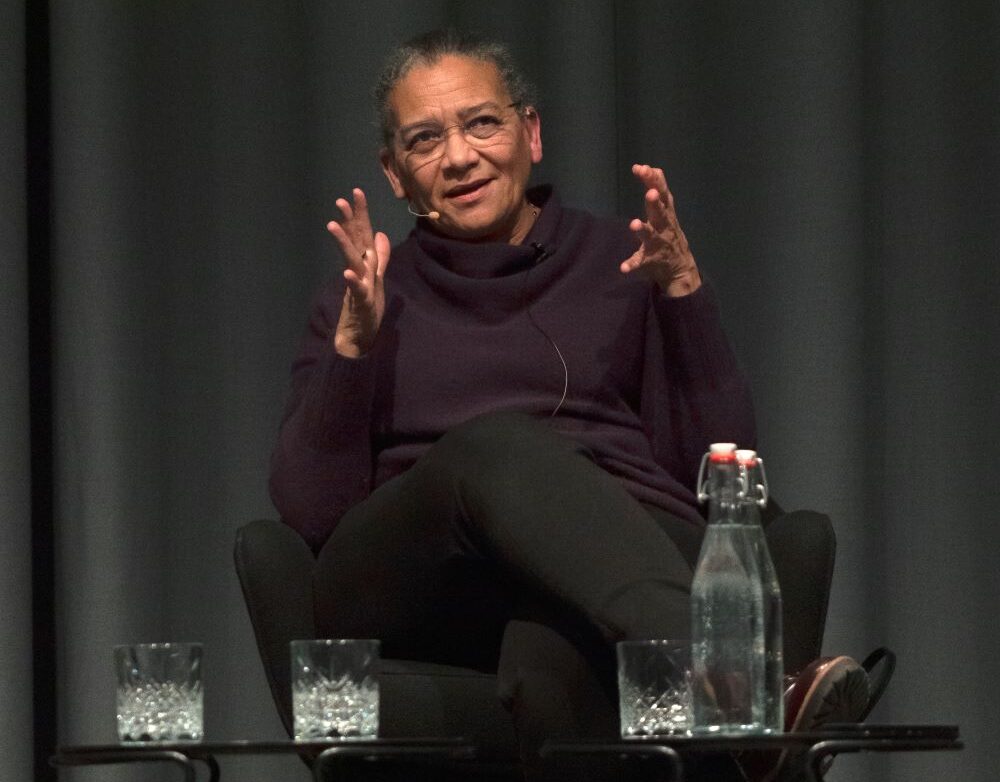
Lubaina Himid. Photograph by Cascade80, via Wikimedia Commons. CC BY 4.0. Image source; licence.






Join the conversation
Comments 0
Share a memory, ask a question or add to this story.
No comments yet. Add your perspective.
Add your voice
Create a free account and verify your email to leave a comment.
All comments are reviewed before publication.