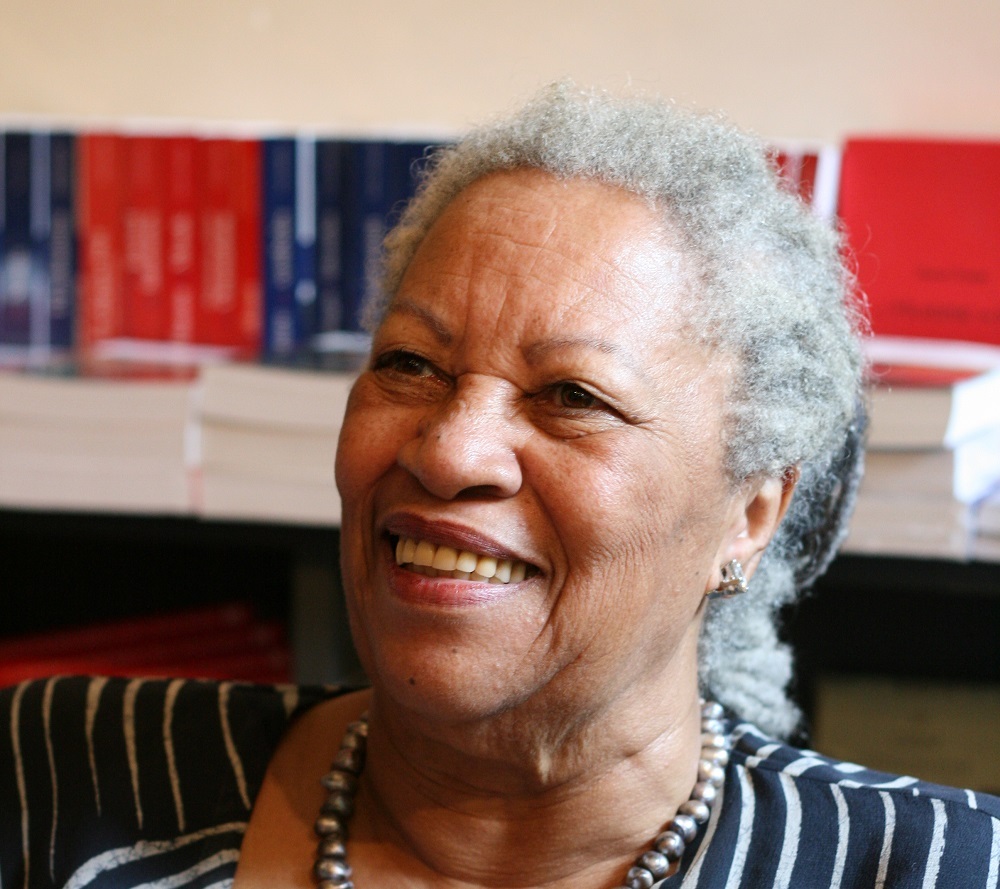
Among Toni Morrison’s papers at Princeton is a hand-drawn map of Ruby, the fictional town at the centre of Paradise. The novel appeared in 1998; the map later featured in the university’s 2023 exhibition, Sites of Memory. Alongside outlines, revisions and research materials, it makes visible the labour behind her imagined worlds. Towns, families and histories had to be worked out on paper, even when the finished novel would reveal them gradually, through competing voices and incomplete memories. 1
A childhood of books and stories
Morrison was born Chloe Wofford on 18 February 1931 in Lorain, Ohio. Her parents, Ramah and George Wofford, came from sharecropping families that had moved north. At home, reading and storytelling belonged together: her parents encouraged her interest in literature while passing on stories from their own cultural inheritance. She attended Lorain High School and took domestic work after classes. Books were part of this working childhood, well before literature became either her profession or her public identity. 2
At Howard University in Washington, she studied English, with a minor in classics, graduating in 1953. She also joined the Howard University Players, the university’s theatre company. Her education therefore included performance as well as the study of written texts. Howard would become a place she returned to as a teacher, and where a writers’ group helped her begin developing fiction. 3
She continued at Cornell University, completing a master’s degree in English in 1955 with a thesis on alienation in the work of Virginia Woolf and William Faulkner. Cornell’s account of her time there preserves a letter she later sent to her thesis adviser, Robert Elias. She thanked him for treating her as an individual, without condescension or racial judgement. 2, 4
Writing around work and family
After Cornell, Morrison taught at Texas Southern University from 1955 to 1957, then returned to Howard. In 1958 she married Harold Morrison, a Jamaican architect; they had two sons, Harold Ford and Slade Kevin. Teaching, family life and the beginnings of fiction overlapped. The Toni Morrison Society’s chronology places her participation in Howard’s writers’ group in 1963. Her first published novel still lay several years ahead, during which she would move into publishing and continue developing her own writing. 5
In her 1993 Paris Review interview, Morrison explained that writing before dawn had begun as a practical arrangement while her children were small. She could work before they needed her attention. A full-time job meant finding other hours at weekends and between commitments; there was no uninterrupted working day reserved for fiction. Later, early morning remained her preferred time because she felt mentally clear. The habit outlasted the circumstances that had produced it, becoming a way of entering the work. 6
Her first novel, The Bluest Eye, appeared in 1970. Its central figure, Pecola Breedlove, is an eleven-year-old Black girl who longs for blue eyes, believing they would make her beautiful and change how others see her. Morrison brought a child’s experience of beauty standards, poverty and racism into the centre of a novel. Pecola’s wish is painfully specific: she imagines changing her own body to secure the recognition and affection that the world around her has failed to provide. 1, 7
Friendship, inheritance and the sound of a sentence
Sula followed in 1973, tracing the relationship between Nel Wright and Sula Peace from childhood into adult life. Their friendship develops in the Bottom, the Black neighbourhood of the fictional Ohio town of Medallion. As their choices diverge, the novel considers marriage, motherhood, sexuality and the community’s judgements about women. Friendship carries much of the emotional weight. Morrison gives the relationship between two Black women the complexity of a lifelong attachment, including tenderness, dependence, disappointment and betrayal. 5, 8
In Song of Solomon, Milkman Dead sets out in search of material riches and discovers the history of his ancestors, including their suffering and flight towards freedom. In a profile published by the National Endowment for the Humanities, Morrison explained her interest in the felt experience of particular people. She wanted to move beyond generalisations about what a situation meant and consider what it was like to inhabit it. Milkman’s search brings that attention to the relationship between an individual and his inherited history. 9
Such books emerged through physical, repeated revision. Morrison told the Paris Review that she preferred drafting in pencil on yellow legal pads, although she also wrote on hotel stationery and scraps of paper. She later transferred work to a computer and revised it again. Ideas did not wait for ideal surroundings: she recorded them while travelling or between other tasks. 6
History and the making of Beloved
Her publishing career developed alongside her fiction. After working for the textbook publisher L.W. Singer in Syracuse, she moved into editorial work at Random House in New York. From 1968 to 1983 she edited work by writers including Toni Cade Bambara, Gayl Jones, Henry Dumas and June Jordan. Editing placed her in sustained relationships with other authors and their manuscripts. Her own books belonged to a wider field of Black writing whose contributors had distinct voices, political concerns and artistic ambitions. 10
One project connected that editorial work directly to a later novel. While compiling The Black Book, published in 1974, Morrison encountered the story of Margaret Garner, an enslaved woman who had escaped to Cincinnati and killed her young daughter when faced with recapture. The historical account helped prompt Beloved, published in 1987. Morrison used this starting point to create fiction about motherhood, ownership and freedom. Sethe, the novel’s central character, is an imaginative creation, rather than a substitute for a biography of Garner. 10
Beloved brings the reader into a household marked by an unresolved past. Sethe lives with her daughter Denver at 124 Bluestone Road, outside Cincinnati. Paul D, who shared her experience of enslavement at Sweet Home in Kentucky, arrives with memories she has tried to suppress. Then a young woman calling herself Beloved appears. Sethe believes this stranger is connected to the daughter she lost. The story moves between the intimate demands of the household and the violence that continues to shape its inhabitants’ lives. 11
The novel refuses to leave enslavement safely behind its characters. Memories recur through conversations, sensations and fragments of earlier events; the reader must gradually piece them together. Morrison combines a ghost story with the relationships of a mother, daughter, lover and surrounding community. That structure makes freedom more complicated than a change in legal status. The characters must also negotiate grief, attachment and the risks of trusting one another, while their experiences resist being arranged into a comfortable, orderly account. 11
Changing the conversation about literature
Beloved won the Pulitzer Prize for Fiction in 1988. Five years later, Morrison received the Nobel Prize in Literature. These were different kinds of recognition: the Pulitzer honoured a particular novel, while the Nobel acknowledged her literary achievement more broadly. The Swedish Academy’s explanation emphasised the imaginative strength and poetic qualities of her fiction, and the American experience it brought into view. Its language recognised literary form alongside subject matter, giving attention to how her novels worked as well as whom they portrayed. 12, 13
Morrison also challenged established ways of reading other American writers. In Playing in the Dark: Whiteness and the Literary Imagination, she examined the presence of Blackness in works by authors including Edgar Allan Poe, Herman Melville, Willa Cather and Ernest Hemingway. She asked how literary ideas of freedom, innocence and individuality depended on a population denied freedom. The argument widened the discussion of race beyond books written by Black authors, placing it within the construction of the American literary canon itself. 14
Her Nobel lecture made its argument through a story. Young visitors challenge a blind, wise woman to say whether a bird they claim to hold is living or dead. She cannot determine its condition, but tells them its fate rests with them. Morrison then considers the bird as language: something people can sustain, neglect or use destructively. The lecture connects storytelling to responsibility, examining how political, racist and exclusionary language can restrict thought, and how living language allows new knowledge and exchange. 15
Learning by making at Princeton
Morrison joined Princeton in 1989 as Robert F. Goheen Professor in the Humanities, following an appointment at the State University of New York at Albany. Her academic work included teaching literature and creative writing, as well as lectures beyond the United States. In 1990 she delivered the Clark Lectures at Trinity College, Cambridge, and the Massey Lectures at Harvard. At Princeton, she also developed a practical experiment in arts education: the Atelier, bringing students and professional artists together to make new work. 16
The first Atelier, in spring 1994, paired novelist A.S. Byatt with choreographer Jacques d’Amboise. Students developed a dance project inspired by Byatt’s novel Possession, writing poetry and music and making scenery. Children from the surrounding community took part, including children living in welfare motels along Route 1. The project required literature, movement, sound and visual design to come together within a limited production period. 17
In spring 1996 she co-directed an Atelier with cellist Yo-Yo Ma. Composer Richard Danielpour and bassist Edgar Meyer also worked with students on pieces bringing poetry and music together. Morrison guided the writing of lyrics, while the musicians helped with composition and performance. Across the Atelier programme, workshops drew students of engineering, economics and the sciences as well as the arts. The workshop gave students the demanding experience of developing material with established practitioners, testing how words could become part of a musical performance. 17
New forms and later novels
Morrison’s collaborations also included her son Slade. Their picture book The Big Box, published in 1999 and illustrated by Giselle Potter, grew from his childhood observations. It considers how well-meaning adults can restrict children’s freedom and individuality. They continued working together on children’s books, including The Book of Mean People, illustrated by Pascal Lemaître. Here a child struggles to understand adult behaviour and social rules. Writing for younger readers gave Morrison another setting in which to explore differences in power and perspective. 18
For Desdemona, she collaborated with Malian singer and songwriter Rokia Traoré and theatre director Peter Sellars. The work revisits Shakespeare’s Othello through Desdemona and Barbary, her African nurse, allowing figures from the play to speak beyond death. Words and music open space for their experiences, including questions about race, gender, love and war. Morrison’s contribution extended her interest in voices that a familiar account leaves underdeveloped, while Traoré’s music and Sellars’s direction made the piece a collaboration across distinct artistic traditions. 19
Her final novel, God Help the Child, brought her fiction into a contemporary setting. Discussing it with Hilton Als in 2015, Morrison said she had initially found the present difficult to grasp. She eventually focused on its preoccupation with self-presentation, giving her glamorous central woman a career in cosmetics. The interview returns to a concern running through her fiction: characters must discover something consequential that they did not understand before. For Morrison, such knowledge did not require a conventionally happy ending. 20
Making space for memory
Morrison died in New York on 5 August 2019, aged eighty-eight. Across eleven novels, she had written about childhood and adulthood, family bonds, beauty, desire and the continuing presence of history. Her work also encompassed criticism and writing for children. The National Endowment for the Humanities, remembering a former Jefferson Lecturer and National Humanities Medal recipient, recognised a career that had extended across fiction and public discussion of the humanities. 22
A different part of that legacy had already taken physical form through the Toni Morrison Society’s Bench by the Road project. Its first bench was dedicated in July 2008 on Sullivan’s Island, South Carolina, commemorating enslaved Africans brought through the island and those lost in the Middle Passage. Further benches followed in 2009 at Oberlin, Ohio, associated with abolitionism and the Underground Railroad, and Hattiesburg, Mississippi, honouring the Freedom Schools of 1964. These were places to sit, read and remember within landscapes carrying Black history: modest public spaces beside the expansive worlds she had made in books. 21
Sources
1. Princeton University Library — Toni Morrison: Sites of Memory.
2. Chicago Public Library — Toni Morrison Biography.
3. Howard University — Toni Morrison.
4. Cornell University — Toni Morrison, by Roger Gilbert.
5. Toni Morrison Society — Author Chronology.
6. The Paris Review — Toni Morrison, The Art of Fiction No. 134 (1993).
7. Penguin Random House — The Bluest Eye.
8. Penguin Random House — Sula: Reader’s Guide.
9. National Endowment for the Humanities — Toni Morrison (National Humanities Medal, 2000).
10. National Endowment for the Arts — Beloved: Big Read Guide.
11. Penguin Random House — Beloved: Reader’s Guide.
12. The Pulitzer Prizes — Toni Morrison, 1988 Fiction Winner.
13. The Nobel Prize — Toni Morrison: Facts, 1993 Literature.
14. Penguin Random House — Playing in the Dark: Whiteness and the Literary Imagination.
15. American RadioWorks — Toni Morrison’s Nobel Lecture (7 December 1993).
16. Princeton University, Department of African American Studies — Toni Morrison.
17. Princeton Alumni Weekly — Toni Morrison’s Atelier (10 September 1997).
18. Princeton University Library — Pictures and Prose.
21. Toni Morrison Society — Bench Histories.
22. National Endowment for the Humanities — Remembering Toni Morrison (6 August 2019).






Join the conversation
Comments 0
Share a memory, ask a question or add to this story.
No comments yet. Add your perspective.
Add your voice
Create a free account and verify your email to leave a comment.
All comments are reviewed before publication.