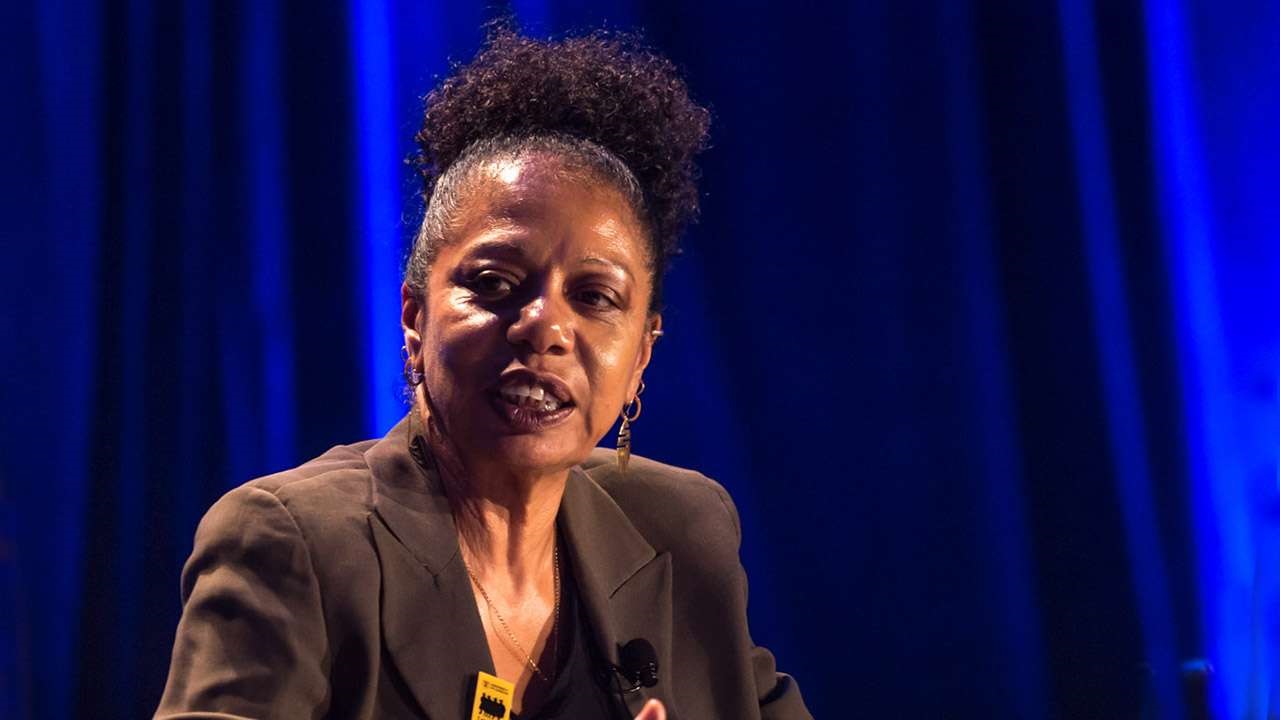
Stella Dadzie’s career connects classrooms, women’s organisations and historical research. She has written resources for teachers and youth workers, co-authored a history of Black women’s lives in Britain and examined women’s resistance to enslavement. Teaching and writing have been closely connected parts of her activism. 1
London, Ghana and an expanding political world
Dadzie was born in London in 1952 to an English mother and a Ghanaian father. In her Museum of Colour interview, she described her continuing connections with Ghana as important to her understanding of herself. Her mother’s experience of raising a Black child as a single parent in 1950s Britain was another formative influence. Her family history brought questions about race, belonging and women’s circumstances into everyday life. 2, 3
A year in Germany during her language studies in the early 1970s sharpened her political awareness. She recalled encountering overt racism and taking inspiration from women involved in African liberation struggles. Her involvement with African Red Family and The Black Liberator also made her question political communication. Standing outside Brixton station with publications whose language she herself sometimes found difficult, she wondered how they could reach the people they discussed. She wanted ideas to become useful in community organising, a concern that would recur throughout her educational work. 2
Teaching and organising in Haringey
By the mid-1970s, Dadzie was teaching German at Creighton School in Haringey. She subsequently ran an education unit for young people considered at risk of reoffending, and later lectured in Tottenham College of Technology’s Community Service Unit. Its courses reached people who struggled to enter conventional provision, including unemployed residents, Black women and people with disabilities. Black studies formed part of the curriculum, and a crèche helped mothers attend. Her account of this work shows how opening a classroom could require changes to childcare and access as well as teaching. 4
Haringey also gave her opportunities to organise through the National Union of Teachers and the United Black Women’s Action Group. In 1979, the women’s group established the Haringey Black Pressure Group on Education, challenging school exclusions and plans to separate pupils labelled disruptive. It also helped establish a supplementary school on West Green Road. These campaigns connected parents’ concerns with the professional questions Dadzie encountered as an educator. In the mid-1980s she became head of educational guidance at Haringey College, before establishing her own equalities training company later that decade. 4
Black women writing their own history
Dadzie became a founder of the Organisation of Women of African and Asian Descent, OWAAD, formed in 1978. Its first national conference in 1979 drew around 300 women. The organisation connected local organising with a wider platform for discussing education, employment, policing and health. Its newsletter, FOWAAD!, helped circulate concerns and campaigns. Bringing African and Asian women together reflected a political commitment to confronting racism alongside inequalities of gender and class. This gave women a setting in which experiences often treated separately could be discussed as connected problems. 1, 5
The Heart of the Race: Black Women’s Lives in Britain appeared in 1985, written jointly by Beverley Bryan, Stella Dadzie and Suzanne Scafe. It examined education, work, healthcare and community life within a history shaped by slavery, colonialism and migration. The book received the Martin Luther King Memorial Prize that year. Its subjects included the women who sustained families and services while confronting institutions that undervalued their work. Their experiences became central to an account of Britain’s social history. 6
Dadzie recalled that the project began with discussions among a larger book collective before the writing settled around its three authors. Oral testimony was central: women described their own experiences, helping shape the narrative. The authors’ collective voice reflected their involvement in the communities they were writing about. Research grew through listening, bringing everyday knowledge into print and treating the women who possessed it as participants in making history. 3
Verso republished the book in 2018 with a foreword by Lola Okolosie and a discussion with the authors chaired by Heidi Safia Mirza. Okolosie’s introduction considers the political significance of preserving accounts that conventional histories had marginalised. She also draws connections between the book’s discussions of public services and the conditions facing a later generation. The new edition therefore placed the earlier research in conversation with readers encountering its arguments decades after publication. 6, 7
Education beyond the school gate
Dadzie developed equally detailed work on how educational institutions should respond to Black learners. Working with Black Adult Learners: A Practical Guide, published by the National Institute of Adult Continuing Education in 1993, follows the learner’s journey from before enrolment through recruitment and the course itself. It addresses community consultation, publicity, guidance, admissions and support. Its structure combines explanations with checklists, case studies and further resources. This approach gives educators specific decisions to examine: who hears about a course, how previous learning is recognised, what happens during assessment and whether language support is available. Access begins well before someone takes a seat in a classroom. 8
The sections dealing with the course itself consider the environment a college creates, personal support and work with refugees. Staff also need to examine whether learners can continue, contribute and have their progress recognised. The guide provides students, practitioners and managers with questions from which to examine the same provision, making review an activity that can involve people in different parts of an institution. 8
Older and Wiser, also published in 1993, examined educational provision for Black and ethnic minority elders. Its case studies included community projects serving African-Caribbean, Asian, Latin American and other groups. The research recognised experiences of racism and exclusion while attending to differences between communities and individuals. Its findings stressed partnership and continuing dialogue with the people services were intended to reach. Learning in later life could involve language, local history, practical activities and opportunities to meet others. The report asked providers to investigate what people wanted and what prevented participation, giving older learners a place in discussions too often centred on the young. 9
In Cardiff, for example, the report examined the Butetown History and Arts Project, where elders worked with researchers, artists and media workers to preserve the district’s history. Photographs and recorded recollections became educational resources through residents’ participation. This was an example of older people contributing expertise as well as learning. Dadzie’s study made space for such projects within its account of educational provision, recognising the connection between community memory and opportunities to acquire new skills. 9
Her subsequent publications extended this practical work into the organisation of education. Equality Assurance, published in 1998, addressed self-assessment in further education. Guides for the Commission for Black Staff in Further Education followed in 2002 and 2003, covering recruitment, retention, progression and staff development. These subjects broadened the question of equality to include the people employed by colleges. Alongside work on teaching, Dadzie was producing resources concerned with how institutions recruited workers, supported careers and examined their own performance. 11
How to challenge racist behaviour
Blood, Sweat and Tears, published by the National Youth Agency in 1997, documented the Bede Anti-Racist Detached Youth Work Project in Bermondsey. Dadzie researched and wrote the report as part of her work with the project. She credited its methods to a collective effort involving young people, the advisory committee and the team coordinated by Aine Woods. Workers engaged with young people on local estates, including white youths whose attitudes were racist, while supporting Black young people facing hostility. The report described the time required to establish relationships, develop shared approaches and assess what was changing. Workers also considered Black participants’ safety when planning activities, rejecting staged encounters with racist peers that could expose them to further abuse. 10
Its conclusions were careful about the scale of the results. The project had made progress, but lasting changes in behaviour would require further investigation. Dadzie turned the experience into training material, with exercises addressing racist comments, provocation and responses to incidents. Readers could examine both the work’s achievements and its difficulties. The report offered practitioners a documented process they could question and adapt. 10
The Toolkit for Tackling Racism in Schools, published in 2000, carried a similarly practical purpose into school settings. Education researcher David Gillborn identified it as a useful resource combining exercises, advice and contacts. Such materials gave teachers ways to begin difficult work with pupils and colleagues. They also placed anti-racist education among the skills that practitioners could develop, practise and discuss together. 12
Recovering enslaved women’s resistance
A Kick in the Belly: Women, Slavery and Resistance, published in October 2020, brought Dadzie’s historical writing to another audience. Verso editor Rosie Warren recalled meeting her at a 2018 event for The Heart of the Race, when Dadzie mentioned a manuscript she had been working on for years. The resulting book examines women’s experiences of enslavement and resistance, following connections between Africa, the Atlantic crossing and the Caribbean, with Jamaica a major focus. 13
Its subjects include women’s responses to captivity, their place in resistance aboard ships and their involvement in rebellion in the Americas. It also examines the violence directed at women and the pressures surrounding reproduction under slavery. Figures such as Nanny of the Maroons appear within this wider account of resistance. Warren highlights Nanny’s role in organising plantation raids that freed enslaved people and supplied the Maroons with food and weapons. The book connects organised rebellion with the many pressures women faced under enslavement. Bringing these questions together makes women’s labour, bodies and political actions central to understanding how slavery operated and how enslaved people opposed it. 13
Dadzie acknowledged the historians whose scholarship made this account possible, including Lucille Mathurin Mair and Hilary Beckles. She described her task as making historical research accessible to a broader readership, particularly Black women. The educator’s concern with who could use knowledge remained central to the historian’s work. 3
Museums and new audiences
Her work with the National Maritime Museum began in 2020 and included staff training, visitor resources and efforts to improve the representation of enslaved women. From 2023, she chaired the advisory board for its Atlantic Worlds gallery. A museum training programme for teachers advertised for November 2025 listed Dadzie and Remiiya Badru as speakers. Its planned topics included teaching enslaved people’s experiences, using objects to support learning and responding to the emotions that this history can produce in learners. 14
Writer Grace Blenkinsop described attending a workshop with Dadzie and other young Black women at the museum in 2022. They explored the Freedom Fighters digital trail and discussed how the gallery’s language and design might develop. This brought visitors into the discussion of how history should be presented. It also connected the recovery of women’s experiences with a practical question familiar from Dadzie’s education work: what helps people engage with what they are being shown? 15
A lifetime of writing
Published by Lawrence & Wishart in October 2025, A Whole Heap of Mix Up gathered Dadzie’s personal, political and creative writing. Poems, stories, travel accounts, speeches and essays sit within a collection that ranges across family life, organising and journeys in Africa and the Caribbean. These different forms make room for an expressive life alongside the better-known historian and campaigner. The collection belongs to the publisher’s Radical Black Women series, extending her work into a form that can accommodate memory, argument and imagination. 16
Discussing the collection at the University of Bristol in November 2025, Dadzie explained that many OWAAD documents had been produced collectively and did not name an individual author. The book gave her another way to assemble the personal and political experiences behind her work. That relationship between an individual voice and collective endeavour runs through her career: she has written under her own name while repeatedly drawing attention to the women whose organising, testimony and knowledge helped make the work possible. 17
Her papers at Black Cultural Archives preserve evidence of that shared activity. They include OWAAD meeting records, campaign material, and publications connected with education and feminism. Alongside her books, these documents allow later readers to investigate the practical work of organising: the discussions, resources and decisions through which campaigns developed. Dadzie’s writing and her archive leave that history open for further study. 5
Sources
2. Black Women Radicals — On the Power of Stella Dadzie: interview by Jaimee A. Swift.
3. Museum of Colour — Stella Dadzie interviewed by Samenua Sesher, Respect Due transcript.
4. Lawrence & Wishart — Stella Dadzie, Haringey: Context and Crucible, authorised chapter.
5. Black Cultural Archives — The Black Women’s Movement: Subject Guide.
6. Penguin Random House — The Heart of the Race.
7. Verso — Lola Okolosie, A Reignited Spirit: Black Women’s Lives in Britain.
8. ERIC — Working with Black Adult Learners: A Practical Guide, NIACE, 1993.
9. NIACE / ERIC — Stella Dadzie, Older and Wiser, 1993.
10. National Youth Agency / ERIC — Stella Dadzie, Blood, Sweat and Tears, 1997.
11. Stella Dadzie — Books and Publications.
12. UCL Discovery — David Gillborn, Developing Antiracist School Policy.
13. Verso — Rosie Warren, A Kick in the Belly: A Letter from the Editor.
14. Royal Museums Greenwich — Sensitive Approaches to Teaching Transatlantic Enslavement, 2025.
15. shado — Grace Blenkinsop, Beyond Friendship: interview with Stella Dadzie.
16. Lawrence & Wishart — Stella Dadzie: A Whole Heap of Mix Up.
17. University of Bristol, WCIF — Stella Dadzie: A Whole Heap of Mix Up, event report.




Join the conversation
Comments 0
Share a memory, ask a question or add to this story.
No comments yet. Add your perspective.
Add your voice
Create a free account and verify your email to leave a comment.
All comments are reviewed before publication.