In 1983, a writing competition asked young people to think about Black identity in terms of culture and consciousness. The winning essays were published by the educational project Len Garrison had founded. Preserved in his papers, the collection records something central to his working life: his conviction that young Black people should have opportunities to describe their experiences, develop arguments and become authors whose work other people would read. 1
Learning to look
Born in Jamaica in 1943, Garrison joined his parents in Britain in 1954. During the 1960s and early 1970s he worked in medical photography, producing images for clinical and educational purposes, and advanced to lead a media and photographic unit. This was skilled, practical employment in which the information carried by an image mattered. He also became involved in the wider documentation of Black life. The historian and archivist Hannah Ishmael places these photographic beginnings within the development of his later commitment to collecting and preserving evidence of Black experience. 2
His wife, Marie Garrison, recalled at a University of Sussex event in 2022 that he habitually carried a camera and photographed ordinary occasions, particularly children. Her recollection gives a personal dimension to his professional interests. He noticed who was missing from the images available to communities and schools, and made pictures himself. A photograph credited to him in the summer 1975 AFRAS Review, showing a younger generation in south London, belongs to this continuing attention to everyday life. 3
Studying Black youth and belonging
Alongside his employment, Garrison contributed photographs to the West Indian Gazette, the newspaper founded by Claudia Jones. He developed his interests through adult education. At Ruskin College in 1971 he studied for a diploma in Development Studies and wrote a dissertation about Rastafari. That research subsequently informed his book Black Youth, Rastafarianism and the Identity Crisis in Britain. His enquiries connected young people’s experiences in Britain with a much wider African and Caribbean world. 4
Between 1973 and 1976 he studied African and Caribbean history at the University of Sussex. These years gave him sustained opportunities to investigate histories largely absent from the education he wanted to change. He graduated with an honours degree, bringing his experience as a working photographer into an academic field concerned with migration, colonialism and the making of societies on both sides of the Atlantic. 5
His study of Rastafari addressed the alienation experienced by some young Black people in Britain. As Ishmael explains in her research on Black-led archives, Garrison understood the movement’s appeal in relation to difficulties at school, strained relationships with parents and the wider society’s rejection of African heritage. He considered how a shared cultural identity could offer dignity and a language for understanding those experiences. He did not treat Rastafari as the complete answer to every young person’s needs. 6
The practical recommendations mattered. He wanted educational resources that took African and Caribbean histories seriously, support for parents and institutions through which this work could continue. His research therefore led towards curriculum development. Understanding how young people responded to exclusion was one part of the task; changing what schools provided was another. This combination of investigation and educational organisation shaped the projects he subsequently built. 6
In 1977 he presented work arising from his research at FESTAC, the international festival of Black and African arts and culture held in Nigeria. The invitation took his study of Black British youth into a gathering with an international audience. 4
Building resources for the classroom
By 1977, following a two-year campaign for funding, Garrison had secured support from the Inner London Education Authority for the African-Caribbean Educational Resource project, usually known as ACER. Its purpose was direct: to produce materials that countered racism and reflected the experiences of African and Caribbean pupils. Teachers needed usable resources, and children needed access to information that recognised their histories and their lives in Britain. ACER set about supplying both. 7
The material was closely connected to contemporary experience. Images and Reflections, published in 1979, included sections concerned with identity, school and the effects of the sus laws on Black children. It brought young people’s writing into teaching materials. Karen Sands-O’Connor’s research identifies contributions by Accabre Huntley and Hugh Boatswain, whose poems allowed readers to encounter childhood and memory through Black writers’ own words. These were resources through which a class could discuss what belonging, authority and difference felt like. 8
ACER also supported the adults expected to teach this material. Based at Wyvil Primary School in south London, it developed a library, bibliographies, training and curriculum work. Its 1985 publication Resources for Anti-Racist Education included contributions from Garrison, Wesley Kerr, Barry Troyna and Paul Boateng. This range of activity addressed a practical difficulty: a teacher persuaded that a curriculum needed changing still required books, knowledge and help in deciding how to begin. 9
Publishing a younger generation
The Black Youth Annual Penmanship Awards extended this work by inviting young people to write for publication. The 1983 collection honoured the memory of Peter Moses, Olive Morris and Elaine Clair. Linking an essay competition with named people from recent community history gave the awards a commemorative purpose as well as an educational one. Entrants were being encouraged to develop their own writing within a larger conversation about Black life and political struggle. 1
Among those whose writing received recognition through the awards were Clive Davis and Nicola Williams, both of whom went on to professional writing careers. The competition offered an early place in print, with the attention and encouragement that publication could bring. It also left behind a substantial record of young people’s concerns, created while they were living through the experiences they described. 7
Some of the essays were sharply analytical. In a 1982 entry, a sixteen-year-old writer named Mike criticised the way television, including Grange Hill, represented Black pupils. Sharon, writing at seventeen in 1981, described how a teacher’s expectations could encourage a pupil to play the class comedian, fall behind and be directed towards remedial provision. Their arguments, examined by historian Laura Tisdall, identified connections between representation, everyday classroom behaviour and educational opportunity. They were already analysing the institutions that judged them. 10
Tisdall also draws attention to the conditions in which such writing was produced. Competition titles could suggest the argument an adult organiser wanted to hear, while entrants made decisions about language and respectability. The essays carry those pressures alongside the writers’ observations. Their value includes the way young people negotiated an audience and tried to make themselves understood. Publishing them preserved disagreements and dilemmas that a general account of educational disadvantage could easily flatten. 10
The 1987 anthology Black Voices brought together writing by contributors aged between nine and thirty. Its breadth meant that childhood, adolescence and early adult life could appear within the same educational project. ACER’s publishing gave readers access to experiences across those stages and created a body of work that subsequent researchers could examine. Young writers had become contributors to the historical record as well as participants in a competition. 8
Poetry and the beginnings of an archive
Garrison wrote poetry himself. While at Sussex, he contributed to the AFRAS Review, including the poem The Power of the Drum in 1976. His collection Beyond Babylon was published by Black Star in London in 1985, bringing together poems dated 1972–82. An earlier version preserved by Black Cultural Archives includes a foreword by the Reverend David L. Moore, an introduction by Ahmed Sheikh and a biographical contribution by Ansel Wong. These accompanying contributions place his poetry within a network of people engaged in cultural and educational work. His own practice as a writer ran alongside his encouragement of others. 3, 11, 12
In 1981, Garrison helped found Black Cultural Archives. The undertaking grew from the conviction that the history of African and Caribbean people in Britain needed a permanent institutional home. His educational work had already shown the importance of access: a history could exist in families, organisations and scattered publications, yet remain difficult for a pupil or researcher to find. An archive offered a way to gather evidence and make continuing study possible. 13
The project depended on a group of organisers. Those involved included Askala Miriam and Makeda Coaston, associated with the Tree of Life initiative in Brent, alongside Garrison and other supporters. Collecting was often patient work with modest materials. Garrison searched second-hand markets, including Portobello Road, and preserved items relating to figures such as the composer Samuel Coleridge-Taylor. Through this work, publications and objects acquired separately could become part of a collection available for a wider purpose. 9
Taking the work to Nottingham
Garrison moved to Nottingham in 1988 and became director of the Association of Caribbean Families and Friends. He developed the BUILD mentoring project and secured King’s Fund support for Timeout, which assisted carers of Black children who had been orphaned or abandoned. These responsibilities brought educational encouragement into contact with the practical circumstances of family life. The work required support for adults as well as opportunities for younger people. 4
The association’s centre in Beaconsfield Street, Hyson Green, became a base for cultural and educational activity, including Black book fairs. Garrison’s Nottingham work brought together an interest in books, community organisation and the city’s history. He researched postwar West Indian settlement and contributed to the exhibition The Black Presence in Nottingham, held at Nottingham Castle Museum in 1993. Local history gave the communities he worked with a place within the account of the city itself. 14
Following George Africanus through the records
One surviving piece of his research is a hand-drawn family tree concerning George Africanus and the Molineux family, dated 1987. Africanus, who had been enslaved as a child, later established a life in Nottingham and married Esther Shaw in 1788. Garrison’s chart follows the family through subsequent generations. Preserved at Black Cultural Archives, it demonstrates his interest in recovering individual relationships as well as identifying figures who could stand for achievement. 15
The family history extends through Africanus’s daughter Hannah and her marriage to the clockmaker Samuel Cropper, and onwards to a granddaughter whose household later moved to London. Such connections give depth to the phrase Black presence. They involve marriages, children, occupations and movement between places. A family tree can make those relationships easier to follow, allowing readers to see a life within the networks that surrounded it and continued after it. 15
An institution built across generations
Garrison’s work influenced later collectors, including the poet and archivist Panya Banjoko, who took up a similar commitment to recording and sharing the city’s Black history through Nottingham Black Archive. Nottingham City of Literature places his contribution within a larger local network of writers, publishers and cultural organisers. That context helps explain why his work in the city mattered: it supported a community of readers and researchers, as well as producing individual publications and exhibitions. 14
Garrison died in 2003, before Black Cultural Archives obtained the permanent centre for which its supporters had worked. The public opening in Brixton’s Windrush Square on 24 July 2014 brought that long effort into a new phase. His wife Marie sang during the celebrations. The occasion connected the people who had sustained the project with a building where its collections could be consulted and its educational work developed. 2, 16
Recognition also came through the universities where he had studied. Sussex awarded him a posthumous honorary degree in 2024. In 2025, the University of Leicester announced three MA scholarships bearing his name, supported by Black Cultural Archives and including placements there. Garrison had himself completed an MA in Local History at Leicester. The scholarships covered tuition fees and included help with travel and subsistence during the archive placement. They joined university study to experience of working with the materials and institution he had helped to establish, giving another generation the opportunity to undertake research of its own. 5, 13
Sources
1. Black Cultural Archives — Black Youth Annual Penmanship Awards: Winning Essays 1983.
2. The Sociological Review — Len Garrison, Archives and Self-Esteem.
3. University of Sussex, Alice Corble — Making Black British History and Future.
4. New Ruskin Archives — Garrison, Lenford Kwesi.
5. University of Sussex — Summer Graduation Honorary Degrees, July 2024.
6. University College London, Hannah Ishmael — The Development of Black-led Archives in London.
7. Black Cultural Archives — African-Caribbean Educational Resource Project.
9. Black Cultural Archives — Development of Black Cultural Archives.
11. Open British National Bibliography — Beyond Babylon: Collection of Poems, 1972–82.
12. Black Cultural Archives — Beyond Babylon, Collection of Poems.
14. Nottingham UNESCO City of Literature — Literary Locations: Beaconsfield Street, Hyson Green.
15. Black Cultural Archives — Hand-drawn Family Tree of George Africanus.
16. Brixton Buzz — Black Cultural Archives Opening Ceremony, July 2014.
Image credit
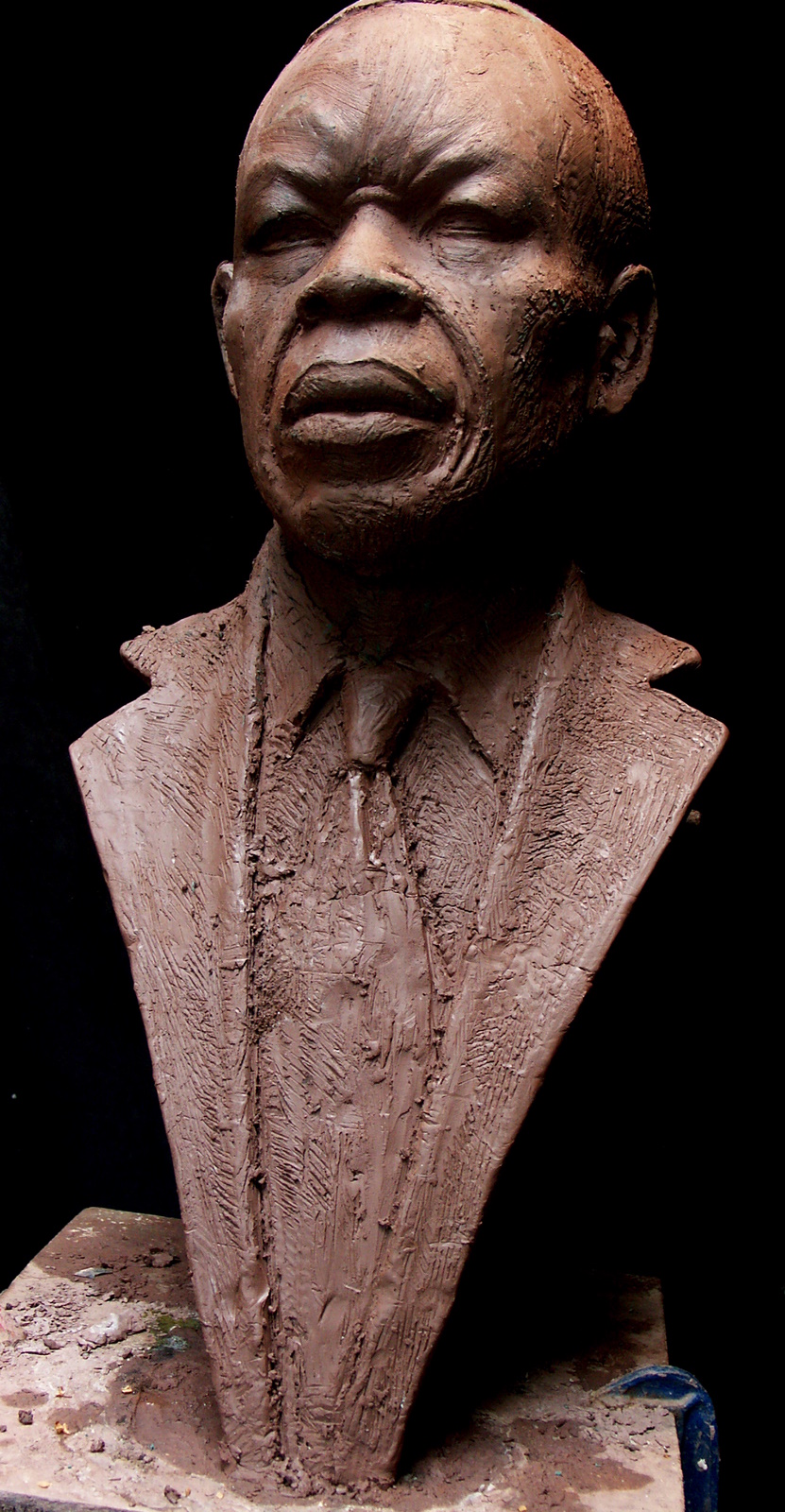
A work-in-progress bust of Len Garrison by Fowokan (George Kelly), commissioned by Black Cultural Archives. Image: George Kelly (Fowokan). CC BY-SA 3.0. Wikimedia Commons. Image source; CC BY-SA 3.0.





Join the conversation
Comments 0
Share a memory, ask a question or add to this story.
No comments yet. Add your perspective.
Add your voice
Create a free account and verify your email to leave a comment.
All comments are reviewed before publication.