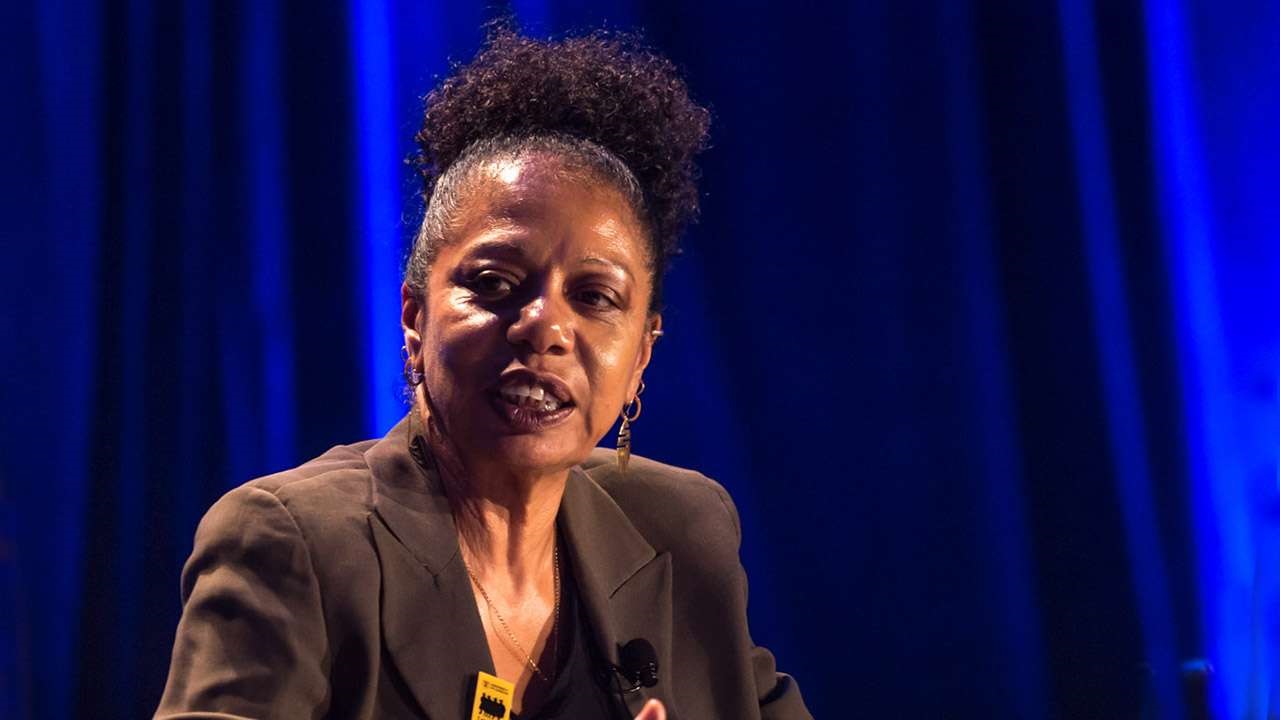
On 18 March 1979, about 250 women gathered at the Abeng Centre in Brixton for a national conference organised by OWAAD, the Organisation of Women of African and Asian Descent. They discussed education, employment, health, immigration and imperialism. Bringing these questions into one meeting made an argument in itself: the difficulties women encountered at work, in public services and within political movements belonged on the same agenda. The conference gave a growing network of local organisers a national meeting place. 1
Making room for women’s priorities
OWAAD had emerged from discussions in Coventry in 1978. Those involved included Stella Dadzie, Olive Morris and Gail Lewis, alongside women associated with the African Students’ Union and organisations connected with African liberation struggles. The gathering brought together different experiences of organising and different expectations of what a women’s movement should do. 1
Dadzie later explained that women were frustrated by political organisations that expected them to perform supporting tasks while pushing their concerns down the agenda. Raising those concerns could bring accusations of dividing the struggle. In her account, an initial proposal for a women’s caucus within the African Students’ Union developed into a decision to organise independently. Women with experience of liberation movements in Africa argued strongly for autonomy. The question was practical as well as political: women needed the authority to decide which issues required attention and how to act on them. 2
Gerlin Bean brought years of experience to this work. A nurse who became a youth worker and activist, she helped develop women’s organising within Black radical politics. The Black Women’s Action Committee, associated with the Black Unity and Freedom Party, published Black Women Speak Out in 1971. It connected the experiences of being working class, Black and female, drawing attention to women’s labour and unequal treatment. Bean also helped establish the Brixton Black Women’s Group in 1973. OWAAD grew from this existing political work, with women carrying ideas and relationships from one organisation into another. 3
What a shared political identity could mean
OWAAD’s draft constitution placed women’s position within a wider history of empire, labour and migration. It argued that women had helped sustain political struggles while continuing to face unequal power themselves. Race, sex and economic position were treated as connected. The document used Black as a political term embracing people of African, Caribbean and Asian descent. Its purpose was to build common action among people whose lives had been shaped by colonialism and racism, while acknowledging differences of culture and history. This was a coalition people had to create through organising, with no guarantee that a shared name would settle every disagreement. 4
The ambition was visible at the first conference. Gerlin Bean encouraged participants to exchange accounts of their work and learn from one another. Women could bring experience from a school campaign, a community group or a liberation organisation and compare it with what others had encountered. Listening was part of the political method: a national movement needed to understand the different circumstances from which its members were speaking. 3
FOWAAD and the work between conferences
A conference could create connections; maintaining them required regular work. FOWAAD, OWAAD’s newsletter, carried reports, campaign information, reviews and letters, alongside listings for women’s groups. Its first issue followed the March 1979 conference. Most articles appeared without individual bylines, reflecting a commitment to collective production. The publication invited readers to contribute information and seek support. Its pages could connect someone dealing with a local difficulty to women who had already begun organising around a similar problem. 5
Producing and circulating it depended on volunteers, subscriptions and practical help. The newsletter committee met regularly and appealed for contributors and distributors beyond London. The first issue asked for typists and access to an IBM typewriter. Serious political discussion also made room for humour: Stella Dadzie’s recurring Sister Owaada cartoon followed a Black woman encountering discrimination in everyday situations. Reports on education cuts or policing sat within a publication shaped by women’s writing, drawings and correspondence. Readers were being invited to help make a shared resource. 5
The draft constitution also set out a structure for this work, distinguishing a coordinating committee, affiliated women’s groups and working committees, including the newsletter committee. OWAAD’s national role depended on relationships between these parts. Local groups brought their own priorities and knowledge; the wider organisation offered ways to circulate information and assemble support. Developing an umbrella organisation meant finding procedures through which cooperation could happen repeatedly, beyond the enthusiasm of a single meeting. 4
Schools, work and the right to be heard
Education was already an important field of women’s organising. Martha Osamor, a co-founder of the United Black Women’s Action Group, recalled the difference collective support made when a child was suspended. A mother accompanied by other women received a different response from a school than one attending alone. Campaigners wrote letters, worked with concerned teachers and organised a Black Pressure Group on Education. Osamor described this as learning how to challenge decisions and secure ways for families to defend their children’s position. 6
Such activity sat within a broader network of practical support. Women’s projects offered legal advice, refuge, training and places to meet. The Black women’s centre in Brixton accommodated a playgroup, support for families, activities for Black female prisoners and a group for Black lesbians. These different uses mattered: women were participating as mothers, workers, friends and political organisers, with needs that changed across their lives. A centre could give room to concerns that a narrowly defined campaign might overlook. 6
OWAAD members also supported women on strike at Futters, alongside campaigns against school exclusions, police harassment and deportation. Employment was part of the organisation’s understanding of women’s freedom. Supporting a workplace dispute connected the demand for fair treatment with the wages and conditions on which households depended. 7
The wider Black women’s movement also examined the health service from the positions of both patients and workers. Access to appropriate care and information about women’s bodies became political concerns. Campaigns around contraception asked whose interests guided decisions and whether women could exercise control over their own lives. Women also helped organise community awareness of sickle cell anaemia. These initiatives made knowledge something that could be shared through community activity, alongside demands for a better response from public institutions. 8
OWAAD’s range followed from the connections between these experiences. A discussion about employment could lead to questions about childcare; a campaign over schools could expose the treatment of parents by public authorities. Black Cultural Archives’ account of the movement places education, health, work and immigration within this common field of organising. Women were developing a political agenda from the circumstances of their lives, including the responsibilities that could make participation difficult in the first place. 8
Challenging abuse at the border
One of OWAAD’s most visible actions addressed the treatment of South Asian women entering Britain. In 1979, reporting exposed the use of invasive examinations by immigration officials to assess women claiming entry as fiancées. A schoolteacher arriving at Heathrow in January had been subjected to such an examination after officials questioned her claim. The practice relied on assumptions about women’s sexual histories and marital status, placing intimate aspects of their lives under the authority of border officials. 9
In July, OWAAD and the Asian women’s organisation Awaz held a sit-in at Heathrow in response to the scandal. The action brought the coalition’s principles into a specific campaign. Women were challenging a form of treatment directed at South Asian migrants, whose experiences did not have to be identical to those of every participant for others to act in support. The border was a place where racial discrimination, state power and the treatment of women converged with particular force. 9
The protest followed an earlier government instruction that the examinations must stop. During a Commons debate on 19 February, Jo Richardson welcomed that instruction while demanding a wider inquiry into immigration procedures, the publication of officials’ guidance and an independent complaints process. Her argument showed why the controversy extended beyond a single practice. Stopping an examination left further questions about accountability, the handling of complaints and the power officials exercised over people seeking entry. 10
Differences within the coalition
OWAAD’s members did not agree on every priority, or on the meaning of feminism. In an assessment published in Feminist Review in 1984, the Brixton Black Women’s Group described difficulties within the umbrella structure and differences between women focused on African liberation struggles and those concentrating on Black life in Britain. The authors also acknowledged that lesbian sexuality and other questions about sexual relationships had been pushed aside. They criticised the homophobia that made those discussions harder. 7
The same account described serious divisions at the 1981 conference, when urgent legal defence work following uprisings also absorbed campaigners’ time. A fourth conference in 1982 did not resolve the disagreements, and attempts to revive the organisation failed. The national coalition lost momentum in the early 1980s, leaving difficult questions about how a common struggle could accommodate differences within it. 7
Local organisations carried the work forward
The end of OWAAD did not bring the local organising it had encouraged to a close. The East London Black Women’s Organisation, founded in Newham in 1979, traced its beginnings to the inspiration of the first national conference. It combined political activity with a resource centre offering advice, counselling, workshops, a supplementary school, a crèche and a library. Film screenings, cultural events and fundraising helped make the organisation part of everyday community life. 11
In 1988, it opened a centre in Forest Gate designed by architect Elsie Owusu. The development of a place where women could obtain support and organise activities gave a durable form to connections first encouraged through the wider movement. It also shows why OWAAD’s influence cannot be measured only by the years during which its national meetings continued. Some of its most important consequences took shape in organisations that built their own histories. 11
Southall Black Sisters followed another path through the same period. Founded in 1979, it joined OWAAD and Awaz in campaigning against the Heathrow examinations and supported the Chix factory strike in Slough. Its women’s centre, established in 1983, provided advice on immigration, housing and family problems. Cooperation with a national network existed alongside the work of developing local services and responding to women seeking help. These organisations shared campaigns while retaining distinct responsibilities to the people around them. 12
Writing Black women’s history
Another continuation took the form of a book. Dadzie recalled bringing a proposal for a history of Black women to her fellow organisers and forming a book collective. As the project developed, the writing came to rest with Beverley Bryan, Dadzie and Suzanne Scafe. They used women’s own accounts to guide the narrative. The collective approach carried through into their decision to write from a shared perspective, placing ordinary women’s experiences at the centre of the history. 2
The Heart of the Race: Black Women’s Lives in Britain appeared in 1985 and won the Martin Luther King Memorial Prize that year. It brought together experiences of education, work, health and political struggle within a history shaped by empire and migration. A new edition published in 2018 included a foreword by Lola Okolosie and a discussion with the authors chaired by Heidi Safia Mirza. The book gave later readers access to arguments and experiences that had developed through years of organising. 13
For readers encountering OWAAD through that history, its brief organisational life opens onto a much longer story. Women created ways to compare experiences, challenge decisions and explain their own place in Britain. Their disagreements also form part of the record: a movement could insist that women be heard while still struggling to hear all the women within it. Preserving those voices gives this history its depth, allowing the achievements and the unresolved arguments to remain available to another generation. 13
Sources
1. South Asian Britain: Connecting Histories — OWAAD.
2. Museum of Colour — Stella Dadzie Interviewed by Samenua Sesher: Respect Due Transcript.
3. The Sociological Review — A. S. Francis: Gerlin Bean and Black British Feminist Socialism.
4. Black Cultural Archives — OWAAD Draft Constitution.
5. Liberating Histories — FOWAAD Periodicals Guide.
8. Black Cultural Archives — The Black Women’s Movement.
9. South Asian Britain: Connecting Histories — Heathrow Airport Virginity Testing on South Asian Women.
10. UK Parliament, Hansard — Immigration Procedures, 19 February 1979.
11. Young Historians Project — About the East London Black Women’s Organisation.
12. South Asian Britain: Connecting Histories — Southall Black Sisters.



Join the conversation
Comments 0
Share a memory, ask a question or add to this story.
No comments yet. Add your perspective.
Add your voice
Create a free account and verify your email to leave a comment.
All comments are reviewed before publication.