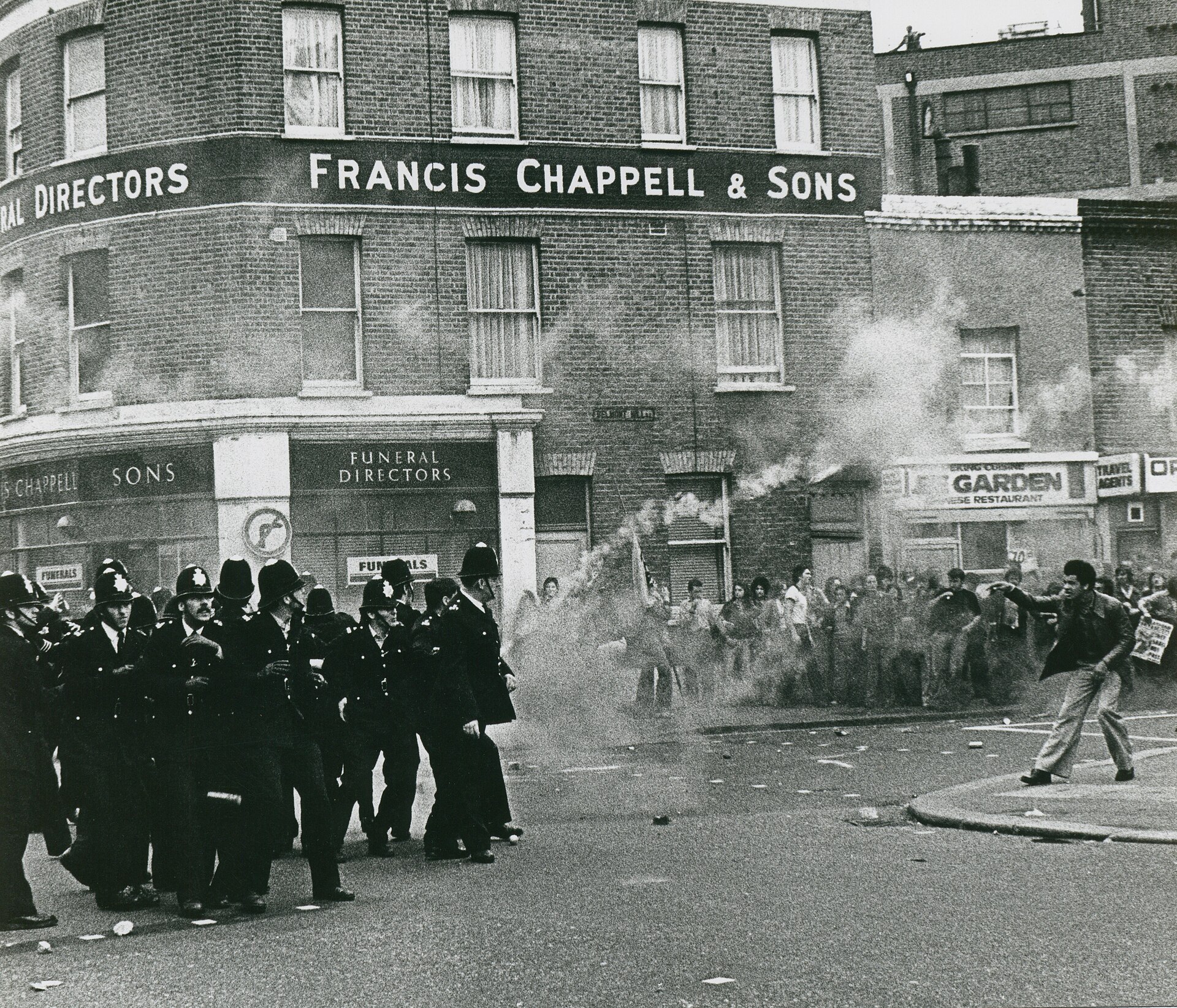
Families, teachers, church groups and political activists were among the people who took to Lewisham’s streets on 13 August 1977. They had a shared objection: the National Front’s attempt to march through an area where Black people had made their homes. For residents, the dispute concerned the streets around their houses and the places where their children grew up. Their presence made opposition to the march a public expression of belonging. 1
Racism and resistance before August 1977
The National Front’s politics threatened that belonging directly. Its programme opposed non-white immigration and called for Black and Asian people to leave Britain. It used elections, newspapers and street demonstrations to build support, presenting minorities as a danger to the country. Marching through their neighbourhoods gave those ideas a physical presence. The People’s History Museum places such marches within a wider campaign of intimidation, in which claims about crime and employment helped the far right recruit supporters. Opposition involved defending neighbours as well as challenging a political party. 2
A local confrontation had developed earlier that summer. On 30 May, police arrested 21 young Black people in connection with alleged street crime. The Lewisham 21 Defence Committee formed in response to the arrests and police methods. Its demonstration in New Cross on 2 July was attacked by National Front supporters. The NF subsequently promoted an August march against mugging, exploiting an already heated dispute in which Black young people’s treatment by the authorities was central. 3
Later recollections describe the pressures behind this mobilisation. Lez Henry, who grew up locally, remembered years of racism from the police as well as the National Front’s presence. At a Goldsmiths discussion in 2015, he also recalled Black young people watching white anti-fascists confront conditions that they themselves had long experienced. His account complicates any picture of a single crowd discovering racism together. Residents brought knowledge of the neighbourhood; visiting campaigners brought their own experience and organisations. Their concerns overlapped without being identical. 4
Different organisations, different strategies
The All Lewisham Campaign Against Racism and Fascism, usually shortened to ALCARAF, brought together a broad alliance. A contemporary leaflet described support extending across party loyalties, churches, trade unions and racial backgrounds. Local Communist Party members helped organise this work and argued for a large peaceful demonstration. They wanted visible opposition broad enough to involve people who would never join a revolutionary party. The campaign’s breadth helped make clear that rejection of the National Front reached well beyond the organised left. 5
Others supported physically blocking the route. The Anti-Racist/Anti-Fascist Co-ordinating Committee backed both ALCARAF’s march and a blockade at Clifton Rise. It belonged to a network of local groups developed after opposition to an NF march at Wood Green earlier in 1977. Women Against Racism and Fascism was among the affiliated organisations. 3
The Socialist Workers Party also mobilised for Clifton Rise. It argued that a demonstration elsewhere could not prevent the NF from establishing a presence in the streets it had chosen. These differences produced real arguments among anti-fascists about confrontation, public support and the dangers of violence. On the day, participation crossed organisational boundaries: some people attended the peaceful march before joining those nearer the NF’s assembly point. Neither gathering can be adequately explained through one party’s membership or instructions. 5
The unsuccessful attempt to prevent the march
Before crowds assembled, opponents sought to have the National Front procession prohibited. Metropolitan Police Commissioner David McNee declined to ban it and successfully resisted a legal challenge. Routes and arrangements for the NF and ALCARAF processions were discussed with police. The central disagreement was already apparent: campaigners regarded the NF’s presence as a threat to the neighbourhood, while the commissioner maintained that the processions could be managed through policing. His decision left residents facing a march they had repeatedly asked the authorities to prevent. 6
The authorities also had advance information about plans for direct confrontation. The Undercover Policing Inquiry’s 2023 interim report describes intelligence about the SWP’s intention to occupy Clifton Rise and obstruct the NF. It records police awareness of substantial local opposition, alongside information gathered by undercover officers inside left-wing organisations. The confrontation therefore developed within an extensively planned police operation. Officials knew that the peaceful counter-march and the proposed blockade had different purposes, even though participants could move between them. 6
From Ladywell Fields to Clifton Rise
On the morning of 13 August, thousands assembled at Ladywell Fields. Speakers included Lewisham’s mayor, Roger Godsiff, and the Bishop of Southwark, Mervyn Stockwood. When police prevented the procession from continuing towards New Cross, some participants made their own way there through the surrounding streets. A second concentration of opposition was already forming around Clifton Rise. 3
Darcus Howe was among those addressing people near the confrontation. Syd Shelton’s photograph, preserved by the National Portrait Gallery, records Howe speaking through a megaphone above a crowd of Black and white participants. Young people stand beside him, while residential buildings fill the background. It places a prominent Black political voice within a gathering that exceeded the boundaries of any single organisation. Howe’s presence also connected the day to the wider Black freedom struggles in which he worked as an activist, writer and broadcaster. 7
Photographer Paul Trevor was at New Cross Road when police charged anti-racists blocking the NF’s route. He later recalled that his camera was damaged as officers cleared the area. His account links the force of the confrontation to the difficulty of recording it: making photographs meant being close enough to be caught in what was happening. Trevor had originally gone to work on a project about Britain’s inner cities, bringing him into a struggle unfolding within the everyday environment he was documenting. 8
Shelton also remembered being knocked to the ground as police horses approached, while continuing to hold his camera. In a later interview, he described a mixture of violence and collective confidence among the NF’s opponents. He stressed that anger at the Metropolitan Police was part of the confrontation. For some participants, police protection of the march could not be separated from their existing experience of racist treatment. The conflict involved relationships that would continue after the visiting marchers had gone. 9
A diverted march and further clashes
The National Front did eventually move under police escort. Counter-demonstrators attacked the procession as it entered New Cross Road, and police separated the opposing groups. Further resistance helped force changes to its route. The NF was directed away from central Lewisham and ended up in a car park in Cressingham Road, where leaders made speeches. Police then escorted supporters towards trains at Lewisham station. The intended procession through the town had been disrupted, although part of the march and a rally had taken place. 10
Confrontation continued around the clock tower and Lewisham High Street. People had gathered expecting the NF to pass through, and some tried to reach its rally after learning of the diversion. Police pushed crowds southwards as clashes developed; vehicles and property were damaged. The NF’s departure did not immediately end the fighting. By late afternoon the main struggle in the streets was between counter-demonstrators and police. 10
Contemporary film records these later confrontations, including police equipped with large riot shields. The change of location and participants matters to understanding the day. A peaceful gathering in Ladywell Fields, attempts to block the NF at New Cross and fighting in Lewisham town centre were connected events with different immediate circumstances. Film made by the Albany Video project preserved evidence of these phases, including the bishop’s address, the escorted procession and the town-centre clashes. 11
Disagreement about responsibility
Arguments about the day continued in Parliament. In February 1978, Home Secretary Merlyn Rees presented Lewisham as disorder caused by opposing extremist groups and affirmed the government’s support for the police. He defended decisions about banning marches being made by police chiefs on public-order grounds. In the same debate, Labour MP John Mendelson challenged the treatment of a march through an immigrant neighbourhood as an ordinary political procession. He argued that an organisation telling residents they should leave was itself creating a danger to the peace. 12
The disagreement persisted. In May 1978, Lewisham West MP Christopher Price argued that accepting local MPs’ request to ban the NF march would have prevented injuries. Home Office minister Shirley Summerskill responded that banning marches was a matter for chief constables. The exchange exposed a continuing division over responsibility. Local representatives had demanded preventative action; ministers defended the allocation of police powers. For those facing racist intimidation, that institutional answer did not resolve the question of who would protect them. 13
Who would tell the story?
The struggle over interpretation also reached photographers. Trevor remembered a woman challenging him about taking pictures during the confrontation. Her question helped inspire a special issue of Camerawork, the magazine produced by the Half Moon Photography Workshop. Its contributors examined the decisions made by photographers and the ways newspapers used their work. Producing the issue allowed people who had been on the streets to discuss the meaning of their photographs and retain a voice in how the event was represented. 8
Four Corners preserves the seventeen-page 1977 issue, Lewisham: What are you taking pictures for? Its contributors included photographers Peter Marlow, Chris Steele-Perkins, Chris Schwarz and Trevor. Derek Boshier contributed design work, while the editorial team included Jan Clarke, Ann Murphy and Shirley Read. Interviews with photographers appeared alongside writing by contributors such as Tom Picton and Maurice Ludmer. These credits make visible the collective work involved in producing a record of the day and examining its representation. 14
Albany Video’s documentary, Aug 13: What Happened?, provided another account. Edited by John White, with camera work credited to Mary Sheridan and Nick Fry, it circulated among anti-racist groups. Its footage and testimony preserved material against which competing descriptions could be considered. The film was later recovered from the Spectacle archive and made accessible through the London Community Video Archive. The survival of this locally produced work widened the historical record beyond newspaper front pages and official reports. 11
A wider anti-racist movement
Campaigning continued beyond Lewisham. The Anti-Nazi League was established in 1977 with the involvement of the SWP, trade union supporters and public figures. It worked with Rock Against Racism, founded the previous year, to reach people through large demonstrations and music. In 1978, their London carnivals brought reggae and punk audiences into a shared anti-racist space. Artists including Steel Pulse, the Clash and Aswad appeared in these events. The continuing organising shows the scale of work required to challenge the far right beyond any single confrontation. 15
Remembering the neighbourhood’s resistance
Public commemoration has brought Lewisham’s history back into the streets where it happened. A council plaque was unveiled on New Cross Road on 13 August 2017, the fortieth anniversary. Walking tours, a screening of the recovered film and a community festival accompanied it. People who had experienced the confrontation contributed their accounts, bringing personal memories into discussion with photographs and moving images. 16
A mural unveiled on Lewisham Way in October 2019 extended that work. Its development drew on collages made by local participants, followed by an advisory group and public consultation. Goldsmiths graduate Ted Low created the design. The process gave residents a role in deciding how a complicated event should occupy public space. Together, these commemorations recognise the people who challenged the National Front while keeping the history open to further testimony from those who lived through it. 17
Sources
1. Lewisham Council — People Power.
2. People’s History Museum — From the collection: British anti-fascism.
3. Goldsmiths, University of London — What was the ‘Battle of Lewisham’?.
4. Samuel Merrill — Lewisham 13th August 1977: The Forgotten Battle?.
6. Undercover Policing Inquiry — Tranche 1 interim report, Chapter 5, paragraphs 15–25.
7. National Portrait Gallery — Darcus Howe (Anti-National Front Demonstration, Lewisham) by Syd Shelton.
8. DACS — Photographer Paul Trevor on documenting city life.
9. Huck — The defiant spirit of the Battle of Lewisham, in photos.
10. Undercover Research Group, Spycops Research — The Battle of Lewisham.
11. London Community Video Archive — Aug 13: What Happened?.
12. UK Parliament, Hansard — Law and Order, 27 February 1978.
13. UK Parliament, Hansard — Metropolitan Police (Injuries from Assault), 4 May 1978.
14. Four Corners Archive — Camerawork Magazine, Issue 08.
15. People’s History Museum — Anti-Nazi League & Carnival, 1978 poster.
16. Goldsmiths, University of London — Plaque commemorating Battle of Lewisham unveiled.
17. Goldsmiths, University of London — Battle of Lewisham public artwork.
Image credit
Police and demonstrators on Lewisham High Street, 13 August 1977. © Frank Duffin, 1977. CC BY 4.0. Wikimedia Commons crop by Salmoonlight; resized version. Image source; CC BY 4.0.





Join the conversation
Comments 0
Share a memory, ask a question or add to this story.
No comments yet. Add your perspective.
Add your voice
Create a free account and verify your email to leave a comment.
All comments are reviewed before publication.