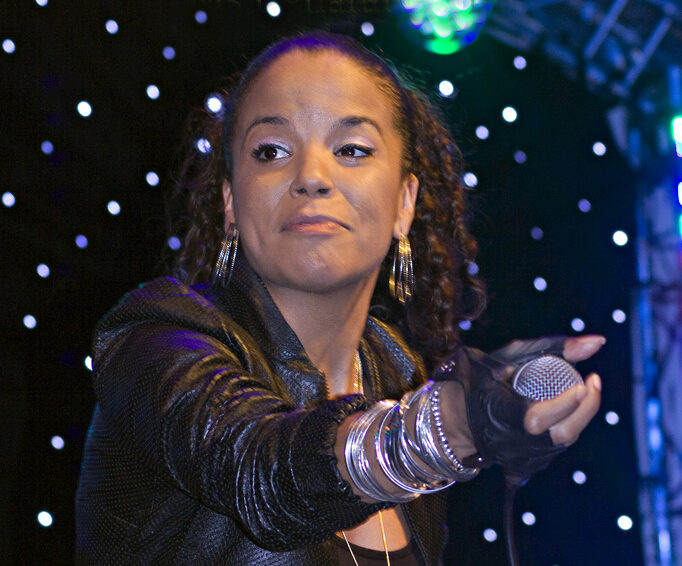
Niomi McLean-Daley was born in London in 1981 to a Scottish mother and Jamaican father. As Ms Dynamite, she emerged from a city where the music heard at home could meet the new sounds of UK garage. The National Portrait Gallery places that background within a longer history of Black British women’s music: a history carried through family listening, individual voices and the audiences who remember them. 1
Finding confidence on the microphone
Her first steps as an MC, delivering words over a DJ’s beats, were informal. Recalling them for The FADER, she described taking a microphone at a friend’s party at seventeen, initially for fun. Within weeks she was appearing on pirate radio. The experience introduced a different kind of musical education: responding to beats, finding a delivery that could hold attention and making herself heard among other performers. It also brought contact with people who recognised something of their own experience in one another, creating a sense of belonging around music. 2
That environment could demand assertiveness. She remembered herself and fellow MC Ms Creation trying to take their place among more than twenty male performers. Confidence was something she developed through participation. Her subject matter was already taking shape, including women’s self-respect and sexual responsibility. Socially conscious writing therefore belonged to her beginnings. Rinse FM’s Sarah Lockhart introduced her to producer Sticky, and a shared enthusiasm for dancehall helped establish the partnership that produced Booo!, the record that carried her voice beyond those early radio circles. 2
Sticky’s recollection of making Booo! puts the relationship between voice and rhythm at the centre of the story. He described responding to the speed and force of her delivery, after which she brought back a vocal idea and he developed the beat around it. The record joined the energy of dancehall with the emerging possibilities of UK garage. It reached number twelve in Britain in 2001, giving a much wider audience an introduction to a performer whose vocal style was already unmistakable. 3
Building A Little Deeper
Her debut album, A Little Deeper, followed in 2002. Its production credits reveal a broader musical team than a simple continuation of the Sticky collaboration. Salaam Remi produced several tracks, including Dy-Na-Mi-Tee, while Punch worked on It Takes More and Sick ’n’ Tired. Bloodshy and Avant also contributed. The credits repeatedly identify Niomi Daley as vocalist and lyricist, making her participation in the writing visible alongside the producers, composers and engineers. A larger production operation gave her several settings in which to develop her songs. 4
The album brought together hip-hop, R&B and Caribbean musical influences, with songs concerned with affection, family, confidence and disappointment. Dy-Na-Mi-Tee draws on her life story; It Takes More and Put Him Out address self-respect and the behaviour expected within relationships. Brother turns towards family experience. These subjects gave listeners ways to connect with her beyond the excitement of her early MC appearances. She could move from a public-facing challenge to a more personal account, allowing the album to introduce several aspects of its writer. 5
Other voices contributed to that range. Keon Bryce appears on Anyway U Want It, and Ky-Mani Marley joins Seed Will Grow. The track credits also show different forms of collaboration behind individual songs: It Takes More combines Punch’s production with additional work by Bloodshy, while Watch Over Them credits Bloodshy and Avant. These details help explain the album as a series of working relationships. Ms Dynamite’s voice and writing provide continuity, while different collaborators contribute to the construction of the recordings around her. 4
An album reaches the wider public
The singles made a clear impact in Britain. It Takes More reached number seven in 2002, Dy-Na-Mi-Tee reached five and Put Him Out reached nineteen. A Little Deeper peaked at number ten and spent 43 weeks on the albums chart. Her debut therefore reached listeners through several records over time. The album had room to circulate beyond a single release, with different songs introducing the singer and writer to people who might never have encountered her on pirate radio. 6
A Little Deeper won the 2002 Mercury Music Prize, making Ms Dynamite the first solo Black woman to receive the award. The nominated albums included work by David Bowie and The Streets. Recognition on that scale gave particular visibility to a young London woman making music across forms often discussed as separate scenes. The achievement also belongs to the album as a whole: the collection of songs, subjects and performances through which she had expanded the possibilities suggested by Booo! 5
At the BRIT Awards in February 2003, she won British Female and British Urban Act. The category names reflect the industry’s language at the time, while the two awards indicate how widely her work was being recognised. She had entered the centre of British pop’s annual celebration with a record shaped by singing, rapping and songwriting. That institutional attention brought another audience into contact with work whose starting points lay in London’s smaller musical networks. 7
She was clear that a broader audience mattered to her. In a 2003 interview with MVRemix, she explained that singing offered a way for her message to reach more people. At the same time, she wanted to continue making garage records for underground circulation because MCing remained something she enjoyed. She described two connected ambitions: reaching listeners through the album and keeping that other musical practice active. Commercial success had enlarged her options, and she wanted to retain the freedom to use them. 8
Music with something to say
Her recordings also became part of collective projects. In 2002, The Reelists featuring Ms Dynamite contributed Back to Life (However Do You Want Me) to War Child’s 1 Love album. Released with NME, the compilation marked fifty years of the magazine and the British singles chart by asking artists to cover favourite number ones. It placed her alongside performers from several musical backgrounds in a shared project for the charity. Revisiting a familiar record offered a way to contribute beyond the promotion of her own debut. 9
Judgement Days followed in 2005, continuing her engagement with public questions as well as personal experience. Put Your Gun Away addressed gun violence. Discussing her work with journalist Will Marlow that year, she said she wrote in response to what she encountered and felt, rather than beginning with a list of issues to cover. Her willingness to release a difficult song depended on the hope that it might be useful to someone. That is a practical account of socially engaged songwriting, grounded in communication with a listener. 10
In the same interview, she argued that young people should be asked what they wanted and needed, with their answers taken seriously. She valued music as a form through which she could speak creatively and directly. The position helps explain the connection between her public voice and the records: she was interested in what people experienced, how they were heard and whether a song could prompt thought. The political concerns grew from that attention to everyday lives. 10
The second album had a shorter chart life than the debut, peaking at number 43; Judgement Day reached number 25 on the singles chart. The difference marks a change in the commercial pace of her career. Later recordings would increasingly arrive through collaborations and individual singles, as new partnerships opened other routes into British dance music. Those releases make it possible to follow her musical development beyond the familiar sequence of debut album, award and follow-up. 6
Back among the beats and basslines
A 2010 interview with DJ Mag captures the pleasure she found in those partnerships. She spoke about working with producers whose music she admired, including Zinc, Redlight, Magnetic Man, Shy FX and Labrinth. Wile Out with Zinc and Wot U Talking About with Redlight belonged to this period of renewed activity. Appearing on other people’s tracks gave her opportunities to try different settings, while performing in clubs brought her into direct contact with audiences responding to the new material as well as Booo! 11
She was also developing Neva Soft with Labrinth. Explaining the track, she connected it with her affection for lovers rock and wanted those influences to shape the feel of the music as well as the words. This was a precise creative choice: older musical attachments could be brought into a contemporary production. Her enthusiasm centred on beats, basslines and the freedom to work with people she respected. The serious writer and the performer who enjoyed a busy dancefloor were both present in that account. 11
Lights On brought her together with Katy B at another important moment for British club music. Discussing the collaboration in 2011, Katy described the song’s connection with the familiar experience of wanting to remain dancing when a night was ending. It reached number four in Britain. On Katy’s debut album, the surrounding work drew on the different backgrounds of producers including Geeneus and Zinc. Ms Dynamite’s contribution belonged within that exchange, connecting an established voice with an artist whose own first album was taking shape. 12
A voice in new musical settings
Her work with Magnetic Man extended the possibilities further. The trio of Artwork, Benga and Skream recorded Fire with her. In a 2011 Red Bull Music Academy discussion, Artwork explained how their studio decisions were influenced by live performance: relatively simple elements could leave more room to change a track on stage. He also emphasised the difference made by having a vocalist physically present, naming Ms Dynamite among those whose appearances changed the show. The collaboration involved the energy of a performer as well as a recorded vocal. 13
At Urban Classic in March 2012, that voice met another kind of ensemble. Ms Dynamite appeared at the Barbican with the BBC Symphony Orchestra, conducted by Jules Buckley, in a programme also featuring Fazer, Skepta and Devlin. A contemporary account by Mixtape Madness describes her performances of Neva Soft, Dy-Na-Mi-Tee and Wile Out, and an audience drawn into dancing by the orchestral version of the latter. Material associated with clubs could work in the concert hall, with live orchestral players taking on the task of carrying its momentum. 14
The review records three restarts of Wile Out, bringing a familiar club practice into the concert hall. A track associated with a producer’s beat was now being carried by musicians playing together under a conductor. Alongside Neva Soft and Dy-Na-Mi-Tee, it brought several chapters of her career onto the same programme. An early album favourite, a later solo recording and a collaboration could each find a place within the orchestral arrangements. 14
Working across generations
Again, released by Clipz in 2020 with Ms Dynamite, Ms Banks and Jaykae, offers another example of how such partnerships develop. Clipz told Link Up TV that his long working relationship with Ms Dynamite helped begin the project. She visited his studio and recorded the chorus; he then continued developing the track before bringing in Ms Banks and travelling to Birmingham to record Jaykae. The musicians’ contributions were assembled over time, held together by a producer’s idea of how their voices could work within a jungle record. 15
Clipz described the process as drawing on his understanding of rap, hip-hop, drum and bass and jungle, then persuading collaborators that the combination could work. Ms Dynamite’s involvement helped turn that intention into a recording. Her career provided the connection through which a new meeting of voices could begin. Following such work reveals a continuing role within British music: an experienced singer and MC whose relationships, judgement and performance could help make another musician’s project possible. 15
Her place within a wider musical history had already been recognised in Sonia Boyce’s Devotional exhibition at the National Portrait Gallery in 2007. The project grew from people naming and remembering Black British women singers, with Ms Dynamite among those represented. Its emphasis was on what listeners remember and pass to one another: names, voices and songs. It placed her within a collective history, made through many careers and sustained through people’s everyday listening. 1
Sources
1. National Portrait Gallery — Sonia Boyce: Devotional (2007).
2. The FADER — In Conversation with the Women of UK Garage (2016).
3. Red Bull — UK dancehall: an oral history, including Sticky.
4. Qobuz / Polydor — A Little Deeper: recording and track credits.
5. ABC Double J — Classic Albums: Ms Dynamite, A Little Deeper.
6. Official Charts — Ms Dynamite: full Official Chart history.
7. BRIT Awards — The BRITs 2003.
8. MVRemix — Ms Dynamite interview (April 2003).
9. War Child — 1 Love: album history and track listing.
10. Will Marlow — total:spec: Ms Dynamite interview (2005), journalist’s archive.
11. DJ Mag — Booming Back Atcha! Ms Dynamite interview (2010).
12. FACT — Five minutes with Katy B (2011).
13. Red Bull Music Academy — Artwork: Madrid 2011 lecture transcript.
14. Mixtape Madness — Urban Classic: eyewitness concert review (4 March 2012).
15. Link Up TV — Get 2 Know: Clipz, interview with Rae Mac (2020).
Image credit
Ms Dynamite at the Flyover Show, 29 May 2010. Photograph: Pedro Kwezi. CC BY 2.0. Existing cropped version from Wikimedia Commons; no further changes. Image source; CC BY 2.0.






Join the conversation
Comments 0
Share a memory, ask a question or add to this story.
No comments yet. Add your perspective.
Add your voice
Create a free account and verify your email to leave a comment.
All comments are reviewed before publication.