Gabrielle arrived in the British charts in 1993 with a song that many listeners still recognise within seconds. Yet Dreams was a beginning, not a complete description of her career. Across changing fashions in pop, she has remained a songwriter and performer whose distinctive voice connects personal feeling with an unusually broad public audience.
A new voice in the summer of 1993
The first weeks of Gabrielle’s recording career are unusually well documented because of the speed at which Dreams took hold. Released in June 1993, the single entered the UK chart at number two and rose to number one the following week. It remained there for three weeks. These figures are useful, but the numbers do not by themselves explain the record. Its appeal lay partly in the contrast between a direct, hopeful song and a vocal performance that sounded lived-in rather than polished into anonymity. Listeners encountered a singer who could suggest hesitation and certainty within the same line, without turning either quality into a theatrical effect.[1]
Before the charts, the song had existed in a different and much quieter form. Gabrielle later recalled writing it as a poem in a small diary, some years before she recorded it. She was living in Brockley, south-east London, and trying to find people who would help her get into a studio. The important point is not that a famous song emerged from a private notebook—many songs begin that way—but that writing came before the machinery of a hit. The lyric expressed a wish to move forward at a time when a professional music career was far from guaranteed. Her account makes Dreams part of a longer apprenticeship in trying, waiting and making work.[2]
A London singer, not a manufactured character
Gabrielle grew up in London, and the music around her helped create an instinctive understanding of several traditions. Her records are often filed under soul, but she has resisted being confined to that description. In a later interview, she recalled her attachment to 1980s pop as well as soul music. That breadth matters when listening again to her early releases. A pop chorus might sit beside an R&B rhythmic arrangement, while the melody allowed the singer to phrase with a freedom familiar from older soul recordings. Rather than pursuing one fashionable sound, she used the range of music she had absorbed to make songs she could inhabit.[3]
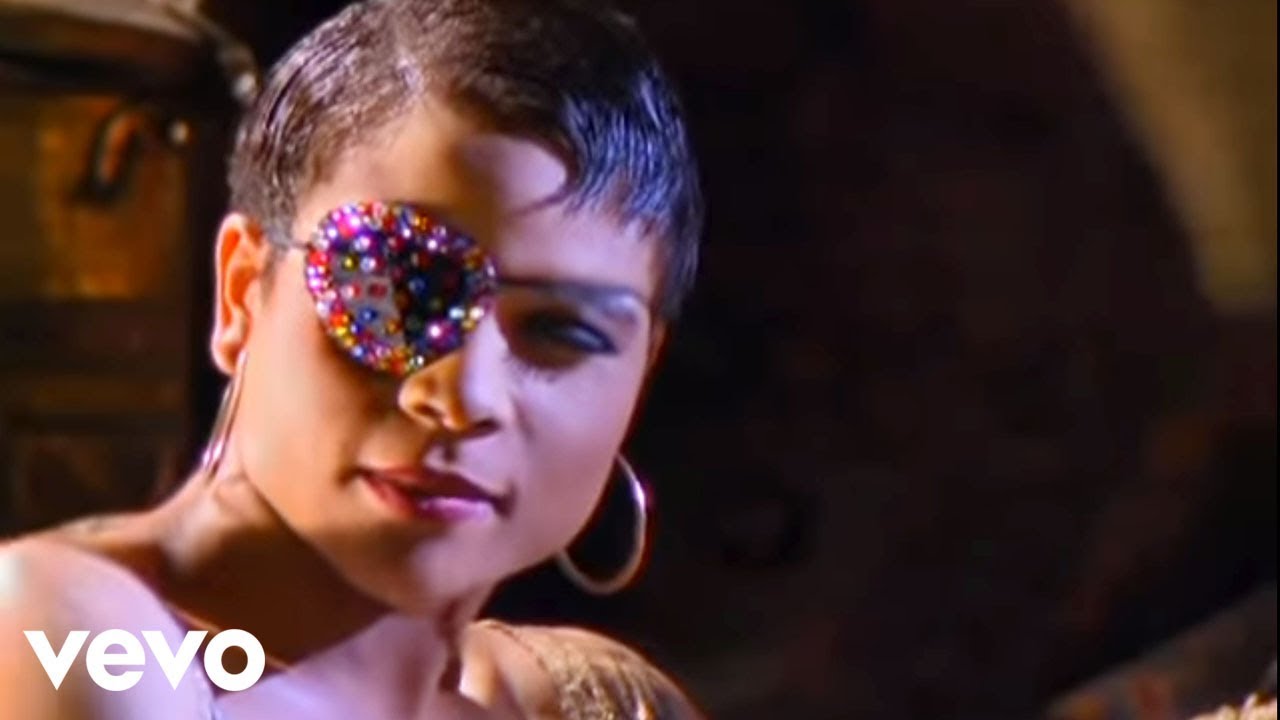
Part of Gabrielle’s public image was formed by the eye patch and hair styling associated with her early appearances. It became an instantly recognisable visual signature, but reducing the singer to that detail misses the choices heard on the records. Her voice is lower and more textured than the bright, agile sound that dominated much early-1990s chart pop. She tends to begin a phrase conversationally, then stretch it without losing the song’s plain meaning. The result can seem effortless, though such directness usually depends on careful decisions about timing, breath and emphasis. Notice, too, how little the best performances insist on a single mood. A bright melodic turn can carry an anxious thought; a slower song can sound resilient without becoming strident. These tensions make the recordings richer than their simplest descriptions and give listeners room to meet the material at different stages of life. The image may have caught attention; the songs are why people kept listening.[4]
Building a catalogue beyond a debut hit
After Dreams came further singles and albums, not an immediate disappearance. The debut album Find Your Way placed the breakthrough in a larger body of material. Later releases, including Going Nowhere, Give Me a Little More Time and the duet If You Ever with East 17, showed how Gabrielle could work with changing production ideas while keeping a recognisable presence at the centre. The Official Charts Company records ten UK top-ten singles across her career. That statistic points to consistency rather than a solitary moment of success. It also shows that her audience was willing to follow her between different kinds of pop recording.[5]
The middle of the 1990s also brought formal recognition. Gabrielle won the BRIT Award for British Female in 1997, the year a large television audience saw the success of women who were changing the sound of commercial radio. Awards do not automatically prove the historical importance of an artist; voting systems and publicity influence them. This one nevertheless marks the degree to which her work had become part of the British mainstream. She was no longer merely a promising newcomer with an unusual voice. She had built a repertoire, an audience and a professional identity that the industry could not treat as a single lucky record.[6]
The writing and production behind *Rise*
The title track of Rise marked another important stage. The single reached number one in Britain in February 2000 and spent two weeks at the top. Its arrangement made use of a musical element associated with Bob Dylan’s Knockin’ on Heaven’s Door, with permission. That detail is sometimes retold as a novelty, yet it reveals something serious about pop writing: familiar musical material can be reorganised so that the emotional direction of a new song is entirely different. Gabrielle’s performance gave Rise a sense of quiet recovery rather than the forceful declaration suggested by its title.[7]
The album of the same name helped establish a broader musical world around her songwriting. Its success was not a replay of the summer of 1993. A singer beginning again with another number-one single might have chosen to repeat her early production almost exactly. Instead, the work was more spacious and mature, allowing uncertainty to sit beside resolve. The first-person voice remains central, but the record is not simply a series of diary entries set to music. Arrangements, co-writing and studio craft turn private emotions into songs that people with very different experiences can recognise as their own. Chart accounts of the period also show how Rise extended her album audience.[8]
Songs that crossed into everyday life
One of Gabrielle’s best-known later songs, Out of Reach, was written for the 2001 film Bridget Jones’s Diary. It peaked at number four in the UK and continued to find listeners outside the cinema. Film songs have a particular difficulty: they must serve a narrative moment while remaining complete enough to stand alone. Out of Reach achieved that balance through a melody and performance that did not depend on knowing the plot. Its treatment of disappointment was restrained. Listeners could bring their own experience to the song rather than being told exactly how to feel.[9]
Her music has also circulated through radio programming, television performances and the shared memories that attach to pop recordings. A listener who first heard Dreams at school may meet it decades later at a wedding, a sporting celebration or a family gathering. Such uses can simplify an artist’s work into nostalgia, but they also provide evidence of a song’s ability to remain available to new generations. This public life of a recording has its own rhythm: a song begins as new material, becomes part of current broadcasting, disappears from some playlists and then returns through films, covers or the listening habits of another generation. The singer cannot control all of those journeys, but can decide how to respond when they happen. The challenge for the singer is to respect the audience’s attachment without allowing it to become the limit of the repertoire. Gabrielle has spoken about accepting that people come to hear the familiar hits, while still wanting them to hear new material.[10]
Stepping back and coming back differently
Following Always in 2007, Gabrielle released less new material for a period. It is tempting to describe a quieter decade as absence, particularly in a music industry that measures visibility by constant promotion. Yet a recording career has periods of writing, family life, touring and decisions about what is worth releasing. Her return with Under My Skin in 2018 demonstrated that a popular singer could return without pretending that no time had passed. The album reached the UK top ten, suggesting an audience interested in a present-tense artist rather than only a collection of remembered singles.[11]
Her 2021 album Do It Again explored songs associated with other writers and performers; A Place in Your Heart, released in 2024, put new compositions at the centre again. She also worked with the younger British singer Mahalia. In an interview about the project, Gabrielle spoke with evident admiration for contemporary artists and described how they met through a concert featuring Adele. This exchange between generations deserves attention. Black British popular music is not a neat procession in which one performer replaces another. Artists listen back, collaborate across age groups and sometimes find that their earliest work has become part of someone else’s musical upbringing.[3]
A live performer with something still to say
A recording can preserve a vocal choice for decades; a concert asks the singer to make that choice again in the present. Gabrielle’s later tours have placed early hits alongside newer songs, testing whether material written in different stages of life can form one coherent evening. Interviews in 2024 described major dates planned for 2025 and reflected on the surprising longevity of her professional life. She did not speak as though success had become routine. Her recollections of the first sudden burst of promotion in 1993 suggest how different it feels to understand a career from inside it, year by year, rather than through a greatest-hits sequence.[12]
There is also a change in the kind of public recognition surrounding her. When younger artists discuss Gabrielle, they can be acknowledging more than a popular record they heard growing up. They may be recognising that a Black British woman with an individual appearance and a singular voice reached large audiences without sounding like a copy of an American star. That does not make her the only person to achieve such a thing, nor does it turn every song into a manifesto. It does explain why the image of Gabrielle singing Dreams continues to mean something in accounts of British music.[13]
The measure of a sustained career
Gabrielle’s career brings together several forms of achievement that are not always considered together: chart success, sustained songwriting, live performance, recording partnerships and an identifiable artistic voice. The records include exhilarating pop moments, reflective ballads and songs whose optimism carries uncertainty beneath it. Her best-known work belongs to the sound of particular decades, but it does not need to be locked there. It remains music that can be replayed without an explanation of the trends that originally surrounded it.
Her story also shows why it is useful to look beyond a singer’s first enormous hit. If the discussion ends with the instant recognition of Dreams, listeners miss the skill needed to follow it, revise an approach, return after a quieter period and continue putting new songs into the world. The enduring achievement is not the absence of change. It is that Gabrielle has carried a recognisable voice through change, finding new settings for it without surrendering the qualities that first made people stop and listen.
Sources and further reading
- Official Charts, *Dreams* chart history
- Songwriting Magazine, how Gabrielle wrote *Dreams*
- Classic Pop, Gabrielle interview on influences and new work
- RETROPOP, Gabrielle on her career and voice
- Official Charts, Gabrielle's full chart history
- The BRIT Awards, winners of 1997
- Official Charts, *Rise* chart history
- Official Charts, Gabrielle's biggest songs
- Official Charts, *Out of Reach* chart history
- The Guardian, readers' questions answered by Gabrielle
- Official Charts, *Under My Skin* chart history
- Greatest Hits Radio, Gabrielle on 1993 and the 2024 album
- The Guardian, Gabrielle's three-decade career and contemporary influence





Join the conversation
Comments 0
Share a memory, ask a question or add to this story.
No comments yet. Add your perspective.
Add your voice
Create a free account and verify your email to leave a comment.
All comments are reviewed before publication.