When Great Britain won the Rugby League World Cup in Lyon in November 1972, the captain holding the trophy was a winger from Cardiff. Clive Sullivan had scored a long-distance try against Australia in the final, bringing his speed to bear on the biggest occasion of his career. His leadership also marked a change in British sporting history: he was the first Black person to captain a team representing Great Britain. The achievement belonged to a player whose route to international rugby had included serious injuries, army service and an opportunity that another club had already passed over. 1
Growing up in Cardiff
Sullivan was born in Splott on 9 April 1943. His father, Charles, had Jamaican origins; his mother, Dorothy, was the daughter of an Antiguan seaman. He attended Moreland Road Primary School before moving with his mother to Ely and going to Herbert Thompson Secondary Modern School. These details place his childhood within Cardiff’s established connections to the Caribbean. His story began in a Welsh family and neighbourhood, years before he became known to crowds in the north of England. The sporting identity he later carried into Great Britain’s team grew from that particular background. 2
Playing professional rugby was far from an obvious prospect. During his teenage years Sullivan underwent operations on his knees, feet and shoulders. Nevertheless, he joined the army in 1961 and played on the wing in military rugby. His early seasons with Hull were interrupted by service commitments, further knee operations and a serious car accident in 1963. He left the army in 1964. The eventual length of his playing career becomes more striking when set beside those interruptions: establishing himself required repeated returns to fitness before he could show what sustained selection might allow him to do. 3
A trial that changed his life
Hull’s club historian Bill Dalton remembered being at the Boulevard for Sullivan’s first-team debut in December 1961. Many spectators had come to see Wilf Rosenberg, a prominent signing from Leeds. Instead, a young trialist on the other wing scored three tries. Sullivan had previously played in a Bradford Northern reserve trial without attracting an offer. Jim Harker, a referee who had served as touch judge, encouraged him to approach Hull and recommended him to the club’s secretary. One person’s attention helped turn an unsuccessful trial elsewhere into a new opportunity. Dalton’s recollection preserves that practical turning point behind the later fame. 4
Sullivan became an exceptionally productive attacking player. Hull FC records credit him with 250 tries in 352 appearances across his spells at the club. His seven tries in a match against Doncaster in 1968 and twenty career hat-tricks also feature in its account of his achievements. Such figures represent repeated contributions over many seasons, rather than one celebrated international performance. Supporters came to know a winger who could turn possession into points with unusual frequency. His standing in Hull rested on the work they watched him do week after week. 5
Black players and the journey north
Sullivan joined a history of Black participation in rugby league that stretched well beyond his own career. Historian Tony Collins identifies Welsh-born players including Roy Francis, Billy Boston and Johnny Freeman among those who established themselves in the professional game. Francis became an influential coach at Hull, while Boston made his career at Wigan and Freeman at Halifax. These journeys connected Welsh communities to northern English towns through employment, sporting skill and family life. Sullivan’s later prominence belonged within that wider movement of players who found opportunities, built reputations and made new homes through rugby league. 6
Public admiration did not remove racism from everyday life. In memories recorded for the African Stories in Hull and East Yorkshire project, Sullivan’s wife Rosalyn described people staring at him and wanting to touch his hair when he first settled in the north. Her own family initially reacted with surprise to their relationship, before getting to know him. She also remembered sensing disapproval when they entered some restaurants and bars together. Her account adds an essential perspective to the sporting record. The couple’s ordinary experiences outside the ground could differ sharply from the welcome a successful player received inside it. 7
Rosalyn also described the demands injuries placed on their lives. Players depended on wages from their day jobs as well as rugby payments, and injury could threaten both incomes. She remembered helping Sullivan through periods when he could not play, massaging injured legs and sometimes running with him while he tested his fitness. Her memories show the support behind his repeated returns to the field. Recovery involved domestic work and encouragement alongside the treatment arranged by the club. 7
Leading Great Britain to the World Cup
Sullivan made his Great Britain debut in 1967. The following year he played in the World Cup and scored a hat-trick against New Zealand. In 1972 he received the captaincy before a series against France, then led the side into that year’s World Cup. His appointment brought responsibility for a team whose success depended on much more than his own running. By then he had accumulated the international experience to accompany the attacking talent that had first brought him to Hull’s attention. 1
Great Britain’s campaign in France began with a 27–21 victory over Australia. A 13–4 win against the hosts followed, before a 53–19 defeat of New Zealand completed an unbeaten group stage. Players from different clubs contributed to that progress: Dennis O’Neill scored in the opening match, while Paul Charlton, Mike Stephenson, George Nicholls and Brian Lockwood appeared throughout the tournament. Remembering those names helps retain the collective character of Sullivan’s achievement. He captained a successful side assembled from the wider rugby league game, with teammates whose contributions made the final possible. 8
The final against Australia ended 10–10, with no further scoring in extra time. Great Britain received the trophy because they had finished above Australia in the group table. Sullivan’s long run to the try line became the match’s enduring image, but the title also depended on the results secured before that day. Describing the final as a draw does not diminish the victory: it explains how the competition was decided. Great Britain were world champions under its rules, and their captain had played a conspicuous part in earning that distinction. 5, 9
Taking the trophy back to work
Stephenson later recalled Sullivan’s influence on the squad’s preparation. If training was scheduled for the morning, the captain would encourage the players to begin earlier. In Stephenson’s account, that example helped create the commitment and team spirit behind the result. Their return received little fanfare. A diverted flight brought the players to Birmingham, where a photographer gathered Sullivan, Stephenson and goal-kicker Terry Clawson for a picture with the trophy. The modest reception stood a long way from the public celebrations usually associated with a major international title. 10
Rosalyn remembered preparing banners in the street, only for her husband to arrive after dark. He brought the World Cup home and took it to work the following day. His factory colleagues therefore encountered the trophy as part of their normal working lives. She stressed that the players had other jobs and were pleased simply to have won. That recollection gives the victory a particular social setting: an international captain could return from the World Cup and resume the employment that helped support his household. 10
A champion on both sides of Hull
In 1974 Sullivan crossed Hull’s sporting divide to join Kingston Rovers. The club was rebuilding after relegation, adding experienced players such as Sullivan and Neil Fox to a side with younger talent. Under captain Roger Millward, Rovers returned to the top division and developed into a stronger force. Their 1977 BBC Floodlit Trophy victory over St Helens formed part of that improvement. Sullivan’s move consequently placed him inside a club’s recovery, bringing the experience of an established international into a team still working towards its most celebrated successes. 11
One arrived at Wembley in 1980, when Hull KR faced Hull FC in the Challenge Cup final. Sullivan was thirty-seven and still seeking his first winner’s medal in the competition. Playing on Rovers’ left wing, he faced the club with which he had made his name. Rovers won 10–5, with Steve Hubbard’s scoring and Millward’s contribution central to the result. For Sullivan, the occasion added a major club honour eight years after his international triumph. His career had continued to produce new achievements well beyond the season for which he would be most widely remembered. 12
Two years later he won the same competition with Hull FC. Following a spell at Oldham, he returned to Hull in a coaching role and was called back into the playing side for the 1982 final replay against Widnes. At thirty-nine, he helped his original club secure the cup. The two victories created a remarkable local distinction: he held Challenge Cup winner’s medals from both sides of the city’s rivalry. Supporters could disagree about almost everything in a derby while finding a substantial part of their own club’s history in the same player. 13
Wales and the final playing years
Sullivan’s international career also included representing Wales in the 1975 World Championship, when England and Wales competed separately. In the match remembered as the Battle of Brisbane, on 10 June, he scored one of Wales’s two tries in a 12–7 win over England. David Watkins captained the side and kicked three goals. The match mattered to the competition’s outcome, with Australia eventually finishing one point above England. It also gave Welsh players a stage on which to represent their own country, even when the opponents included men they knew closely through their club careers. 14
Coaching and occasional playing appearances overlapped in Sullivan’s later career. He took charge at Doncaster in January 1983 and subsequently returned for another spell with Hull FC. His final appearance for Hull came at Bradford in April 1985, when the club needed help during a crowded fixture programme. The great international captain was still available to contribute in whatever role the team required. That late appearance extended a relationship with Hull that had begun with an unknown trialist more than two decades earlier. 4
Sullivan died of liver cancer on 8 October 1985, aged forty-two. A section of the main road into Hull was named Clive Sullivan Way, placing his name in the city’s everyday geography. His son Anthony also became a professional winger, representing Wales in both rugby league and rugby union. The family connection continued, although Anthony’s career belonged to a different period in relations between the two games. 2
Remembering the player in Hull and Cardiff
In 2023 Hull’s Streetlife Museum brought together the Sullivan family, Hull FC, Hull KR and the Hull Roundheads rugby union team for a display about rugby in the city. Rosalyn lent personal possessions, some appearing in public for the first time. Those objects offered another way to encounter a career often reduced to a photograph of the World Cup. They placed Sullivan within local sporting history while preserving the family’s role in deciding how his life would be remembered. The display also connected his story with the continuing development of rugby in Hull. 15
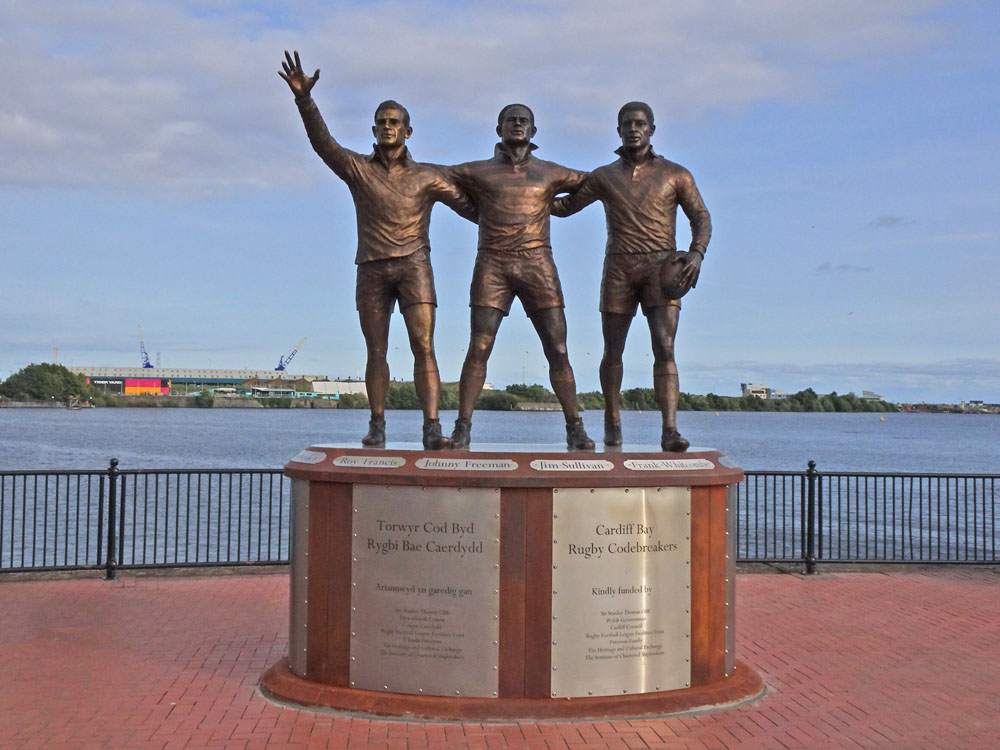
That July, a statue featuring Sullivan, Billy Boston and Gus Risman was unveiled in Cardiff Bay. It recognised three Cardiff players whose rugby league careers had taken them north. Anthony Sullivan attended and spoke about the importance of seeing his father honoured in his home city. Hull had made room for Clive’s name in its roads and sporting traditions; Cardiff now gave his achievement a prominent place in its own public landscape. Between those cities lies the central story of his life: Welsh roots, a long working career in rugby league, and a World Cup won through skill, preparation and collective effort. 16
Sources
1. Rugby Football League — Clive Sullivan factfile.
2. Dictionary of Welsh Biography — Clive Sullivan.
3. Carnegie Heritage Centre — Clive Sullivan MBE.
4. Hull FC — Bill Dalton remembers Clive Sullivan.
5. Hull FC Hall of Fame — Clive Sullivan.
6. Rugby Football League — Tony Collins on the Black pioneers of rugby league.
7. African Stories in Hull and East Yorkshire — Clive Sullivan and Rosalyn’s memories.
8. Rugby Football League — Great Britain’s 1972 World Cup team.
9. National Rugby League — The Foxx’s tale: a kick, a chase, a place in history.
10. The Independent — Mike Stephenson and Ros Sullivan remember the 1972 World Cup.
11. Hull Kingston Rovers — Club history.
12. Rugby Football League — Hull KR and Leigh: Challenge Cup history.
13. Sky Sports — Clive Sullivan, Great Britain’s first Black sports team captain.
14. Wales Rugby League — Fifty years since the Battle of Brisbane.
15. Hull Museums — Clive Sullivan and Rugby in Hull.
16. Wales Rugby League — Codebreakers Statue unveiled in Cardiff Bay.
Image credit
The Rugby Codebreakers monument in Cardiff Bay commemorates Gus Risman, Billy Boston and Clive Sullivan. Photographed in 2023. Sculpture: Steve Winterburn. Photograph: Sionk, via Wikimedia Commons. Image source; CC BY-SA 4.0.






Join the conversation
Comments 0
Share a memory, ask a question or add to this story.
No comments yet. Add your perspective.
Add your voice
Create a free account and verify your email to leave a comment.
All comments are reviewed before publication.