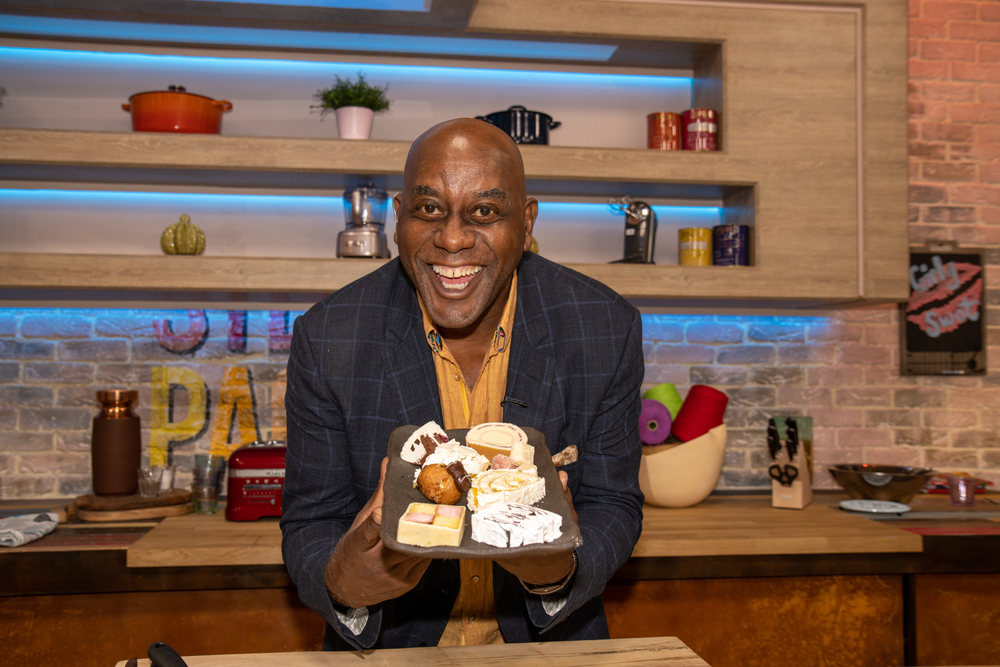
Making the kitchen welcoming
Ainsley Harriott built a television career around an invitation: come into the kitchen and have a go. His best-known programmes, including Can’t Cook, Won’t Cook and Ready Steady Cook, brought professional cooking into contact with people who were learning, improvising or simply enjoying themselves. His official biography records twenty-one series of Ready Steady Cook alongside a substantial career in travel programmes and cookbooks. 1 The cheerful presentation was only the visible part of a job that required culinary knowledge, quick decisions and an ability to keep other people involved.
His place in Black British history belongs partly to that everyday setting. Food television enters homes through familiar routines. A presenter can become a companion while viewers prepare dinner, look after children or take a break. Harriott’s career put a Black British professional at the centre of that relationship, explaining, entertaining and making the next meal seem achievable. It also connects the public world of broadcasting with less celebrated histories of family cooking and hospitality.
London childhood and a Jamaican family kitchen
Harriott was born in Paddington, London, on 28 February 1957. 2 His parents came from Jamaica, and his memories of growing up in Wandsworth are full of food. In an interview with Good Food, he recalled his mother baking cakes, the pleasure of licking mixture from the bowl, and the special shopping trips needed to find yams, green bananas and sweet potatoes. 3
His father, a pianist and singer, enjoyed entertaining friends. His mother prepared marinades while his father took charge of the barbecue. Other family dishes included slowly cooked oxtail and his mother’s red pea stew. These recollections show cooking as an activity shared across the household, with preparation and performance both contributing to the occasion. Harriott also remembered eating noodles and wonton soup with his father after trips to a Soho barber. Chinese food became an important influence on his cooking. 3
The details resist a narrow account of cultural inheritance. His food education included Jamaican family traditions and discoveries made in London. There was room for continuity and curiosity together. Remembering a parent’s stew did not prevent a child from becoming excited about somebody else’s cooking.
Learning a trade and learning to perform
Harriott trained at Westminster College, whose successor, Westminster Kingsway, identifies him among its notable culinary alumni. The college’s Vincent Rooms link hospitality education with cooking and serving paying guests. 14 That connection helps place his career within the practical world of catering. Knowing a recipe is only part of professional work: a kitchen must organise ingredients, manage time and produce food for other people. Television would later turn those demands into entertainment, but the demands themselves were already familiar.
He worked in London hotels and restaurants and became head chef at the Long Room at Lord’s cricket ground. 15 Alongside this career, he performed with Paul Boross as the Calypso Twins, a musical comedy partnership. The duo appeared at venues including the Comedy Store, Jongleurs and the London Palladium, and released the record World Party. Their own account also records appearances in the United States and on television. 5
These were two kinds of public work. A restaurant guest and a comedy audience both notice whether someone can deliver, although they judge different things. Harriott’s later presenting brought the skills together: he could cook while keeping a conversation moving, respond to a mishap and allow another person to remain part of the joke. The entertainer did not replace the trained chef; the two careers supplied different parts of the same television presence.
A familiar face on daytime television
In the early 1990s, Harriott became the resident chef on Good Morning with Anne and Nick. Can’t Cook, Won’t Cook followed as another important part of his television career. 1 Their titles and domestic settings placed cooking close to ordinary viewers. The invitation was not dependent on owning an elaborate kitchen or already knowing the language of restaurant menus.
Ready Steady Cook first appeared in 1994 with Fern Britton as presenter. Harriott later took over the hosting role, presenting from 2000 until 2010. 67 Its recognisable red tomato and green pepper teams paired chefs with contestants and turned bags of ingredients into a timed challenge. The central cooking round allowed twenty minutes. The appeal lay partly in the transformation: a handful of purchases could become several dishes through skill, timing and invention. 6
For the host, the challenge was to make that process legible. Viewers needed to understand what the chefs were doing while the contestants remained involved and the programme kept moving. An engaging manner served a practical purpose, making expertise feel approachable. The format could also reveal that cooking involved adjustments and choices rather than simply following instructions without deviation.
Its return in 2020 with Rylan Clark-Neal showed the durability of the idea, while changes around packaging, leftovers and sourcing reflected newer expectations of a food programme. 7 Harriott’s years remain a substantial chapter within that longer programme history, rather than its entire history.
Recipes beyond the television screen
Cookbooks gave viewers a way to continue after a programme finished. Harriott’s titles include Meals in Minutes, Barbecue Bible and Friends and Family, while his official biography reports sales of more than two million books worldwide. 1 The themes are revealing: cooking quickly, feeding visitors and making gatherings enjoyable recur alongside recipes from particular places.
His name also became a food brand. The Ainsley Foods range has included flavoured couscous, soups and Caribbean-inspired products. 13 This is another part of the professional story, linking a recognisable presenter with products bought for everyday meals. It should be understood as a commercial enterprise as well as an extension of his public identity. A supermarket packet offers a different experience from learning a recipe, but both depend on whether people trust the name attached to them.
The movement between broadcasting, publishing and retail illustrates how a cook’s work can circulate. One programme can prompt a purchase, a book can outlast the series that accompanied it, and a familiar name can reach people who never watched the original broadcasts.
Returning to Caribbean food
Ainsley’s Caribbean Kitchen, published in 2019 alongside the television series, brought family connections and professional cooking into the same project. The book contained more than eighty dishes. Its range included fish, vegetables, fruit, puddings and drinks as well as jerk chicken. One recipe combined cauliflower with black beans and coconut; another paired snapper with okra. A rum punch associated with his mother connected the collection explicitly with family memory. 8
That range matters because a regional food culture can easily be reduced to its most familiar restaurant dish. A collection with vegetables, seafood and desserts gives a home cook more ways to approach it. It also allows inheritance to be active: something cooked, adapted and shared in a present-day kitchen. Harriott’s family background gave the project a personal connection, while his professional role required him to explain the food to people with very different experiences.
The result belongs to a broader question about how culture is passed on. A recipe can carry the memory of a person or place without requiring every cook to have the same background. Preparing it becomes an encounter, with room to ask where ingredients come from and how a dish acquired its meaning.
A family history with difficult discoveries
Harriott’s appearance on Who Do You Think You Are? opened a different route into the Caribbean past. The programme’s family research challenged an inherited story about Indian ancestry. Records instead revealed Catherine Smith, born into slavery in 1831, and her parents, Joan Davy and Jonathan Briggs, a white overseer. Another branch led to James Gordon Harriott, an ancestor involved in the trade in enslaved people. 10
The investigation also followed his great-grandfather Ebenezer Harriott, a soldier in the British West India Regiment who served in Sierra Leone during the suppression of resistance to colonial taxation. 10 These findings made the family story more complicated than a simple journey from one national identity to another. Enslavement, military service and imperial power could appear within the same ancestry.
Family history of this kind is not a test that awards or removes someone’s right to belong. Its value is in bringing particular people back into view and asking what conditions shaped their lives. The discoveries also show why oral accounts and documentary evidence need to be read together. A remembered explanation may be meaningful within a family while still requiring revision when records reveal something different.
Curiosity across the Mediterranean
Harriott’s cooking has never been confined to a single region. Ainsley’s Mediterranean Cookbook appeared in March 2020, accompanying a ten-part ITV series that travelled through Spain, Sardinia, Corsica, Morocco and Jordan. The publisher’s description places straightforward salads and dips alongside pasta, fish, meat and vegetarian dishes. Its recipes include a mint omelette from Corsica and a vegetable tagine, suggesting different routes into the food of the region. 9
The geographical range encourages a view of the Mediterranean as a place of contact across Europe, Africa and the Middle East. For viewers, the useful part is not simply seeing somewhere attractive. Food offers a way to pay attention: to an ingredient, a technique, a market or the person explaining a local custom. A successful cookery journey gives its audience something specific to notice and something practical to try.
This approach also makes sense beside his London childhood. The remembered excitement of discovering Chinese dishes with his father and the later work of introducing unfamiliar recipes belong to a similar habit of curiosity.
Kitchen gardens and British places
In 2024, Ainsley’s National Trust Cook Off placed him in the kitchen gardens of Blickling in Norfolk, Wimpole in Cambridgeshire and Tyntesfield in Somerset. The ten-part series brought guest chefs into outdoor cooking challenges using produce from the gardens. Staff and volunteers formed part of the programme’s setting and work. 11
The format connected the finished dish with the work before it: growing, tending and harvesting. It also put Harriott in a familiar role as a host who could introduce other people’s knowledge. A garden is a different kind of source from a bag of ingredients brought into a studio, yet both invite the cook to respond to what is available.
These programmes also belong in an account of Black British cultural life because they concern shared national spaces. A Black presenter exploring gardens and regional food need not explain his presence as an exception. He can lead the encounter through professional interest, asking the questions and inviting an audience to follow.
Continuing the journey
A further series, Ainsley’s Taste of the Bahamas, began in January 2026. Announced as ten programmes, it included Nassau and Paradise Island and encounters with chefs, farmers, fishers and artisans. Its stated range extended beyond recipes to mangroves, reefs, aquaponics and local celebrations. 12 This broadened the setting around the plate, placing food beside environments and the people whose work sustains it.
The continuity is in the way Harriott approaches an audience. Whether the setting is a studio, a garden or an island, the presenter needs to make a meeting intelligible and enjoyable. Travel television can turn people into scenery; giving cooks and producers something to explain offers a more useful exchange. His later programmes provide material for that exchange while extending a career well beyond the daytime series that first made him familiar.
Recognition and everyday cultural influence
Harriott received his MBE at Buckingham Palace on 5 March 2020 for services to broadcasting and the culinary arts. His response credited the people who had helped him and remembered his mother. 14 The wording of the honour fits a career in which cooking and communication are inseparable: knowing how to make food and knowing how to bring an audience with him.
His historical significance is found in that combination. The family cook, catering student, working chef, comic performer, television host and businessman are all parts of the story. Reducing him to an infectious laugh would obscure the labour that made the performances possible. Reducing him to a symbolic first would miss the specific pleasures and skills through which audiences came to know him.
Harriott’s career gives everyday life its proper place in cultural history. Meals carry memories, television creates familiar company, and practical advice can help someone feel capable of doing something new. A Black British life can shape those ordinary experiences over decades. That influence is modest in any single kitchen and substantial when viewed across a long working life.
Sources
[1] Ainsley Harriott official website. Biography Ainsley’s Story.
[2] Wikipedia. Ainsley Harriott; Living biography checked October 2026.
[3] Good Food. Food milestones Ainsley Harriott; Undated interview.
[4] Capital City College. The Vincent Rooms launches new look with star chef Michel Roux Jr; 7 May 2025.
[5] The Calypso Twins. The Calypso Twins official biography.
[6] Radio Times. When is Ready Steady Cook on TV Who is hosting and who are the chefs; 2 March 2020.
[7] Radio Times. Ready Steady Cook promises to be one of the most sustainable food shows on TV; 30 December 2019.
[8] Ainsley Harriott official website. Ainsley’s Caribbean Kitchen; 30 July 2019.
[9] Penguin Ebury Press. Ainsley’s Mediterranean Cookbook; 26 March 2020.
[10] Who Do You Think You Are Magazine. Ainsley Harriott Who Do You Think You Are; 26 February 2021.
[11] Ainsley Harriott official website. Ainsley’s National Trust Cook Off starts from Saturday 18th May; 14 May 2024.
[12] Ainsley Harriott official website. Ainsley’s Taste of the Bahamas comes to ITV in the New Year; 17 December 2025.
[13] Ainsley Harriott official website. Ainsley Foods; Undated current range.
[14] Ainsley Harriott official website. Ainsley is awarded his MBE by HRH Prince Charles at Buckingham Palace; 6 March 2020.
Sources checked on 22 October 2026.






Join the conversation
Comments 0
Share a memory, ask a question or add to this story.
No comments yet. Add your perspective.
Add your voice
Create a free account and verify your email to leave a comment.
All comments are reviewed before publication.