Frank Crichlow helped make a restaurant useful to a whole neighbourhood. At the Mangrove, food and conversation developed into a wider network of practical support. Its associated projects included housing for Black pensioners, opportunities for local artists and Carnival activities. Those initiatives show the range of his work: people needed somewhere to enjoy themselves, but also somewhere from which they could improve the conditions of their lives. The restaurant became famous through its battles with the police; the community around it had many other reasons to value it. 1
From Trinidad to west London
Frank Gilbert Crichlow was born in Port of Spain, Trinidad, in 1932 and arrived in England aboard the SS Colombie in June 1953. Settling in Paddington, he worked for British Rail. Music offered another route: he formed the Starlight Four in 1956, and the group made radio and television appearances. Its earnings helped him open the El Rio café on Westbourne Park Road in 1959. 2
Looking back in an interview with Hassan Mahamdallie, Crichlow remembered learning from Caribbean men who had remained in Britain after the Second World War. They understood the importance of places where newcomers could find one another. People arriving from different islands met in clubs and cafés, compared experiences and established friendships. Exclusion from accommodation or hostility in a shop could become something to discuss with others, sometimes with humour. These conversations helped people make sense of the society in which they were trying to settle. 3
The Rio opened after the racist violence in Notting Hill in 1958. Crichlow recalled an all-night coffee bar where Caribbean customers mixed with local white residents, writers and musicians. People arrived after the West End clubs had closed. Alongside its social life, the café heard accounts of arrests and mistreatment. Crichlow remembered contacting a solicitor willing to explain what people should do if arrested. Running a welcoming business was drawing him into the problems customers brought through its door. 3
Turning contacts into practical help
This work developed through relationships between residents, campaigners and sympathetic professionals. Historian Kate Bradley traces the founding of Defence, a legal-support project, to a meeting hosted by Crichlow at the Rio in the 1960s. Its committee included Courtney Tulloch, Michael X and the writer Colin MacInnes. Tulloch handled much of the work of arranging lawyers and finding people who could provide bail sureties. A telephone line made the service available around the clock, when an arrest or another urgent problem could not wait for ordinary office hours. 4
The arrangement joined local knowledge to specialist help. Someone who distrusted the police, or had never dealt with a solicitor, could approach a familiar person first. The cafés supplied contact points through which that help could be found. Defence itself was short-lived, but it belonged to a developing practice of making legal assistance accessible through the places and relationships people already used. Crichlow helped provide the setting in which those connections could become organised work. 4
The Mangrove and its newspaper
In 1968, Crichlow opened the Mangrove at 8 All Saints Road. It offered Caribbean food and became a meeting place for neighbours, political activists and visitors. The National Archives describes its combination of eating, socialising, political discussion and mutual support. The business also faced repeated police raids supposedly looking for drugs, which produced no evidence. In December 1969, its permission to operate as an all-night restaurant was revoked. The ability to keep a business open, and to gather there without disruption, became a matter of public dispute. 5
The Mangrove also provided a base for Hustler, a Black community newspaper first published in May 1968 and initially edited by Courtney Tulloch. Crichlow encouraged the project, and Darcus Howe, who worked at the restaurant, contributed to later issues. The paper connected the immediate concerns of west London residents with wider Black political debates. News could circulate through a publication produced within the community, alongside the conversations taking place over food and coffee. 6
A surviving issue contains reports about housing, employment discrimination and racist attacks, as well as international cultural and political coverage. It also carried advertisements, a crossword and other familiar newspaper features. Housing advice from solicitor Bruce Douglas-Mann sat within this mixture. Hustler’s readers were being addressed as people with ordinary interests and practical needs, as well as political grievances. Crichlow’s premises helped make space for that fuller account of Black life. 6
The protest and the Mangrove Nine
Crichlow complained to the Race Relations Board about discrimination, while supporters formed an Action Committee for the Defence of the Mangrove. On 9 August 1970, demonstrators marched against the treatment of the restaurant. A large police presence accompanied them, and confrontations and arrests followed. Nine people, including Crichlow, subsequently faced serious charges. What had begun as a demand to stop the raids became a test of whether the protesters’ own account of events would be heard in court. 5
The Old Bailey trial lasted 55 days and ended in December 1971. All nine defendants were cleared of the principal charge of inciting a riot. Four received suspended sentences for lesser offences; Crichlow was among the five acquitted of everything. The proceedings brought police racism under sustained public scrutiny, and the judge acknowledged evidence of racial hatred within the force. The outcome was a major victory, achieved collectively by defendants and supporters who had challenged the account presented against them. 7
Community work beyond the courtroom
The Mangrove’s associated work reached into needs that a court victory could not resolve. Children of the Mangrove, a later social-care organisation inspired by the original community, records a supported-housing project for Black pensioners and a T-shirt printing venture providing opportunities for local artists. Alongside the steel and masquerade bands, such initiatives connected creativity with employment, care and belonging. Crichlow worked with others to turn the relationships around a restaurant into resources that people could use at different stages of life. 1
Lee Jasper, who worked at the Mangrove for years, remembered a team that included Jebb Johnson, Carol Scott, Trevor Carter and the doctor Richard Stone. In his account, the work involved building alliances and learning how to challenge injustice. The community association took part in anti-apartheid campaigning and supported liberation struggles overseas. Its outlook connected problems encountered in west London with questions of power elsewhere, while its daily work continued to depend on people prepared to help one another locally. 8
Jasper described Crichlow as an important political teacher. The learning happened through working together: pursuing cases, dealing with institutions and considering how support could be widened. This helps explain his influence on younger activists. It did not depend on holding a prominent public office. People learned from his persistence, his contacts and the expectation that someone facing a difficulty should be able to find others willing to stand alongside them. 8
Carnival and the sound of belonging
The Mangrove name also became part of Britain’s musical life. Mangrove Steelband’s own history dates its establishment on All Saints Road to 1980 and places its origins within the restaurant and community association’s world of activism and cultural expression. The band offered an outlet for Caribbean traditions of steelpan and masquerade. Experienced musicians and people new to the instrument could participate in a shared undertaking. Cultural activity gave the community a public presence sustained through rehearsal, learning and performance. 9
The band’s account describes the effort behind Panorama, the major competition associated with Carnival: a larger ensemble assembled for intensive summer rehearsals, bringing together players with different experience and abilities. That required listening, cooperation and commitment. Such work extended the Mangrove’s possibilities beyond the restaurant itself. Its name could be heard and seen in a musical setting, carrying an association with a neighbourhood and its struggles while providing enjoyment and opportunities to develop a skill. 9
Crichlow remained involved in debates about Carnival’s future. A radio report broadcast on 25 August 1989 included him among the people interviewed during a dispute about its organisation, commercial priorities and the influence of funders and police. The argument concerned who would shape an event rooted in community participation. His involvement placed him within those continuing negotiations over culture and public space. 10
Further cases and the cost of resistance
The 1971 acquittal did not end his encounters with the criminal courts. A major later case followed a police raid on the Mangrove in May 1988. Crichlow alleged that officers had planted drugs. He spent five weeks in custody and was subsequently tried. Contemporary reporting in Statewatch records his acquittal of all charges in June 1989. The proceedings placed his liberty and livelihood at risk for more than a year. 11
The pressures also affected the association’s wider work. In April–May 1991, the campaigning magazine CARF reported that policing had deterred customers and that charities interested in supporting community projects had been approached by police. Its report described correspondence urging the local authority to withdraw funding. Solicitor Gareth Peirce linked these pressures to an effort to undermine the restaurant. The account shows why those defending Crichlow also worried about the survival of an organisation on which other people depended. 12
CARF reported that the restaurant had been sold at auction after mortgage arrears and that the association was seeking new premises. It also described the damaging effect of bail conditions preventing Crichlow from going to the area while the case was pending. The business had relied heavily on his presence and energy. Even after an acquittal, customers, income and working arrangements could not simply be restored. Crichlow appealed for support from a community to which the Mangrove had contributed over many years. 12
In 1992, he accepted £50,000 plus costs from the Metropolitan Police to settle his civil action for false imprisonment, assault and battery, and malicious prosecution. The civil action followed his acquittal and sought compensation for his treatment. Its financial value could not undo the disruption already experienced by Crichlow, the business and those connected with it. His resistance had continued well beyond the celebrated Mangrove Nine trial. 11
Remembering the man and the work
Some of the movement’s own record was made while the outcome of the original trial remained uncertain. John La Rose and Franco Rosso’s 1973 documentary The Mangrove Nine includes interviews recorded before the verdicts. It preserved the voices of defendants speaking about their experiences, giving later audiences access to their arguments and concerns. The film forms part of a history recorded by people close to the struggle, alongside the official papers produced about it. 7
In 2020, Shaun Parkes portrayed Crichlow in Mangrove, part of Steve McQueen’s Small Axe films. Discussing the project with historian David Olusoga, McQueen described the urgency of recording stories while people who remembered them were still alive. The dramatisation brought Crichlow’s name to audiences who might know little about the restaurant or the campaign. His life also reaches beyond the film’s central events, into the years of work that made him someone neighbours and activists repeatedly turned to. 13
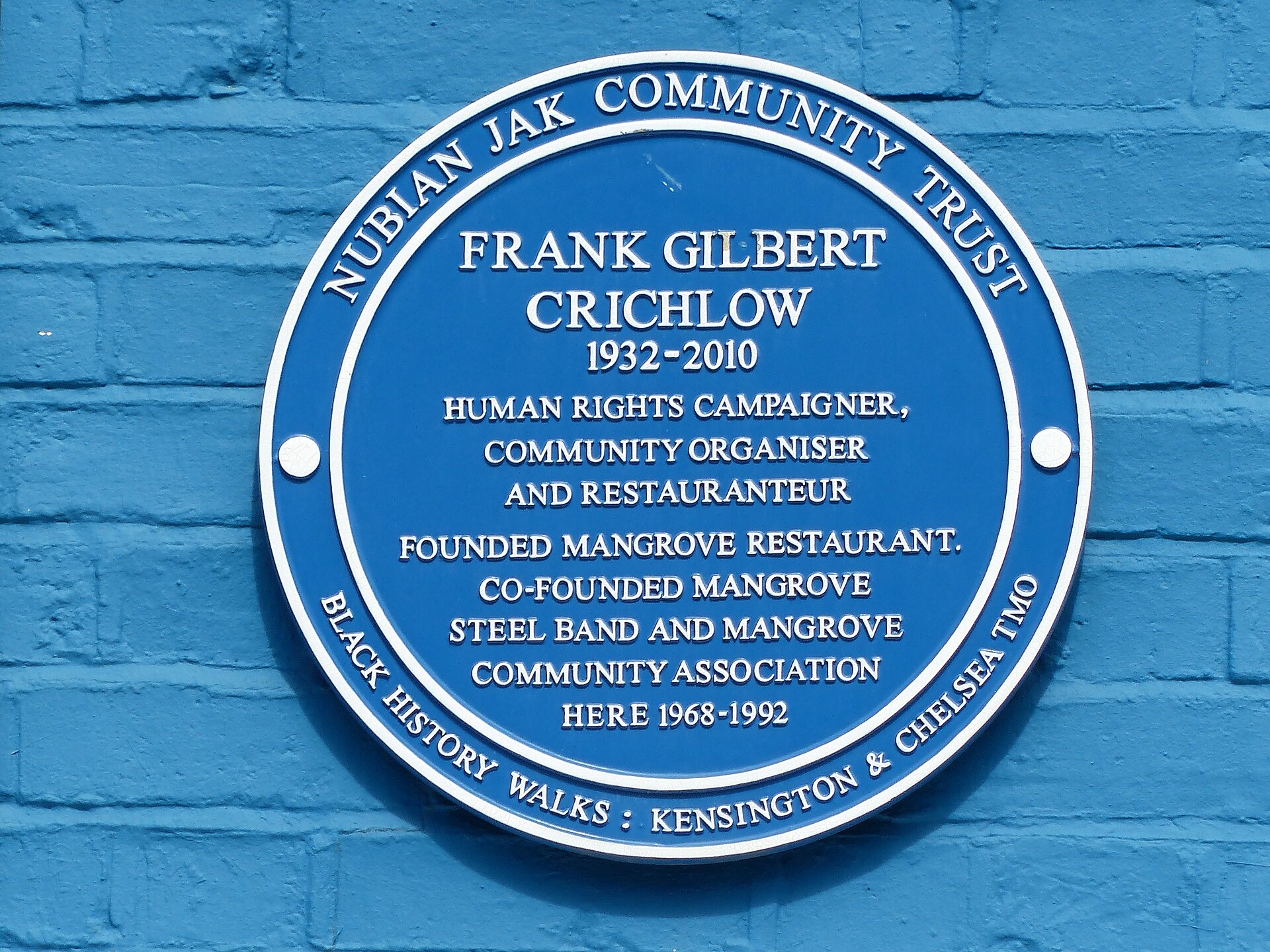
A blue plaque unveiled in December 2011 at the former restaurant commemorates Crichlow as a campaigner, community organiser and restaurateur, and credits his contribution to the steelband and association. Those roles belong together. Remembering the food, music and practical help alongside the confrontations with authority gives a fuller account of the man, and of the many ways a community maintained its life. 14
Crichlow died in 2010. His archive at Bishopsgate Institute contains correspondence, photographs, witness statements, legal papers and material about community activism and Carnival. It preserves the evidence of a life spent making connections and defending what people had built together. Through those records, his place in Black British history can be understood in the work itself, as well as in the trials that made national news. 2
Sources
1. Children of the Mangrove — History.
2. Bishopsgate Institute — Frank Crichlow Archive.
3. Lives Retold — Frank Crichlow: interview by Hassan Mahamdallie.
5. The National Archives — The Mangrove Nine: Resource Pack.
6. John Rylands Library — Hustler: Black Power, Mangrove and the Notting Hill Carnival.
7. George Padmore Institute — Mangrove Nine Documentary (1973).
8. Operation Black Vote — Lee Jasper: Frank Crichlow, founder of Mangrove Community Association.
9. Mangrove Steelband — History.
10. Learning on Screen, LBC/IRN — Notting Hill Carnival organisational row erupts, 25 August 1989.
11. Statewatch — Damages for Frank Crichlow, November–December 1992.
12. Campaign Against Racism and Fascism — Mangrove: Down but Not Out, April–May 1991, page 13.
13. BFI, Sight and Sound — David Olusoga interviews Steve McQueen on Small Axe.
14. London Remembers — Frank Crichlow plaque.
Image credit
Plaque commemorating Frank Crichlow at the former Mangrove restaurant in Notting Hill, photographed in 2020. Photograph: Megalit, 2020. CC BY-SA 4.0. Wikimedia Commons; resized version. Image source; CC BY-SA 4.0.






Join the conversation
Comments 0
Share a memory, ask a question or add to this story.
No comments yet. Add your perspective.
Add your voice
Create a free account and verify your email to leave a comment.
All comments are reviewed before publication.