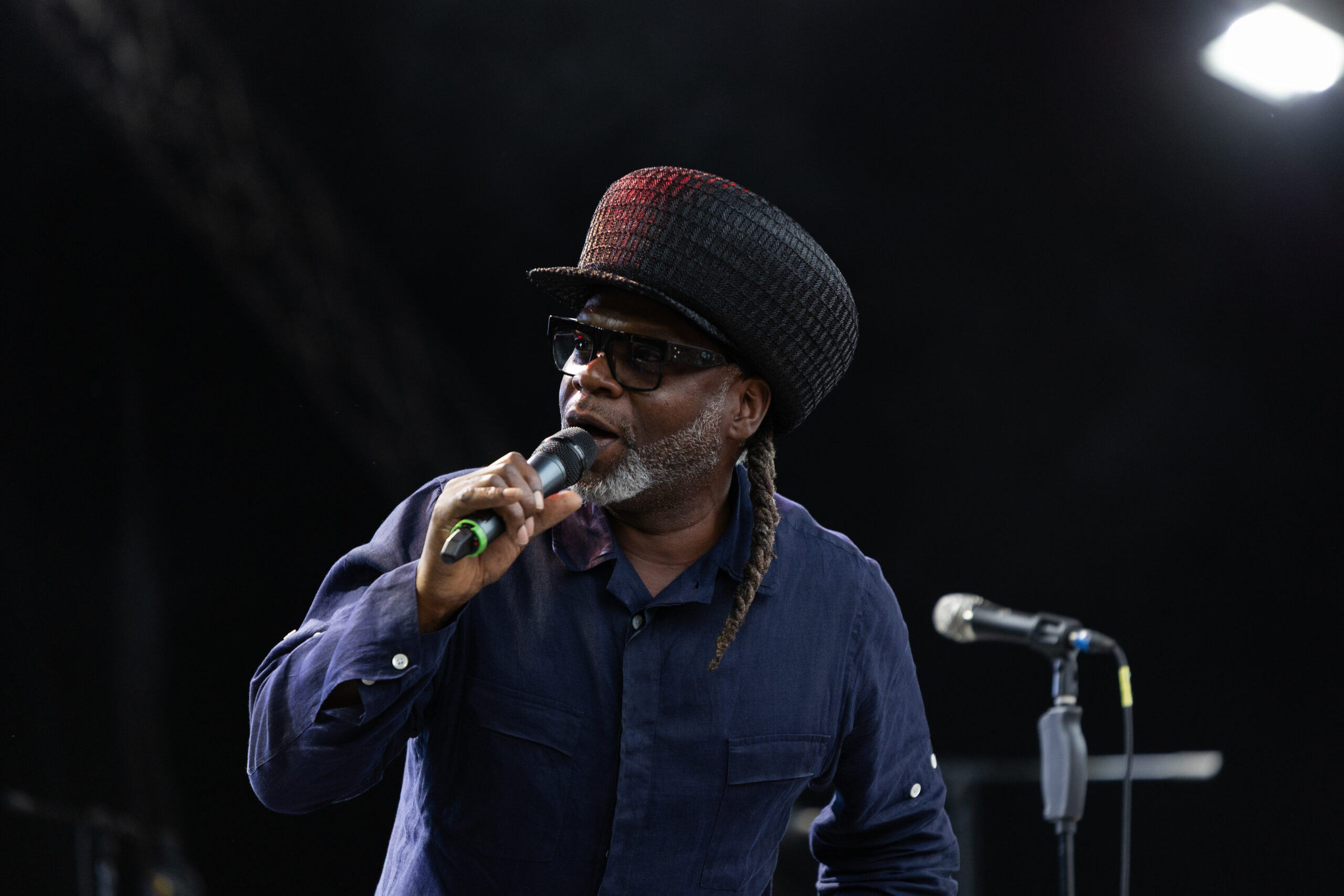
Before Soul II Soul became a name on record sleeves, it named a way of bringing people together. There were speakers to build, dances to organise and records to choose. Later came clothing, shops, studio sessions and international tours. Jazzie B connected these activities through an understanding of an audience: how people wanted to dance, what they wore and the atmosphere that made them return. Making the music and building a place around it were part of the same task. 1
A musical education in north London
Born Trevor Beresford Romeo in Hornsey in 1963, Jazzie B grew up in a large family with Antiguan parents. He was the ninth of ten children. The sounds around that household gave him an early connection to Caribbean music and to the people who organised its public life in London. 2, 12
Several of his brothers ran sound systems. As a boy, he helped carry the valves used in their amplifiers, acquiring responsibilities before he was old enough to run a dance himself. In a 2010 Red Bull Music Academy lecture, he remembered church halls hosting celebrations, parties and other gatherings, with music running through community life. A sound system demanded equipment, records and people prepared to transport, assemble and operate them. His account makes the apprenticeship tangible: he encountered music through the labour that allowed other people to hear it. Knowledge passed between relatives, musicians and technically minded enthusiasts. 3
He also grew up negotiating racism. Recalling his years at Holloway Boys’ School, he told the Big Issue that police repeatedly stopped him. On one occasion, officers treated a plugboard he was carrying for his sound system as a possible weapon. He also remembered encouragement from community institutions, including the Black House youth project on Holloway Road. Such places offered friendships, activity and room for ambition during years when his surroundings could be hostile. 4
Learning what makes a system work
With school friend Daddae, also known as Philip Harvey, he began running the reggae sound Jah Rico. Their interests widened towards soul and funk, and the partnership developed into Soul II Soul. The name expressed their musical direction and their connection to one another. Their early activity involved the practical improvisation of young operators getting equipment to dances, while paid employment helped support the music. 1
Studio work provided another education. Jazzie later recalled working at Tommy Steele’s studio near Marble Arch and gaining an engineering credit on Kandidate’s Can’t Say Bye in 1982. He applied what he learnt to his sound system, moving between recording sessions and dance nights. Those circuits also connected him with Bristol’s Wild Bunch, including Nellee Hooper. Equipment and expertise travelled alongside records: musicians who would later become known through different groups were already exchanging ideas and sharing systems. 5
His technical interests were precise. Speaking to Music Technology in 1989, he discussed speaker cabinets, cable lengths, cartridges and the challenge of making a studio recording work through a powerful club system. Technician Bruce Francis had built his first system and continued maintaining it. Jazzie understood that a record passed through several stages before reaching a dancer: recording, mixing, cutting and playback. A weakness at any stage could alter its impact. This attention to reproduction helps explain why the equipment mattered so much to his identity as a music maker. 6
Jazzie and Hooper established Silent Productions, the partnership behind their work on Club Classics. In that contemporary interview, Jazzie credited Hooper with encouraging him to make the move into recording. Their first encounter, at a sound clash, had involved friction over a booking; friendship and collaboration followed. Working together brought their different experiences into the studio. Hooper held a substantial creative role within a partnership formed in the competitive but interconnected world from which both had emerged. 6
The Africa Centre and a room of possibilities
The Africa Centre in Covent Garden became a crucial meeting place. Opened to the public in 1964 at 38 King Street, it supported cultural and political exchange between Africa and Britain. Its history includes writers, artists, activists and musicians, and it identifies Soul II Soul among those whose work developed there. The collective’s presence belongs within that wider story of people of African descent making places for themselves in London. A venue could provide continuity: somewhere to meet again, introduce friends and turn an occasional encounter into a working relationship. 7
Soul II Soul’s Sunday sessions gave that continuity a particular musical shape. Jazzie has described choosing the venue for its sprung dancefloor, its balcony and its central location. The choice of Sunday also helped establish the atmosphere he wanted. His account emphasises the dancers and the mixture of people who came, including future collaborators. The room allowed music to be tested in front of listeners who responded physically and returned week after week. 8
A recognisable visual identity grew alongside the music. Clothing carrying the Funki Dred style was sold through the collective’s shops and became associated with late 1980s and 1990s club culture. It gave people another way to identify with Soul II Soul between dances. Music, clothes and social life reinforced one another, extending the collective’s presence beyond the hours when its speakers were switched on. 2
Fairplay: taking the dance onto a record
Fairplay emerged from the practice of making exclusive recordings for a sound system. Jazzie has described its groove accompanying live microphone contributions from Rose Windross, who sang about the Sunday sessions. Releasing this material changed its reach. A recording once associated with the collective’s own repertoire could now be played by other DJs. His ambition was expansive: spreading Soul II Soul’s records would carry its sound into places its own equipment could never reach. The deal with Virgin subsidiary Ten Records grew from activity that already had an audience. 8
Windross was a creative participant in that process. Her own account identifies her as a singer and songwriter on Fairplay, and places the recording at the beginning of Soul II Soul’s public story. The song appeared on Club Classics Vol. One, which reached the Americas under the title Keep On Movin’. Windross also returned to perform with the collective, singing its catalogue for audiences across Europe and further afield. Her involvement extended from creating an early signature song to helping carry that repertoire onto international stages. 9
Simon Law’s route into the group also began on the dancefloor. A regular at the Africa Centre, he became a friend and collaborator of Jazzie’s. His musical background included childhood in Trinidad and singing as head chorister at Hereford Cathedral. He brought that experience into the collective’s songwriting and musicianship, including co-writing Back to Life and African Dance. His story shows the range of musical education that could meet inside a London club: formal training and the knowledge acquired through dancing became part of the same working environment. 10
How Back to Life found its shape
The recording process drew on further collaboration. Japanese musician and programmer Gota Yashiki worked with Jazzie and Nellee Hooper to combine electronic drum sounds with sampled or live rhythms. He described bringing together the weight of drum machines and the movement of breakbeats, adjusting their timing until they worked as one. He also played the bass on Back to Life. The familiar groove emerged through decisions made by several people, with Hooper helping communicate ideas during the sessions. 11
Back to Life was co-written by Jazzie, Hooper, Law and Caron Wheeler. Wheeler’s vocals appeared without the full instrumental backing on the original Club Classics Vol. One album. For the subsequent single, the backing returned and further elements were added, including strings played by the Reggae Philharmonic Orchestra. Yashiki sampled the string performance to tighten its timing. That combination of vocal strength, programmed rhythm and instrumental detail explains the record’s distinctive construction. Its apparent ease conceals meticulous work, and Wheeler’s contribution is central to both versions. 11
The chart breakthrough came in stages. Fairplay reached number 63 in 1988, followed by Feel Free at number 64. Keep on Movin’, featuring Wheeler, reached number five in 1989; Back to Life then spent four weeks at number one. Club Classics Volume One also topped the UK album chart. Those results record a rapid expansion from a committed club audience to listeners encountering the music through radio, television and record shops. 12
Success with many names behind it
At the 1990 Grammy Awards, Soul II Soul won for African Dance in the R&B instrumental category and for Back to Life in the R&B vocal duo or group category. Caron Wheeler is named alongside Soul II Soul in the latter award record. The two wins recognised different aspects of the work: the instrumental music and the vocal performance. Keeping both in view helps preserve the breadth of an album often remembered through its biggest singles. 13
The success continued beyond the debut. Volume II: 1990 – A New Decade became another UK number-one album. Get a Life reached number three, A Dream’s a Dream number six and, in 1992, Joy number four. The collective was developing a continuing catalogue, with changing voices and working partnerships. 12
A Sound On Sound visit in 1992 found Soul II Soul operating a substantial private studio in Camden while preparing its third album. Keyboard player and writer Will Mowatt described working with Jazzie on songs, while engineer Eugene Ellis helped determine their recorded sound. Aitch, also known as Haydn Browne, contributed lyrics. Percussionist Luís Jardim was another important presence. The report captures a workplace in which expertise was distributed and Jazzie’s production decisions gave the sessions direction. 14, 16
Mowatt described recording musicians and then sampling or rearranging parts of their performances. This created possibilities beyond choosing between a live band and electronic production. The same performance could become material for further composition. People passing through the control room also offered reactions, continuing the collective’s habit of paying attention to listeners. Its larger studio facilities gave that approach more resources and time, while preserving the exchange between technical work and an audience’s response. 14
Production, teaching and a lasting local presence
Jazzie’s work extended to other artists. With James Brown, he co-wrote and produced tracks including Just Do It, Watch Me and Show Me Your Friends. His remix credits include Fine Young Cannibals’ I’m Not the Man I Used to Be and the Family Stand’s Ghetto Heaven. These collaborations carried his production experience into different musical settings. The relationship with Brown was especially striking for a musician whose early listening had included so much American funk and soul: records that helped form his taste were followed by work with one of their central figures. 15
He also put time into teaching and youth activity. His official biography records work as an FA coach with north London youth football teams and teaching music and music technology on Channel 4’s Jamie’s Dream School in 2011. In 2013, local residents selected him for a portrait bench at Finsbury Park, alongside Edith Garrud and Florence Keen. This placed recognition within the neighbourhood life from which his career had developed. 15
An OBE for services to music and the inaugural Ivor Novello Inspiration award, both received in 2008, recognised his wider contribution. They sit within a career whose achievements encompass organising, recording, production and the creation of a public identity for Soul II Soul. 2
Jazzie’s account of that identity returns to growing up Black in Britain and finding a way to express the mixture of music around him. Soul II Soul offered a practical answer: make the records, create the places where people could hear them, and develop the skills to keep working. Its history allows room for the dancers, technicians, singers and partners who made that answer possible. Following those connections gives a fuller picture of what he built and why the collective continues to matter in British music. 5
Sources
1. Soul II Soul — The Lasting Legacy of Soul II Soul.
2. National Portrait Gallery — Jazzie B.
3. Red Bull Music Academy — Jazzie B, London 2010 lecture.
4. The Big Issue — Jazzie B, Letter to My Younger Self interview.
5. The Quietus — Keep On Moving: Jazzie B of Soul II Soul Interviewed.
6. Music Technology, June 1989, via mu:zines — Soul Searching.
7. The Africa Centre — Our Story.
8. DJ Mag — How Soul II Soul’s Fairplay Carved a New Path for Black British Soundsystem Culture.
11. Sound On Sound, September 2022 — Classic Tracks: Soul II Soul, Back to Life.
12. Official Charts — Soul II Soul: Full Official Chart History.
13. Recording Academy — Soul II Soul: Grammy Awards and Nominations.
14. Sound On Sound, April 1992, via mu:zines — In the Studio with Soul II Soul.
15. Jazzie B — The Story So Far.
16. Headliner — Jazzie B on Soundsystem Culture and Making Soul II Soul a Household Name.
Image credit
Jazzie B at Lazydays Festival, Southend, 27 July 2025. Photograph: JM Poilpre. CC BY-SA 4.0. Unmodified. Image source; CC BY-SA 4.0.





Join the conversation
Comments 0
Share a memory, ask a question or add to this story.
No comments yet. Add your perspective.
Add your voice
Create a free account and verify your email to leave a comment.
All comments are reviewed before publication.