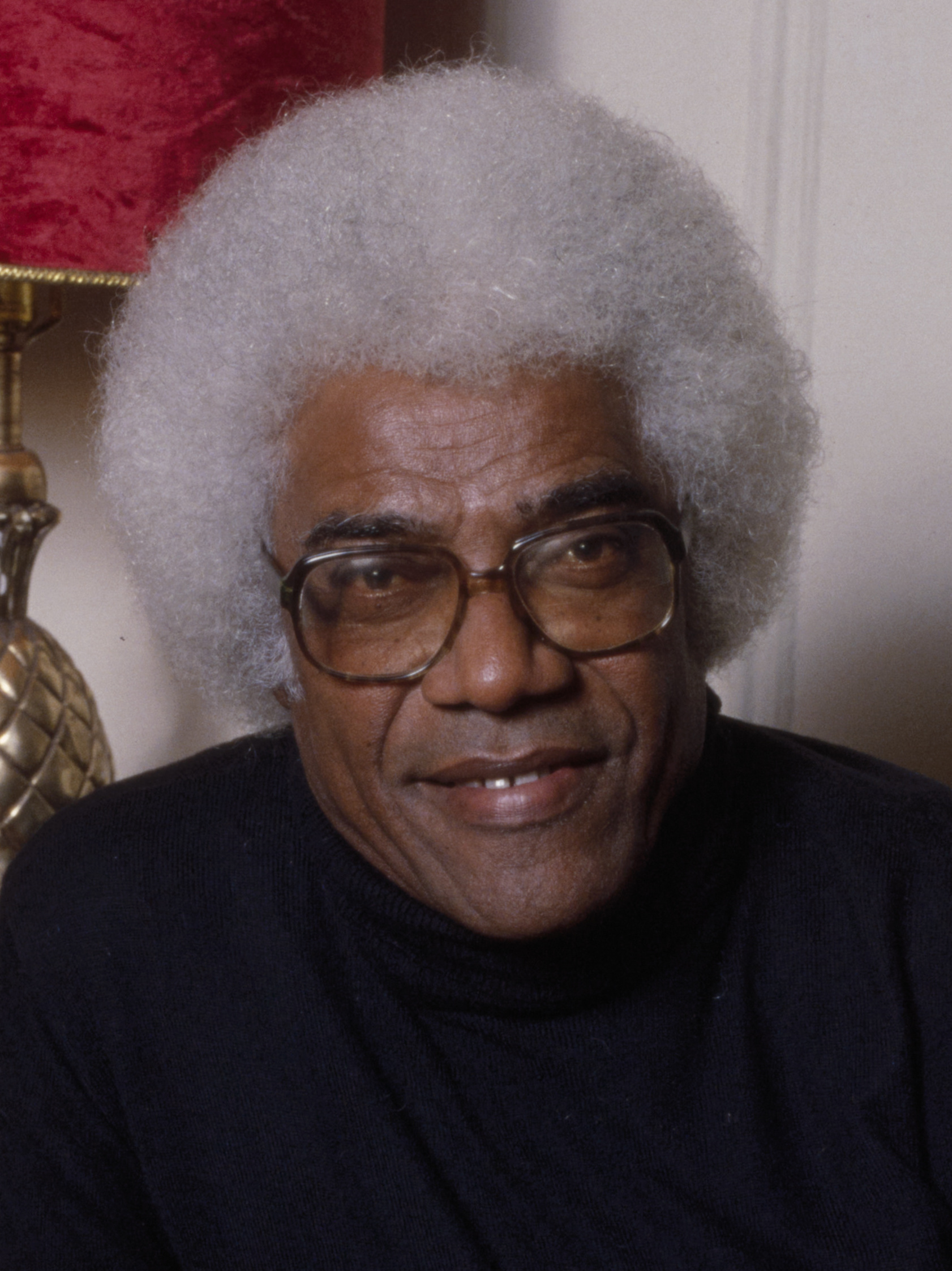
George Lamming made childhood, migration and the unfinished business of colonial rule subjects for a major body of Caribbean writing. His six novels move between island communities, Britain and the history of European conquest. Alongside them, his essays and lectures ask who has the authority to describe a people, and how that authority might change hands. 13
A reader in Barbados, a teacher in Trinidad
Born in Carrington Village, Barbados, on 8 June 1927, Lamming attended Roebuck Boys’ School before winning a scholarship to Combermere. There, the teacher and writer Frank Collymore encouraged him and opened his private library to the young reader. Collymore also edited the literary magazine Bim. The relationship offered Lamming both books to encounter and someone who took his own writing seriously, an important combination for a schoolboy beginning to imagine a literary life. 1
In 1946, with Collymore’s recommendation, he went to Trinidad to teach English at El Colegio de Venezuela in Port of Spain. He remained there until 1950. Trinidad widened his experience of the Caribbean: its writers, political arguments and developing labour movement offered another setting in which to consider questions first encountered in Barbados. His journey towards London therefore began with movement within the region, and with several years of working life. 1
Lamming was publishing before he became a novelist. Examining his early contributions to Bim, the critic Kenneth Ramchand identifies poems, short stories and extracts from the books still taking shape. This apprenticeship matters: the magazine allowed work to circulate within a Caribbean literary community before international publication brought a much larger audience. 5
Making a writing life in London
Lamming moved to England in 1950. He initially worked in a factory and subsequently as a BBC announcer. The route into literature involved earning a living as well as writing, while broadcasting offered contact with another public. His first novel, In the Castle of My Skin, appeared in 1953. Its reception was not uniformly enthusiastic, but a favourable review by V. S. Pritchett helped establish its reputation. Richard Wright and Jean-Paul Sartre were among the writers who championed the book. 2
That early success could also obscure the rest of his achievement. Looking back in a 1998 interview, Lamming expressed regret that the novel had appeared first: he felt readers’ attachment to it could overshadow later books produced through a more developed imaginative practice. He valued its close connection to childhood experience, while placing particular importance on Season of Adventure and Natives of My Person. The distinction is useful when approaching him: the celebrated debut is an entrance to a writing life that continued in several directions. 2
The village and the boy in In the Castle of My Skin
The novel centres on G., a boy growing up in Barbados during the 1930s. His everyday world includes friends, games and the village’s English landlord, Mr Creighton. A flood on his birthday and violence within school life disturb any easy picture of rural contentment. As G. becomes more conscious of adult society, the relationships sustaining the village grow increasingly unsettled. Lamming gives childhood its pleasures and its limitations: the boy experiences events before he can fully understand the arrangements of property and power behind them. 4
Although the book draws deeply on Lamming’s upbringing, G. belongs to a novel. Treating every incident as direct autobiography would flatten the work of selection, arrangement and invention. The story’s account of education and class develops through different perspectives: the growing boy, his companions and older villagers each bring a different understanding to what happens. A child’s questions can expose things that adults regard as ordinary, while older people carry memories the child cannot possess. The resulting picture exceeds any single person’s account of himself. 3
In an exchange reproduced by Bim, Boy Blue and his companion debate what happens when someone begins to feel different from everyone around him. Their conversation moves through uncertainty, correction and examples as they struggle to explain themselves. The difficulty of finding words becomes part of the subject. Lamming allows spoken Caribbean English to carry a serious argument about individuality and loneliness. The boys are thinking together, and their thinking takes shape through the rhythms of their conversation. Intellectual life is present in the village, including among people who have no formal authority to pronounce on it. 5
The movement towards adulthood also gives education an uneasy double role. Schooling promises access to a wider world, yet it can deepen the distance between a person and the community that formed them. Read alongside the novel’s class tensions, G.’s development raises a question with consequences beyond his own future: what does advancement mean when the standards of success come from a colonial society? 3
The Emigrants and the experience of arrival
Published in 1954, The Emigrants follows Caribbean travellers on their passage to Britain and through the difficult business of settling there. Lamming gives the journey itself substantial attention. The emigrants have expectations of the country they have been taught to admire; reaching it exposes those expectations to practical experience. Their search for opportunities brings them into an unfamiliar society in which the imperial connection offers little protection against exclusion. 6
The book follows a group rather than making one exemplary migrant stand for everyone. Its characters respond differently to displacement: some discover a stronger sense of themselves as West Indians, while others experience increasing isolation and confrontation. This variety is central to the novel’s account of arrival. A common point of departure does not produce identical lives in Britain. The new surroundings test friendships, expectations and the language through which people understand their position. Lamming’s fictional migrants inhabit a history linking the Caribbean and Britain, but they have to negotiate its consequences individually. 6
Imagining the Caribbean’s political future
Of Age and Innocence, published in 1958, turns towards San Cristobal, a fictional Caribbean island whose political life brings different ethnic communities into an uneasy relationship. Its opening places travellers together on an aeroplane, while their private fears and preoccupations keep them apart. Mark Kennedy studies his diaries; Marcia tries to reach him and finds his attention elsewhere. Being carried towards the same destination has not created a shared understanding. 8
The novel develops that difficulty across its political world. In his introduction, Jeremy Poynting connects its divisions to the breakdown of solidarity in the anticolonial movement in British Guiana. San Cristobal allows Lamming to compose a society from regional experiences without presenting it as a documentary portrait of one country. The question is demanding: how can people act together when colonial history has shaped them to distrust one another, and when even intimate relationships can fail through misunderstanding? 8
Season of Adventure, published in 1960, also takes place in San Cristobal. Its central character, Fola, is a young woman whose comparatively privileged upbringing has left her uncertain about important parts of her inheritance. Attendance at a ceremony intended to bring the living into contact with the dead sets her on a search for her past. Music, particularly drums, gives the novel another way of approaching knowledge and communal memory. 9
The setting is a newly independent society, where inherited divisions persist beneath the change in political status. Fola’s experience brings questions of class and cultural belonging into the same story. European values continue to determine what counts as respectable or valuable, while other traditions face neglect. Lamming’s interest lies in the work required to understand and remake those judgements, including the painful reconsideration of assumptions absorbed within one’s own family and social world. 9
Caliban, London rooms and the history of conquest
The Pleasures of Exile appeared in 1960, bringing memoir, literary criticism and political reflection into a single book. Written during Lamming’s years in Britain, it considers the experience of a Caribbean writer whose education has been shaped by the country in which he now lives. Shakespeare’s The Tempest and C. L. R. James’s The Black Jacobins become central resources. Reading across them allows Lamming to connect inherited European literature with the struggle of enslaved people to transform their circumstances. 7
His attention to Caliban is especially consequential. A character commonly approached through Prospero’s account can become a way of examining the position of the colonised: being named, represented and judged through another person’s authority. Language carries that authority, yet it also makes argument and imaginative invention possible. For a Caribbean author writing in English, this is a practical question about the material of his work. Lamming’s essays approach the literary tradition as something available for renewed interpretation, while examining the conditions under which its authority was established. 7
Water with Berries, first published in 1971, brings the inquiry back to London through three Caribbean artists: Teeton, a painter; Roger, a composer; and Derek, an actor. In the opening, Teeton is preparing to leave after seven years. His room contains maps, paintings and a tree trunk used as furniture. These objects have acquired a place in a household whose landlady, the Old Dowager, has developed her own attachment to them. 10
The prospect of departure unsettles that arrangement. Teeton keeps postponing the difficult announcement that he is going home, while apparently casual conversation gives both characters ways to approach or avoid what matters. Their accommodation includes affection, dependence and unequal authority. Lamming makes these coexist within ordinary domestic exchanges. As J. Dillon Brown explains in his introduction, the novel’s connections with The Tempest resist a simple assignment of one Shakespearean role to each character. The history of colonial relations enters a complicated human relationship, where goodwill cannot by itself settle the question of power. 10
Natives of My Person widens the historical frame to a European expedition towards San Cristobal. Its nameless Commandant and imperial voyage direct attention towards the people undertaking conquest and the ambitions they carry with them. The invented geography gives Lamming room to examine empire as an imaginative and psychological undertaking as well as a material one. Across the distance between a London rented room and an expeditionary ship, his fiction keeps returning to the consequences of one person or society claiming the right to define another. 11
Teaching, argument and a Caribbean public
Lamming’s intellectual life extended far beyond Britain. He attended the First Congress of Black Writers and Artists in Paris in 1956 and later taught at universities in the Caribbean, Africa and the United States. At Brown University in 2004, his planned Caribbean literature course included the plantation, childhood and national identities, with writing by Jean Rhys and Alejo Carpentier. He wanted the region understood as central to the making of the modern world, a place where histories of labour, migration and empire had brought different peoples together. 12
His relationship with the University of the West Indies included a period as writer-in-residence at Mona in 1967 and later lectures across its campuses. Essays, addresses and interviews carried his arguments into collections including Conversations. At Cave Hill, a centre bearing his name recognised his contribution to teaching and cultural thought. These activities formed a continuing part of his work after the publication of his six novels. 13
His politics involved commitments that deserve to be named. He supported Cuban socialism and identified with the projects of Maurice Bishop and Walter Rodney. In its tribute after his death, the University of the West Indies connected those allegiances with his determination that Caribbean societies should gain meaningful control over their futures. His idea of cultural freedom belonged within that larger argument about economic power, education and self-government. 14
Lamming died in Barbados on 4 June 2022. The range of his work remains a reason to return to it: the schoolboy’s questions, the emigrants’ competing expectations, the uneasy household and the arguments of newly independent societies each demand a different kind of attention. His teaching and public interventions continued the inquiry beyond the page. The Caribbean, in that work, is a place from which people can interpret the world and debate how they wish to live within it. 14
Sources
1. CARICOM — Citation for George Lamming’s Order of the Caribbean Community, 2008.
2. Anisfield-Wolf Book Awards — George Lamming, 2014 Lifetime Achievement.
3. University of Michigan Press — In the Castle of My Skin.
4. Penguin — In the Castle of My Skin.
6. University of Michigan Press / BiblioVault — The Emigrants.
7. Pluto Press — The Pleasures of Exile.
9. University of Michigan Press / Google Books — Season of Adventure.
11. Penguin — Natives of My Person.
12. Brown University — George Lamming, new faculty profile, September 2004.
13. University of the West Indies — From Castle to Kingdom, July 2022.
14. University of the West Indies — Tribute to Professor George Lamming, June 2022.
Image credit
George Lamming in 1988. Photograph by Bernard Gotfryd, Library of Congress; cropped version by Filetime, via Wikimedia Commons. No known restrictions on publication. Image source; Rights information.







Join the conversation
Comments 0
Share a memory, ask a question or add to this story.
No comments yet. Add your perspective.
Add your voice
Create a free account and verify your email to leave a comment.
All comments are reviewed before publication.