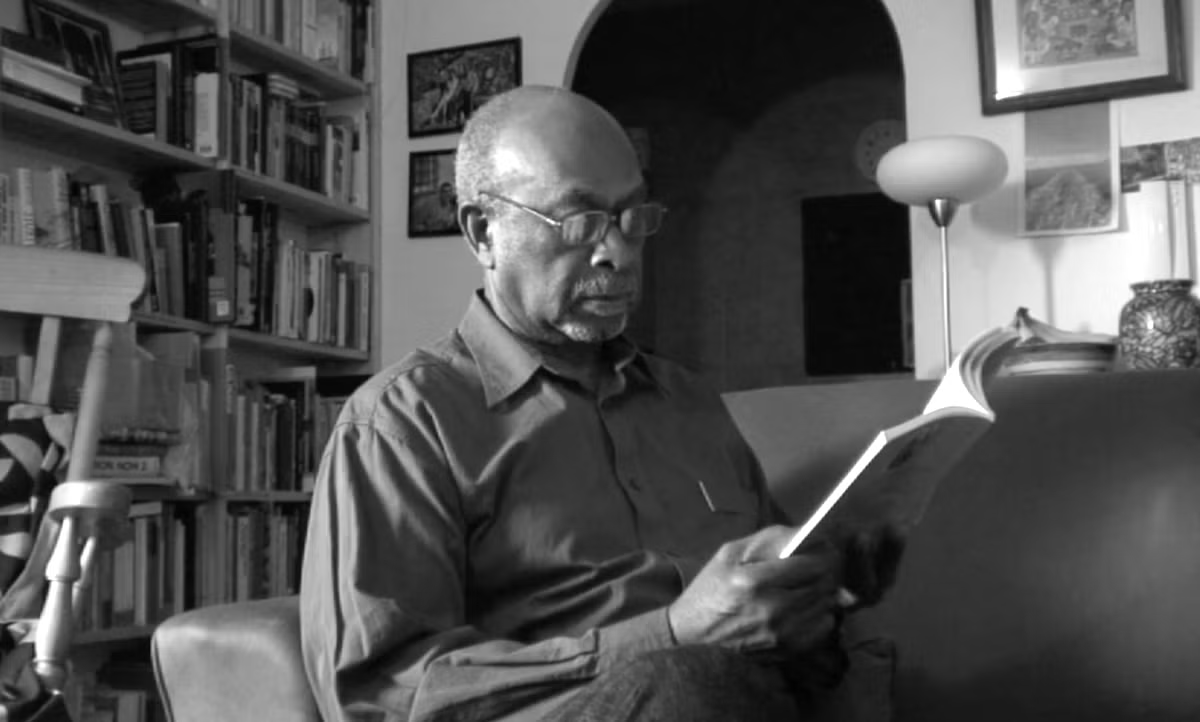
James Berry’s poetry moves between Caribbean villages and London streets, between a child’s discoveries and an adult’s encounter with prejudice. He settled in Britain in 1948 and became a significant poet, editor and writer for children. Across these different kinds of work, he attended to the difficulty of understanding another person. His writing could confront humiliation while finding pleasure in conversation, family memory and the natural world. 3
From Jamaica to postwar London
Born in Portland, Jamaica, in 1924, Berry was the son of Robert, a smallholder and fisherman, and Maud, a seamstress. His elementary schooling left him eager for further education, while opportunities to earn a living were limited. As a young man he travelled to the United States, where the racism he encountered challenged any expectation that employment abroad would bring freedom. His subsequent journey to Britain carried hopes for education, work and a more equal place in society. 1
Berry travelled on the SS Orbita, joining the early postwar migration from the Caribbean. In London he attended night school and worked as a telegrapher while continuing to write. Literary recognition came gradually, after years of employment alongside that ambition. His writing developed through this long period of study and employment. 2
Language had already given him several kinds of education. The Bible and prayer book brought the rhythms of formal English into his childhood, while everyday Jamaican speech supplied proverbs, distinctive vocabulary and ways of telling a story. Both entered his writing. A poem could draw on the weight of ceremonial language or the quick exchanges of conversation. This range gave Berry choices about how a speaker might address readers and what sort of attention the words would ask for. 13
Family memory and a migrant’s voice
My Arrival returns to the beginning of a life. Introducing his recording for the Poetry Archive, Berry explains that the poem concerns his birth and his grandmother’s decision to name him after her recently deceased husband. The poem turns that family account into a scene of voices and actions: the midwife announces the child, his mother seeks reassurance and his grandmother recognises a connection with the person she has lost. A new individual arrives within relationships that already have their own histories. 4
The surrounding landscape has a presence in that arrival. Sea, streams and village birds accompany the household, and the final image connects the child with a fruit-bearing tree. The movement from birth to growth gives belonging a physical form. Berry makes the remembered world expansive enough to contain family custom, grief and the continuance of life. The poem’s intimacy comes through these particulars, including the different things each adult needs to say. 4
Lucy’s Letters and Loving, published in 1982, takes another route into the relationship between place and voice. Its recurring narrator is a Jamaican woman in London writing home about her experiences. Lucy is a created character, with the distance between writer and recipient built into her situation. The letter allows life in the capital to be described from within an ongoing relationship with Jamaica. Migration changes the surroundings without ending the need to explain oneself to people elsewhere. 3
Publishing a shared literature
Berry also helped bring other Caribbean writers to readers. He edited Bluefoot Traveller in 1976 and News for Babylon in 1984, anthologies that established a collective presence for Caribbean British poetry. His own first collection, Fractured Circles, appeared from New Beacon Books in 1979. These publications show two connected ambitions: developing an individual body of work and helping make the activity of a wider community visible in print. Editing required choices about whose poems would enter that shared record. 2
His participation in the Caribbean Artists Movement placed him within exchanges about art and cultural identity. He also belonged to the humanist Progressive League and edited its anniversary anthology, PLAN Poets, in 1982. In introducing that collection, he emphasised the shared work behind it. These affiliations reveal the breadth of his literary and ethical interests. After taking early retirement in 1977 to concentrate on writing, he also pursued educational work, concerned with how a changing Britain might understand its different communities. 1
Money, power and a police search
Fantasy of an African Boy won the National Poetry Competition in 1981. The poem begins with the apparent strangeness of people living without enough money while knowing that wealth exists elsewhere. Its young speaker examines an adult system through straightforward questions about need. Money cannot itself provide nourishment or medicine, yet access to both depends on having it. The repeated movement between what money physically is and what it enables exposes the severity of that contradiction. 5
The argument expands from hunger towards schooling, travel and health. Each example increases the distance between those denied ordinary possibilities and those who control wealth. Near the end, the imagined release of money offers a vision of movement beyond guarded boundaries. The speaker’s apparent simplicity makes a demanding political argument accessible. Berry gives a young voice the authority to examine arrangements that the powerful have made familiar, asking readers to consider their consequences through the body and future of a child. 5
In-a Brixtan Markit brings the misuse of power into an everyday London encounter. A man describes being singled out by a police officer who searches his bag. Its contents are ordinary purchases, including food and a Bob Marley recording. The speaker’s repeated expressions of disbelief communicate the injury of being treated as suspicious while going about his business. The poem makes the search significant through his account of it, allowing him to name the humiliation that the officer’s action produces. 6
Anger then becomes an urgent internal conversation. The speaker addresses himself as Tony and repeatedly orders himself to remain still and control his response. The ending measures achievement through this hard act of restraint. In his recorded introduction, Berry connects the poem with an experience in Brixton; the text gives that experience the shape of a dramatic monologue. Its force lies in the listener’s proximity to thought as it happens, with composure requiring effort at every stage. 6
Returning to the migration story
Windrush Songs, published in 2007, gathered the reasons for leaving the Caribbean into a larger sequence. Berry belonged to the migration it explored, although the ship he travelled on was the Orbita. The collection approaches departure through different speakers, with varied ambitions, anxieties and attachments. Its contents move from frustration with conditions at home through the sea journey towards arrival. That organisation gives migration a duration, involving preparation, remembered experience and anticipation as well as the moment of reaching Britain. 7
The book also brings these journeys into relation with the earlier forced transportation of Africans into slavery. Its account of the Caribbean includes the pressures of poverty and earning a living alongside affection for the place being left. The plurality of voices matters: the migrants cannot be reduced to one motive or one emotional response. Berry’s late return to the subject gives room to the contradictions contained in seeking a future away from a country one loves. 7
Children as readers and questioners
Writing for younger readers occupied a substantial part of Berry’s career. His books included the story collection A Thief in the Village and poetry gathered in Only One of Me. The Centre for Literacy in Primary Education highlights the relationship between Britain’s inner cities and the rural Caribbean in his work, and the speech rhythms he drew from both. A new edition of Only One of Me appeared in 2022 with a foreword by John Agard, carrying this writing towards another generation. 9
Recognition came across forms and audiences. A Thief in the Village won the Smarties Grand Prix Award in 1987, while When I Dance received the Signal Poetry Award in 1989. Berry was awarded an OBE in 1990. 3
What Do We Do with a Variation? makes the reader a participant in an ethical inquiry. It proceeds through questions about responses to difference: curiosity, avoidance, hostility, the wish to make somebody resemble oneself. The recurring question prevents any response from passing unnoticed. Some possibilities are openly violent; others appear quieter but still require the unfamiliar person or quality to disappear. By the end, communication becomes a possibility that readers must weigh against everything preceding it. The poem does not supply a named character whose behaviour can conveniently be judged from outside. Its repeated collective address includes the person reading. That is why the questions remain demanding even though the language is accessible: they concern actions, habits and decisions in which a reader might recognise themselves. 10
A Story about Afiya offers a different kind of imaginative encounter for children. Illustrated by Anna Cunha, the picture book follows a girl whose single dress records what she experiences around her. Flowers, birds, zoo animals and falling leaves become part of its changing appearance. The premise gives a child’s attention a visible trace, turning encounters with the world into something she can carry. Its recognition included a place among the New York Times’s twenty-five best children’s books of 2020 and the USBBY Outstanding International Books selection for 2021. 11
A poetry of attention
Berry’s pleasure in looking is particularly clear in Rough Sketch Beginning. The speaker sets out to prepare a picture, then repeatedly transforms what is seen through imaginative comparison. Sun, mountain, sea, woodland and weather acquire unexpected relationships with human actions and states of mind. Each short unit begins again, as though another possible image has entered the sketchbook. The series makes observation active: to look is to discover a form through which something familiar can become strange. Even birdsong is approached as a visual experience, crossing the boundary between senses. The title leaves the work at an early stage of making. Readers encounter possibilities being tried, with enough space between the brief images to consider what each comparison reveals. 8
Benediction uses a more restrained pattern. Its sequence of thanks begins with the human capacities for hearing, seeing, feeling and touch. Each is valued through the encounter it makes possible. The poem then widens its field to the night sky above human settlements, bringing distant places into one scene. Its brief form makes generosity an act of sustained attention. Read alongside the anger of In-a Brixtan Markit, this quieter poem shows the breadth of Berry’s responses to experience. Understanding requires senses that remain available to the world, even when that world has given people reasons to withdraw. 12
A body of work and opportunities for others
A Story I Am In, published in 2011, brought together poems from five collections alongside selections from four books for children. That arrangement makes it possible to follow connections across the divisions of a publishing list. Readers can move between the voices, settings and forms through which Berry developed his concerns over decades. The volume includes substantial material from Windrush Songs, placing the migration sequence within the larger span of his writing. His work for younger readers forms part of that same retrospective view. 13
Berry died in London on 20 June 2017, aged ninety-two. His publications left a record of a literary life sustained across Britain and the Caribbean. 2
In 2021, Newcastle University and Bloodaxe Books launched the James Berry Poetry Prize for emerging poets of colour. Devised by Bernardine Evaristo and Nathalie Teitler, it combined an award with mentoring and the publication of a debut collection. The structure recalls the practical work of making a writer’s voice available: time to develop poems, experienced readers to help shape them and a publisher to bring them to an audience. It also recognises Berry’s encouragement of younger writers, including Hannah Lowe and Raymond Antrobus. His name now accompanies opportunities for poets whose work will take its own directions, extending the kind of literary possibility that his anthologies and personal support helped create. 14
Sources
1. Humanists UK, Humanist Heritage — James Berry (1924–2017).
2. Bloodaxe Books — James Berry (1924–2017).
3. Poetry Archive — James Berry: biography, books and awards.
4. James Berry / Poetry Archive — My Arrival: poem and author’s introduction.
5. James Berry / The Poetry Society — Fantasy of an African Boy.
6. James Berry / Poetry Archive — In-a Brixtan Markit: poem and author’s introduction.
7. Bloodaxe Books — Windrush Songs: publication details and contents.
8. James Berry / Poetry Archive — Rough Sketch Beginning.
9. Centre for Literacy in Primary Education — James Berry.
10. James Berry / Facing History and Ourselves — What Do We Do with a Variation?.
11. Lantana Publishing — A Story about Afiya.
12. James Berry / Poetry Archive — Benediction.
13. Bloodaxe Books — A Story I Am In: Selected Poems.
14. Newcastle University — The James Berry Poetry Prize for emerging poets of colour, 8 April 2021.





Join the conversation
Comments 0
Share a memory, ask a question or add to this story.
No comments yet. Add your perspective.
Add your voice
Create a free account and verify your email to leave a comment.
All comments are reviewed before publication.