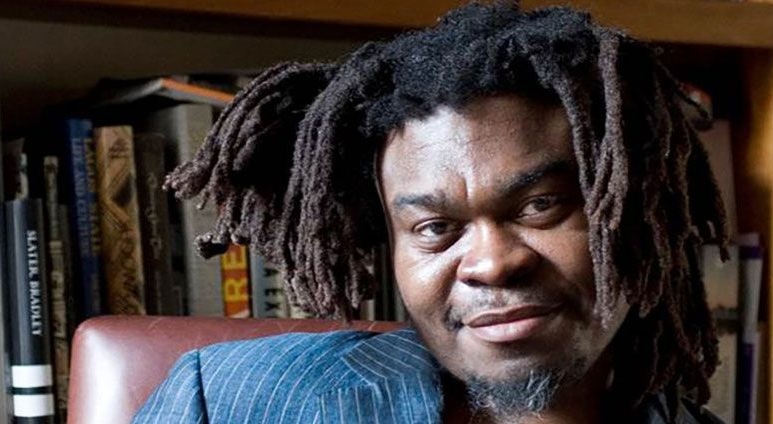
Yinka Shonibare has built an international artistic career by asking how objects carry histories across borders. His vivid costumes, sculptures, installations and public commissions bring together humour, beauty and uncomfortable questions about empire. Behind their theatrical surfaces lies a sustained investigation of who makes culture, who claims it and who is allowed to belong.
Between London and Lagos
Yinka Shonibare was born in London in 1962 and grew up largely in Lagos, Nigeria, after his family moved there when he was young. His education and later artistic work took him back to Britain, but the movement between these places did not simply furnish him with two national labels. It gave him an early experience of how people change language, manners and expectations as they cross borders. The artist studied at Byam Shaw School of Art and Goldsmiths, University of London, where conceptual approaches to making art shaped his practice. He came to see identity not as a fixed possession but as something formed through encounters with other people, institutions and histories. [1]
That perspective has mattered throughout his career because audiences often expect artists with African backgrounds to provide recognisably African imagery. Shonibare has repeatedly complicated that demand. He can use an extravagant Victorian costume to expose the confidence of British imperial culture, or place an object associated with European high society beside references to contemporary migration. Rather than offer a single lesson, he puts contradictory signs together and lets viewers confront their assumptions. Disability is another important part of the context of his work: after a serious illness in his late teens, he continued to develop his practice while living with lasting physical effects. That experience informs his attention to access and possibility without being the whole explanation of his achievement. [2]
The complicated history of a fabric
Perhaps the most recognisable feature of Shonibare's work is brightly patterned wax-printed cotton. Viewers may initially see it as a straightforward emblem of African identity. Its trade history makes that reading incomplete. European manufacturers adapted processes associated with Indonesian batik, produced cloth for commercial markets and ultimately found strong demand in West Africa, where consumers and traders made the material part of changing local fashions. These textiles therefore carry histories of Asian technique, European industry, colonial commerce and African taste. Their patterns are not a timeless ethnic code. Shonibare uses the fabric precisely because its journey frustrates simple ideas about where a culture begins and who owns its symbols. [3]
His costumes create a particularly sharp collision when their eighteenth- or nineteenth-century shapes are made from wax print. The body may seem dressed for a European aristocratic gathering, yet the material directs attention to the trade routes and labour behind the wealth that made such gatherings possible. The colours attract us before the questions become clear. This combination of pleasure and disturbance is one reason the work travels successfully between galleries and audiences. It does not require every visitor to arrive with a detailed knowledge of colonial history, but it rewards anyone who looks beyond the surface. The textile becomes a way of asking how fashion, empire and exchange have always influenced each other. [4]
Recasting European stories
During the 1990s and 2000s, Shonibare developed a language of headless mannequins, elaborate period clothing, staged photographs and carefully constructed tableaux. The missing heads prevent a familiar form of individual identification: the figures often stand for a social world rather than a named historical person. Their gestures can be comic, elegant or ominous. By drawing on European painting, literature and courtly imagery, he demonstrates how a picture can present hierarchy as natural even when the economics supporting it are anything but. The viewer recognises beauty and ceremony while sensing that the official account of the past has been deliberately unsettled. [5]
His inclusion in Documenta 11 in 2002, the influential international exhibition directed by Okwui Enwezor, placed the work within conversations about global art and the movement of ideas beyond older Western centres. A Turner Prize nomination followed in 2004. These milestones mattered not because they resolved questions about representation, but because they showed an artist making technically ambitious and intellectually challenging work could command attention without reducing his concerns to a neat category. Shonibare's practice has continued to move through sculpture, photography, painting and installation; its variety is central to the way he repeatedly revisits the same histories from different directions. [6]
An earlier strand of this experiment can be seen in Shonibare’s mannequin installations, where confident poses and splendid clothes are separated from the reassuring presence of a recognisable face. The Museum of Modern Art records his work in this field alongside other forms of mixed-media sculpture. In a museum devoted to modern art, those figures make viewers think about the relationship between European portrait conventions and the people who were rarely permitted to commission portraits of themselves. The point is not that every historical sitter was personally involved in exploitation. It is that a social image can conceal the systems which support its authority. Removing the face makes that mechanism easier to notice. [18]
A ship on Trafalgar Square
One of his best-known public works, Nelson's Ship in a Bottle, occupied the Fourth Plinth in Trafalgar Square from 2010 to 2012. The sculpture presents a scale model of HMS Victory, the warship associated with Admiral Nelson, enclosed inside an enormous glass bottle. Its sails are made from Shonibare's characteristic printed fabric. A vessel celebrating a defining moment in British naval history becomes, at the same time, a reminder that sea power depended on far-reaching commercial and colonial networks. The work's apparently playful format made a complicated historical challenge visible to people who might never enter an art gallery. [7]
The installation was subsequently acquired for the National Maritime Museum at Greenwich with help from the Art Fund. That change of setting is revealing. In Trafalgar Square, it appeared among symbols of national remembrance; in a maritime museum, it enters a collection where ships, navigation and imperial trade can be examined together. The object is neither a straightforward attack on Nelson nor a conventional celebration. It opens the narrative to the many people, places and exchanges omitted from simplified patriotic accounts. Its continued public presence also suggests how a commission can outlive the moment of controversy or applause and become an educational resource for generations of visitors. [8]
The artist has also made work directly for communities living with painful local histories. In Leeds, his towering Hibiscus Rising was unveiled in November 2023 in memory of David Oluwale, a British-Nigerian man who drowned in 1969 following sustained harassment by police officers. The commission grew from the efforts of the David Oluwale Memorial Association, Leeds 2023 and the city council, with Art Fund support. It was conceived as a place of remembrance and connection, not a replacement for the work of confronting racism. A bright flower and a difficult story coexist in the public space, allowing visitors to remember a person rather than only the circumstances of his death. [17]
Libraries, statues and difficult history
Shonibare has taken the physical form of books as another way to reveal hidden connections. In works such as The British Library, volumes covered in patterned cloth evoke the scale and variety of migration to Britain. Names and categories of migrants turn an imposing installation into an invitation to consider individual lives. A library usually suggests authority, classification and collected knowledge. By using this form, he asks who is included in national memory, which stories become established and how institutions can acknowledge the people who shaped them. The visual generosity of the work does not lessen its political seriousness; it makes an unfamiliar history approachable without making it simple. [9]
His 2024 exhibition Suspended States at the Serpentine brought related questions into conversation with statues, armed conflict and the idea of refuge. Decolonised Structures transformed historical figures through the artist's material language, while Sanctuary City imagined places of protection. An installation involving thousands of books explored the names and histories attached to war. These projects invite consideration of whether a society can examine its monuments without erasing evidence of the past. Shonibare has argued for engaging with difficult histories rather than pretending they did not happen, a position that gives his art a more layered purpose than simple removal or preservation. [10]
Making space for other artists
Artistic success has not kept Shonibare's attention solely on his own exhibitions. His work with Guest Artists Space, often called GAS, has helped develop places where artists and researchers can spend time in Nigeria and engage in exchanges across disciplines and national boundaries. The programme reflects a concern with practical infrastructure: where an artist can work, who has access to supportive networks, and whether ideas can move in more than one direction between African and European cultural centres. Its premise challenges a familiar pattern in which artists from Africa are expected to travel to older Western institutions for recognition. [11]
In interviews about the initiative, Shonibare has discussed the importance of facilities, time and meaningful encounters for younger practitioners. Such commitments should not be romanticised as one celebrated figure single-handedly transforming an entire arts sector. Curators, technicians, administrators, local organisations and participating artists all help make residencies work. What distinguishes the project within his larger career is that it treats cultural exchange as something requiring material conditions, not merely good intentions. A contemporary artist may question the history of international trade inside a museum while helping create new, more equal routes for contemporary artists to collaborate outside it. [12]
Environment, exchange and the present
Shonibare's recent work also makes the environmental consequences of global commerce harder to separate from its cultural consequences. Historical costumes, statues and libraries may seem distant from climate change. Yet the routes of extraction, consumption and unequal power that shaped empires are also part of today's discussion about resources and responsibility. In Suspended States, the relationship between cultural movement and environmental vulnerability entered the same visual conversation. His art does not propose a technical solution to climate change; rather, it shows why environmental discussions cannot be detached from the different capacities societies have to withstand loss. [13]
The point is especially clear when work about migration appears beside work about war, displacement and sanctuary. People move for many reasons, and their journeys cannot all be compressed into one story of either opportunity or suffering. The Serpentine projects use public and historical symbols to encourage a broader understanding of what makes a place safe or unstable. Their theatrical forms also resist an overly dry presentation of politics. Shonibare has long understood that viewers may first be drawn by pattern, scale or spectacle, then stay with questions about responsibility that have no easy resolution. [14]
Why the work matters
The breadth of Shonibare's career makes it difficult to file him under a single movement or cultural identity. He belongs to important histories of Black British art, conceptual art and international installation, but he continually brings the boundaries between these fields into view. Exhibitions in Britain and abroad have allowed him to return to familiar objects with new questions. When a European costume is remade, or a statue seems to change its cultural clothing, the alteration is never only decorative. It asks visitors to notice the conventions through which power becomes ordinary and apparently natural. [15]
His lasting contribution is also a model of how historical curiosity can sit beside visual delight. The works can be humorous without making empire amusing; they can recognise the beauty of objects without excusing the conditions of their production. They ask us to examine the relationships behind things we may have learned to call purely British, African or European. At the same time, Shonibare's support for artistic exchange points towards a future in which a wider range of people can tell their own stories. The result is art that does not close history with a verdict. It keeps the conversation open and insists that more voices belong in it. [16]
Sources
- https://shop.royalacademy.org.uk/art-artists/artists/yinka-shonibare-ra
- https://iniva.org/library/digital-archive/people/s/shonibare-mbe-yinka/
- https://www.rmg.co.uk/stories/art-culture/artist-profile-yinka-shonibare-cbe
- https://www.phillips.com/article/67780135/in-conversation-with-yinka-shonibare
- https://www.serpentinegalleries.org/about/press/yinka-shonibare-cbe-ra-suspended-states/
- https://www.swanngalleries.com/profile/yinka-shonibare/
- https://www.artfund.org/our-purpose/art-funded-by-you/nelsons-ship-in-a-bottle
- https://www.artfund.org/explore/get-inspired/features/yinka-shonibare-difficult-histories-inclusive-art
- https://shop.tate.org.uk/yinka-shonibare-cbe-silk-scarf/22808.html
- https://news.sky.com/story/we-should-not-erase-history-yinka-shonibare-on-his-new-exhibition-and-the-impact-of-imperial-ambition-13113660
- https://somethingcurated.com/2022/11/10/interview-yinka-shonibare-on-equipping-the-next-generation-to-thrive-not-just-survive/
- https://guardian.ng/art/a-conversation-with-yinka-shonibare/
- https://www.theartnewspaper.com/2024/07/17/green-is-the-new-black-%7C-yinka-shonibares-serpentine-show-reveals-what-cultural-exchange-can-do-for-the-climate-crisis
- https://www.serpentinegalleries.org/whats-on/yinka-shonibare-cbe-suspended-states/
- https://www.smithsonianmag.com/travel/front-international-brings-art-world-cleveland-180969629/
- https://goodman-gallery.com/artists/yinka-shonibare
- https://www.artfund.org/our-purpose/news/in-pictures-yinka-shonibare-hibiscus-rising-leeds
- https://www.moma.org/artists/24869-yinka-shonibare




Join the conversation
Comments 0
Share a memory, ask a question or add to this story.
No comments yet. Add your perspective.
Add your voice
Create a free account and verify your email to leave a comment.
All comments are reviewed before publication.