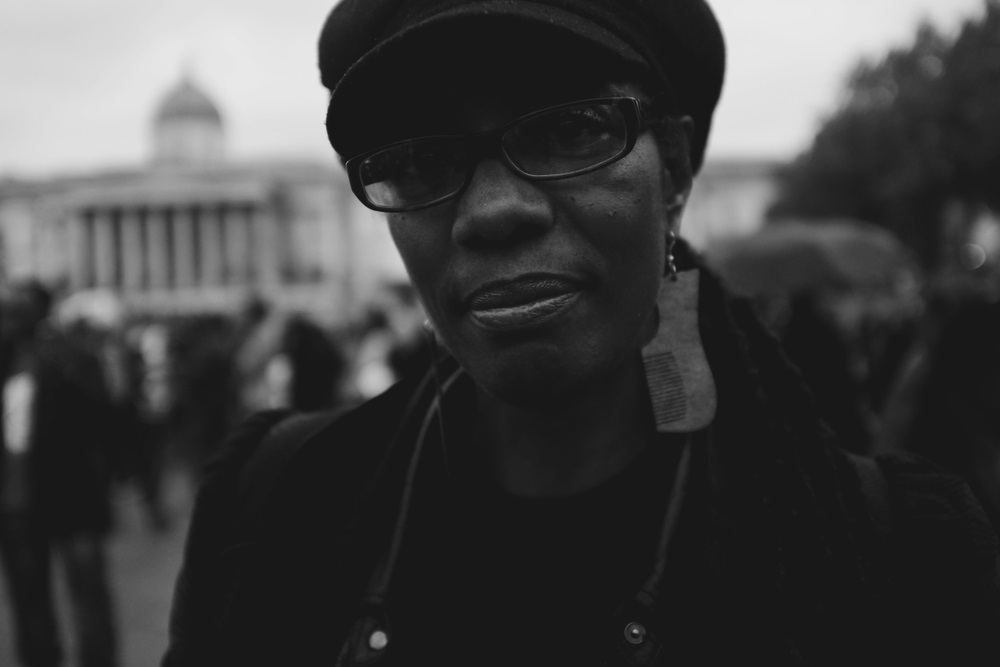
A public role shaped by a family loss
Marcia Rigg’s campaigning began with the death of someone she knew as a brother, not as a public case. Over the years that followed, she became involved in the United Families and Friends Campaign and worked closely with INQUEST, the charity supporting families after deaths involving the state. Her public role has included speaking about police restraint, mental health and the treatment of bereaved people within investigations. It is work grounded in a family’s experience but directed towards questions that affect many others. 16
Born in Gloucestershire in 1964 to Jamaican parents, Rigg was the eldest of six children. Her mother’s work included nursing and her father worked as a bus driver. Rigg herself worked as a model and later as a legal secretary, raised five children and helped care for Sean, who had a mental health condition. Her oral history remembers him as a musician who enjoyed travelling. Those details are essential to an account of her activism: before the investigations and hearings, there was a family relationship and a life with interests, responsibilities and affection. 1
Sean Rigg’s death in 2008
On 21 August 2008, forty-year-old Sean Rigg was experiencing mental ill health when four Metropolitan Police officers detained him. The police watchdog’s later official chronology records that he was restrained face down for between seven and eight minutes, with his hands cuffed behind his back and pressure applied to parts of his body. He was transported to Brixton police station, where he collapsed in the caged area at the entrance to the custody suite. Medical help was not sought immediately. He died there following a cardiac arrest. 2
The first investigation by the Independent Police Complaints Commission, or IPCC, concluded in February 2010 without recommending disciplinary action against any officer. That was an outcome of an investigation, not the end of the family’s questions. The difference between the account initially accepted by an oversight body and the evidence later examined publicly would become central to the campaign. Marcia and her relatives continued seeking an explanation through the processes available to them. 2
What the inquest established
On 1 August 2012, the inquest jury returned a detailed narrative verdict. It found that the force used during the face-down restraint was unsuitable and that the duration was unnecessary. The majority concluded that the restraint had more than minimally contributed to Sean’s death. The jury also criticised the failure to recognise his vulnerability and the decision to take him to a police station rather than an appropriate medical setting. These were serious findings about what had happened and about the care he should have received. 3
The findings extended beyond the police. The jury concluded that the South London and Maudsley NHS trust’s failure to arrange a Mental Health Act assessment from 11 August had more than minimally contributed to the death. This placed the events within a wider history of missed opportunities for care. The verdict was a narrative account, not an unlawful-killing verdict or a criminal conviction. It gave the family a public account against which to assess the earlier investigation and to press for further scrutiny. 3
The coroner’s subsequent report raised continuing concerns about how agencies worked together. In October 2012, Dr Andrew Harris identified uncertainty about responsibilities, communication and emergency action, as well as shortcomings in mental health training. INQUEST sent the report to ministers in an effort to secure wider learning. Marcia welcomed its recommendations and argued that they needed to prevent further families experiencing the same loss. Her response connected the particular findings about Sean to the practical question of how another person in crisis would be treated. 4
Challenging the investigation itself
The inquest also prompted an external examination of the IPCC’s original work. Dr Silvia Casale’s review, published in May 2013, identified failings in that investigation. The family, their lawyers and INQUEST had met the review team during its work. Marcia welcomed the IPCC’s acceptance of the recommendations while insisting that independent oversight had to be effective in practice. Her position was not simply opposition to the existence of a watchdog: it was a demand that the body charged with scrutinising the police should fulfil that responsibility. 5
When the IPCC reopened its investigation in 2013, Marcia called for a thorough, transparent process with sufficient resources to avoid further delay. More than five years had already passed since Sean’s death. Her statement also raised concern that legal obstacles surrounding the first investigation could hold up the new one. This was a recurring feature of the family’s experience: reaching the next stage required attention to the rules governing that stage, as well as to the evidence about the death itself. 6
In May 2014 the High Court quashed the original investigation. A further dispute followed over an officer’s proposed resignation while his conduct was being reinvestigated. After intervention by the family, the Metropolitan Police refused to accept the resignation; the officer’s challenge to that decision was dismissed in September. The judgment also explained why an inquest and disciplinary or criminal proceedings served different purposes. Establishing the circumstances of a death did not itself determine personal criminal or disciplinary responsibility. The family was consequently navigating several distinct processes, each with its own questions and possible outcomes. 7
The outcomes of later proceedings
The criminal proceedings did not produce the accountability the family sought. In November 2016, a jury acquitted custody sergeant Paul White of perjury concerning his evidence at the inquest. The charge related to that evidence, rather than being a prosecution for causing Sean’s death. The family had pressed for scrutiny of the testimony and described the verdict as devastating. The prosecution had put the disputed account before a criminal court, but it did not produce a conviction. 9
Separately, the Crown Prosecution Service decided in 2016 that there was insufficient evidence to prosecute officers in relation to the events surrounding Sean’s death. Following the family’s use of the Victims’ Right to Review process, that decision was confirmed in December 2017. Marcia disputed the outcome. The distinction between her assessment and the prosecution decision matters: her campaign continued because the official conclusions did not answer her demand for responsibility, while the legal position remained that those charges were not brought. 8
A six-week gross misconduct hearing ended on 1 March 2019, more than ten years after the death. None of the allegations against the five officers was proved. Marcia publicly rejected the panel’s decision and maintained that the family had not received justice. The contrast between the earlier inquest findings and the later outcomes became part of her wider argument about the limits of accountability. It also explains why completing a sequence of hearings did not bring the campaign, or the family’s distress, to a natural close. 10
From one investigation to wider reform
The case nevertheless contributed to changes in the discussion of police investigations. In February 2017, the IPCC published guidance on gathering evidence after a death or serious injury involving police. It explicitly traced the guidance’s origins partly to the independent review of its investigation into Sean’s death. The proposals included separating key police witnesses as soon as operationally safe, taking their individual initial accounts before they went off duty and obtaining those accounts before they viewed their own body-worn video. The purpose was to protect independent recollections and confidence in the evidence. 11
At that stage, the guidance was awaiting approval by the Home Secretary. Its significance lay in the identifiable connection between a challenged investigation and proposed safeguards for future investigations. Questions about the quality of evidence had become practical proposals about what officers should do in the hours immediately after a serious incident. This was one route through which scrutiny of Sean’s case could reach beyond the family’s own proceedings. 11
A broader intervention was Dame Elish Angiolini’s independent review of deaths and serious incidents in police custody, published in October 2017. Theresa May had commissioned it as Home Secretary after meeting the families of Sean Rigg and Olaseni Lewis. INQUEST helped the review hear from many bereaved families. Its recommendations addressed legal representation, delays, discrimination, accountability and the treatment of people needing urgent health care. The contribution of the Rigg family belonged to this collective effort, in which personal testimony became evidence for examining the system as a whole. 12
The cost of seeking answers
Rigg has written candidly about the demands of that work. In a 2018 article for INQUEST, she described exhaustion and the lasting effect of navigating repeated legal processes. She recalled her family being asked to contribute £21,000 after means testing for legal aid for the inquest. She also described confronting several teams of publicly funded lawyers. These recollections explain why access to representation became such an important campaigning issue: the opportunity to participate effectively cannot be separated from whether a family can obtain the help it needs. 13
In the same account, she described supporting others through family forums, listening days and INQUEST’s skills and support toolkit, to which she contributed alongside Tony Herbert, whose son James had died following police restraint. This was practical work as well as public advocacy. Experience gained painfully through one case could help another family understand an inquest and prepare for what lay ahead. Rigg’s campaigning therefore included sharing knowledge, not only calling for institutional change. 13
Her concern about delay had reached Parliament much earlier. Written evidence submitted by INQUEST and lawyers’ groups in 2020 recalled her appearance before the Home Affairs Select Committee in February 2010, when she questioned the length of the investigation. The later submission placed that testimony alongside continuing concerns from other families about delay, independence and the quality of investigations. The recurrence of those issues helps explain the persistence of her public work: a complaint about one prolonged case could become part of a longer argument about how oversight operates. 17
An apology fifteen years later
On the fifteenth anniversary of Sean’s death, 21 August 2023, the Independent Office for Police Conduct, which had replaced the IPCC, wrote to Marcia. Acting director general Tom Whiting apologised for delays in both investigations and for the failure to keep the family properly informed about a civil claim brought by some of the officers. The watchdog had settled that claim, paid compensation and apologised to the officers. The family learnt about the settlement from a Police Federation article rather than from the watchdog itself. Whiting acknowledged the additional distress this had caused. 14
The apology became public in September. Marcia said she appreciated it, while explaining that the effects of the death and subsequent processes continued. She also asked that families and complainants should be informed about similar settlements in future, as a matter of courtesy and public interest. Even at this stage, her response moved from what had happened to her family towards a practical expectation for how others should be treated. An apology was an acknowledgement; it did not erase the years that had preceded it. 15
Keeping family experience in public view
In 2023, INQUEST announced Rigg’s appointment to its board of trustees. The organisation also recorded her membership of its Family Reference Group and her leadership within the United Families and Friends Campaign, which brings together families affected by deaths in police custody, prisons and mental health settings. These roles gave formal recognition to knowledge developed through campaigning. They placed experience of bereavement within the organisation’s work, alongside other forms of professional and practical expertise. 16
Her oral history offers a particularly clear explanation of collective remembrance. Speaking about families gathering with banners and photographs, she emphasised that the people who died were loved individuals, not simply entries in a legal record. She described the recognition and support that families offered one another. That insistence on personhood connects public campaigning to its private origin: Sean remained her brother throughout the succession of institutional descriptions of his death. 1
Marcia Rigg’s contribution to Black British history lies in that sustained connection between family life and public accountability. Her work demonstrates how bereaved people can become knowledgeable participants in arguments about policing, health care and justice, while continuing to carry the loss that brought them there. It also resists an easy ending. Reviews, recommendations, court decisions and apologies have different meanings; none can stand in for the person who died. The history includes both the changes pursued and the continuing demand to know whether institutions have learnt from them.
Sources
[1] INQUEST. Marcia Rigg – oral history; Undated oral-history page.
[2] Independent Office for Police Conduct. The circumstances of Sean Rigg’s death and the history of the IPCC and IOPC involvement; September 2023.
[3] INQUEST. Jury condemns actions of the police and mental health trust in verdict over death of Sean Rigg; 1 August 2012.
[4] INQUEST. Sean Rigg case – further developments after the 1 August 2012 jury verdict; 12 November 2012.
[5] INQUEST. INQUEST and Sean Rigg’s family respond to findings of independent review of IPCC investigation; 17 May 2013.
[6] INQUEST. IPCC reopens investigation into death of Sean Rigg – family and INQUEST response; 9 December 2013.
[7] Garden Court Chambers. Sean Rigg police officer fails in resignation judicial review challenge; 25 September 2014.
[8] INQUEST. Crown Prosecution Service confirm decision not to charge officers involved in the death of Sean Rigg; 6 December 2017.
[9] INQUEST. Police sergeant found not guilty of perjury following the death of Sean Rigg; 8 November 2016.
[10] INQUEST. All charges of gross misconduct against officers involved in the death of Sean Rigg dismissed; 1 March 2019.
[11] Independent Office for Police Conduct. IPCC publishes guidance for use following a death or serious injury involving the police; 20 February 2017.
[12] INQUEST. Landmark review on deaths in police custody published today is an opportunity to save lives; 30 October 2017.
[13] INQUEST; article by Marcia Rigg. Almost ten years without true justice; 9 February 2018.
[14] Independent Office for Police Conduct. Letter to Ms Rigg; 21 August 2023.
[15] INQUEST. Sean Rigg – police watchdog issues apology to family fifteen years after Brixton custody death; 8 September 2023.
[16] INQUEST. INQUEST appoints three new trustees; 2 May 2023.
[17] House of Commons Home Affairs Committee. Written evidence from INQUEST, Police Action Lawyers Group and INQUEST Lawyers Group – PCO0041; 2020.
Sources checked on 22 October 2026.





Join the conversation
Comments 0
Share a memory, ask a question or add to this story.
No comments yet. Add your perspective.
Add your voice
Create a free account and verify your email to leave a comment.
All comments are reviewed before publication.