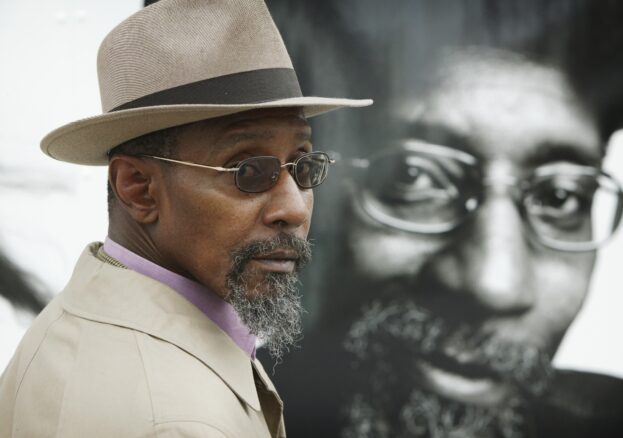
Linton Kwesi Johnson helped change the sound and public reach of British poetry. His work made the experiences of Black communities central to an art carried through books, records and live performance. Racism, migration and struggles for justice became subjects for close observation and verbal invention. His political commitment was sustained across a career that also encompassed journalism and cultural organising. When English PEN awarded him its Pinter Prize in 2020, the judges recognised both the force of his writing and its influence across generations. 12
From Jamaica to south London
Born in Jamaica in 1952, Johnson came to London as a child to join his mother. Brixton became an important setting for his life and work. While still at school, he joined the Black Panther movement, finding a political language concerned with working people, freedom and racial justice. Remembering that period for Goldsmiths, he described the strength of his commitment to equality. The movement offered a way of understanding experiences that could otherwise appear as isolated encounters with prejudice. 1
He subsequently studied sociology at Goldsmiths. He had hoped the subject would explain society and his own place within it; looking back, he valued the questions and methods it gave him instead. He remembered his tutor Paul Filmer as encouraging independent thought. That account places inquiry alongside political conviction in his development. Johnson’s poems would often examine a situation from within, attending to how people described events, responded to pressure and made sense of the world around them. 1
Within the Panthers, Johnson helped organise a poetry workshop and developed work with Rasta Love, a group of poets and drummers. His professional life also included work as library resources and education officer at the Keskidee Centre, an important home for Black arts. These connections located writing within shared activity: workshops, access to books and exchanges between performers. 2
Finding a language for the poems
In a 2023 conversation with Gary Younge, Johnson explained that hearing blues and jazz poetry encouraged him to write reggae poetry. He identified Louise Bennett’s use of Jamaican language as a source of authority, alongside the Last Poets’ use of African American urban speech. Reggae deejays including Big Youth and U-Roy also mattered. These influences offered examples of artists making forms out of the language and music around them. Johnson approached poetry through that creative inheritance and through the lives of the people he wanted to address. 3
He told Younge that it made sense to write about Afro-Caribbean communities in their everyday language. This was an artistic decision involving audience, sound and belonging. His explanations also resist treating every speaker as an uncomplicated version of himself. Discussing Inglan Is a Bitch, for example, he described an attempt to convey what his parents’ generation had endured. The poem’s complaint belongs to a wider history of labour and migration, shaped into a voice that can make those experiences immediate. 3
Black publishing organisations helped bring the work into print. His poems appeared in Race Today, which published Voices of the Living and the Dead in 1974. Bogle-L’Ouverture published Dread Beat An’ Blood the following year. The latter title also became his first album, released in 1978. These connections between a political journal, an independent publisher and recorded music are central to his emergence. Different routes carried the poems towards readers and listeners, allowing their audience to grow across several cultural settings. 2
Working with reggae and Dennis Bovell
The musician and producer Dennis Bovell became a crucial collaborator. A member of the British reggae group Matumbi, Bovell brought experience as a multi-instrumentalist, sound engineer and bandleader. His partnership with Johnson connected the making of poems with the collective work of musicians and recording studios. The records therefore belong within the history of British reggae as well as within literary history, involving skills and creative decisions distributed across an ensemble. 4
Their work together included Forces of Victory in 1979, Bass Culture in 1980 and Tings An’ Times in 1991. Bovell formed the Dub Band, with which Johnson recorded and toured internationally. The partnership gave the writing a life beyond its original London settings. Audiences in different countries could encounter poems closely rooted in British conditions through the shared possibilities of musical performance. The continuity of that collaboration also allowed the relationship between voice and accompaniment to develop over time. 4
Johnson also recorded without instrumental accompaniment. LKJ A Cappella Live, released in 1996, brought together fourteen poems. That format places particular attention on the resources of the speaking voice: stresses, pauses, repeated sounds and the movement of a story through time. 12
Sonny’s letter and the experience of policing
Sonny’s Lettah takes the form of a letter from Brixton Prison to the speaker’s mother. Sonny has promised to look after Jim, and now must explain how both have been arrested. An ordinary wait for a bus becomes an encounter with police violence. Sonny intervenes, an officer dies and the charges against the two men differ: Jim faces a charge under the law known as sus, while Sonny is charged with murder. Johnson places a sequence of public events inside a difficult act of family communication. 5
The repeated address to his mother gives the account its emotional structure. Sonny’s need to explain himself accompanies the increasingly rapid description of blows and retaliation. The formal opening and closing of a letter hold together an experience that threatens to overwhelm its writer. This is an invented dramatic account, whose power depends on voice, pace and the relationship it creates with an absent listener. Readers encounter a person trying to maintain that relationship while communicating devastating news. 5
Its subtitle identifies it as an anti-sus poem, placing the work within a specific political campaign. Parliament repealed the sus law through the Criminal Attempts Act in 1981. 6
Brixton and the making of a collective account
Di Great Insohreckshan responds to the Brixton uprising of April 1981. Its opening identifies a place, a month and a year, announcing an event of historical importance. It presents resistance to policing through a recurring account of what the participants did. Operation Swamp 81, the police operation in Brixton, becomes part of the poem’s explanation of the confrontation. Repetition helps turn separate actions into a collective statement, while the language insists that those involved understood the events through a history of oppression. 7
The narrator explicitly wishes he had been there and describes finding out what happened through other people’s accounts. That position matters: the poem is not a straightforward declaration of personal eyewitness testimony. It stages the circulation of stories afterwards, including boasts, justifications and acknowledgements that innocent people were hurt. Its defiance is therefore carried through reported speech as well as through the narrator’s own voice. The closing warnings about further force retain the tension between a celebrated moment of resistance and an unresolved political conflict. 7
Grief, memory and a wider emotional range
Reggae fi Dada turns towards a father’s illness and death, connecting personal loss with the circumstances of life in Jamaica. Its speaker travels back after hearing that his father is sick, then makes another journey following news of his death. The account moves through poverty, violence and the difficulty of providing for a family. A repeated farewell offers the father rest, while the surrounding passages ask what kind of life he was able to live and what his labour received in return. 8
The poem’s movement between tenderness and accusation prevents the father from becoming merely an example in an argument. His efforts to feed and clothe children remain particular acts of care. The ending names the burial ground and nearby relatives, bringing the larger social account back to a place and a family. Johnson’s political imagination makes room for this intimacy: structures of inequality become visible through what they demand from one person over a lifetime and through what survives in another person’s memory. 8
There is wit and literary conversation in If I Woz a Tap-Natch Poet. Johnson’s speaker imagines the poems he might write if he possessed the qualities of writers he admires. The names include Christopher Okigbo, Derek Walcott, T. S. Eliot, Kamau Brathwaite, Jayne Cortez and Lorna Goodison. This is a wide field of reference, bringing African, Caribbean, African American and European writing into the same encounter. The imagined possibilities range across emotional depth, beauty and political force. 9
Each movement returns to the speaker’s own rhythm, rhyme and sense of timing. The apparent modesty of the premise gradually gives way to confidence in his particular resources. Admiration does not require imitation, and the poem resists reducing the writer to a performance of cultural identity for someone else’s approval. Its repeated returns enact that independence. Johnson can acknowledge a varied literary inheritance while continuing to make work through the sounds, commitments and forms he has chosen for himself. 9
Creating opportunities for other voices
Johnson established LKJ Records in 1981, initially releasing two singles by the Jamaican poet Michael Smith. His work as a producer also included recordings by Jean ‘Binta’ Breeze and the jazz trumpeter Shake Keane. Running a label extended his contribution into the practical work of bringing other artists to listeners. 2
He also helped organise and participated in the International Book Fair of Radical, Black and Third World Books, held between 1982 and 1995. Initiated by New Beacon Books, Bogle-L’Ouverture and Race Today Publications, the fairs brought together publishing, literature and the arts. Participants included writers such as Ama Ata Aidoo, Kamau Brathwaite, Lorna Goodison and Ngũgĩ wa Thiong’o. Johnson belonged to an international exchange whose possibilities depended on the organising work surrounding the public events. 10
The George Padmore Institute revisited this history at an event he hosted in 2024. Remembering the fairs reveals another dimension of cultural achievement: the creation of places where writers, publishers and readers can meet. The history of the poems includes these networks of exchange and the people who sustained them. 10
Books, recognition and continuing influence
Mi Revalueshanary Fren appeared in Penguin’s Classics series in 2002. It was reissued as Selected Poems with additional material in 2006 and expanded again in 2022. The later edition includes an introduction by Gary Younge and new work by Johnson, including Reggae fi Mama and Towards Closure. Its publication details record that the latter was commissioned for the television documentary Uprising. These successive editions let readers follow a body of writing that continues beyond the best-known poems of the 1970s and 1980s, adding further occasions for reflection and remembrance. 11
The PEN Pinter Prize in 2020 recognised Johnson’s commitment to political expression and historical scrutiny. The judges also noted the humour of his work and its effect on younger generations. The award brought together literary judgement and the concern for freedom of expression associated with Harold Pinter’s name. 12
Time Come, published in 2023 with an introduction by Paul Gilroy, gathered another substantial part of Johnson’s writing. Its contents draw on reviews, lectures, speeches, obituaries and other prose written across decades. The subjects include Caribbean and Black British music, literature and political life, alongside tributes to artists and activists who mattered to him. Readers can encounter a critic listening to records, assessing books and considering the achievements of others, as well as the poet whose own voice has become widely recognised. 13
The variety of those forms is significant. An obituary attends to a particular life, a review makes an argument about a work and a speech addresses an occasion and an audience. Collected together, they show how many kinds of writing can contribute to cultural memory. Johnson’s career has included this sustained attention to the work and struggles that surrounded his own. 13
A younger poet, Jay Bernard, offered a specific response to that inheritance in England Street (Reggae fi Linton), commissioned by English PEN in 2020. Explaining the poem, Bernard connected Johnson’s work with the Brixton streets where they had grown up and first heard his recordings. They considered the literary names attached to local roads and the relationship between those names, Britishness and the surrounding neighbourhood. Johnson’s example became an occasion to ask who is remembered in the places people inhabit. 14
Bernard also drew attention to the measured, observant qualities of Johnson’s voice and to his practice of writing reggaes for other people. Their tribute carried those possibilities into a different poem and historical moment. That is a particularly revealing form of influence: another writer finding resources for their own questions in Johnson’s ways of listening, remembering and making language public. 14
Sources
1. Goldsmiths, University of London — Linton Kwesi Johnson: student profile and recollections.
2. Linton Kwesi Johnson / LKJ Records — About LKJ.
3. Chatham House — Gary Younge interviews Linton Kwesi Johnson, 2023.
4. Linton Kwesi Johnson / LKJ Records — Dennis Bovell.
5. Linton Kwesi Johnson / Poetry Archive — Sonny’s Lettah: authorised poem text.
7. Linton Kwesi Johnson / Poetry Archive — Di Great Insohreckshan: authorised poem text.
8. Linton Kwesi Johnson / Poetry International — Reggae fi Dada: original poem with Dutch translation.
9. Linton Kwesi Johnson / Poetry Archive — If I Woz a Tap-Natch Poet: authorised poem text.
11. Penguin Books — Selected Poems, 2022 edition: publisher’s sample, publication history and contents.
12. English PEN — Linton Kwesi Johnson awarded PEN Pinter Prize 2020.
13. Pan Macmillan / Picador — Time Come: Selected Prose.
14. Jay Bernard / PEN Transmissions — Why I Wrote England Street, October 2020.
Image credit
Linton Kwesi Johnson performing in Brussels in October 2017. Photograph by Peter Verwimp, via Wikimedia Commons. CC BY-SA 4.0. Image source; licence.





Join the conversation
Comments 0
Share a memory, ask a question or add to this story.
No comments yet. Add your perspective.
Add your voice
Create a free account and verify your email to leave a comment.
All comments are reviewed before publication.