Notting Hill Carnival took shape in a neighbourhood where Caribbean residents faced poor housing, discrimination and racist violence. In 1958, white gangs attacked Black people; the following year, the murder of Antiguan resident Kelso Cochrane deepened local anger. Campaigning included meetings and demonstrations, but public celebration also became a way of bringing people together. The festival that developed was changed by successive generations of performers and organisers. Their decisions shaped its costumes, musical programme and ways of occupying the streets. 1
Indoor carnival and the neighbourhood festival
One important strand began away from Notting Hill. In 1959, Claudia Jones organised an indoor Caribbean carnival at St Pancras Town Hall, broadcast by the BBC. Jones, the Trinidadian activist and founder of the West Indian Gazette, helped give Caribbean performance a public platform in Britain. Edric and Pearl Connor, working with the Gazette and other partners, promoted further indoor events in London halls during the 1960s. These gatherings created audiences and opportunities for artists. They belong to Carnival’s cultural history, but the 1959 event was an indoor celebration in another part of London. The later Notting Hill street festival emerged through neighbourhood organising of its own. 2
Rhaune Laslett’s work grew out of local activities for children and efforts to improve relations among the area’s different communities. Through the London Free School, she developed the idea of a free festival. The Notting Hill Fayre and Pageant took place over a week in September 1966. Its parade included children dressed as characters from Charles Dickens, alongside performers representing the neighbourhood’s varied backgrounds. In the Free School’s newsletter, The Grove, Laslett explained that living close together had not necessarily produced communication between residents. Participation was intended to change that. This mixture of a children’s event, a neighbourhood celebration and live performance provided the setting in which the street carnival developed. 3
Traditions made through change
The Caribbean traditions available to these organisers already carried histories of adaptation. In Trinidad, Canboulay developed from processions associated with enslaved labour into celebrations after emancipation. Patrick Murphy’s research follows how participants transformed both the procession and the figure of the field labourer during the nineteenth century. Elite revellers had caricatured that figure; Black participants subsequently reworked it within their own street celebrations. Performance involved changing the meaning of an inherited character and asserting a presence in urban space. Caribbean carnival therefore brought together memory, satire and the use of public streets. Its history was shaped by disputes over slavery, freedom and authority as well as by changes in costume and music. 13
Steelpan brought a distinctive combination of musical skill and mobility. The Trinidad All Steel Percussion Orchestra performed at the Festival of Britain in 1951, and players including Sterling Betancourt remained in Britain. Russell Henderson, who also arrived in 1951, worked with Betancourt in a band that performed in clubs and smaller venues. Henderson’s musicians later played for Laslett’s events. With instruments supported around their necks, they could move while performing and draw listeners into a procession. This movement helped turn an arranged programme into participation along the streets. Steelbands also developed a continuing competitive life: Panorama and Carnival provided settings in which ensembles from different parts of Britain could perform music prepared through sustained rehearsal. 4
A changing Caribbean programme
By the early 1970s, Caribbean participation was reshaping the festival. Leslie Palmer’s 1973 programme involved performers with links to Dominica, Grenada and St Lucia, while experienced Trinidadian masquerade-makers contributed costumes. The widening range of participants mattered: Caribbean culture at Carnival included different island traditions and the preferences of people growing up in Britain. Programme choices helped determine whose music and forms of performance would be heard. 1
Sound systems were formally invited into Carnival in 1973 under Palmer, although Duke Vin and Count Suckle had already played sets on local streets unofficially. Their inclusion gave organised space to an approach rooted in Jamaican musical culture. A sound system involved a named team and its equipment, record choices and presentation, rather than simply loudspeakers hired for a stage. At Carnival, static systems created places where audiences could gather while a procession moved elsewhere through the area. The festival could therefore contain several musical experiences at once. Reggae and dub became part of a programme that also accommodated changing tastes, with later systems playing styles including soul, hip-hop and jungle. 5
Calypso had a different relationship with its audience, placing particular weight on lyrics, humour and commentary. Soca’s emphasis on dance and movement served another part of the carnival experience. Britain’s calypsonians continued performing at dances and shows even when broadcasters gave the genre less attention during the 1960s. Official competitions around Carnival began in 1976. The Association of British Calypsonians subsequently created a more durable base for performers: its first London Calypso Tent opened at the Yaa Asantewaa Centre on 7 August 1992. The event moved to the Tabernacle in 2008. A carnival season thus included organised performances and competition in indoor venues, alongside the music encountered during the street procession. 12
Mas as storytelling and design
Mas, short for masquerade, involves joining a band and performing in costume. Traditionally, a band develops a theme, with individual roles such as a king and queen contributing to a larger presentation. Characters including the Midnight Robber, Dame Lorraine and Moko Jumbie belong to this varied repertoire. Bands have also adopted more decorative forms of costuming, including designs influenced by Brazilian carnival. There is no single visual style that represents every participant. Preparing a presentation involves designing costumes, introducing a theme to prospective members and organising people into sections for the parade and judging. The costumes visible on the road are the result of choices made collectively and work undertaken well before the event. 6
The possibilities extended beyond familiar historical characters. For the 1998 presentation Call the Rain, Ali Pretty and Ray Mahabir designed Radiance, a queen costume depicting the renewal of the earth after drought. The presentation drew inspiration from Jeanette Winterson’s writing and won first prize in Carnival’s design competition. The surviving design, held by the Victoria and Albert Museum, places a literary idea alongside the demands of performance. Carnival designers were working with colour, form and a theme that an audience could encounter through a moving body. This was a new subject presented through a familiar queen role and a competition in which design itself was judged. 7
Policing and the struggle over representation
The 1976 Carnival became a turning point in public discussion of the event. Violence broke out on the bank holiday Monday after a confrontation involving police and suspected pickpockets. The historian Jessica White’s examination of newspaper coverage shows how reporting frequently foregrounded injured officers and images of Black young men as a threat. Some community leaders and residents argued that the scale and conduct of policing had aggravated tensions. These were competing explanations of the same events, with consequences for how Carnival was understood outside the neighbourhood. A celebration involving musicians, families and costume bands could be publicly represented through a narrow sequence of confrontation. The selection of photographs and headlines helped establish that emphasis. 10
Questions about organisation and policing continued into the following decade. The Association for a People’s Carnival and the Notting Hill International Carnival Committee were formed in autumn 1989 in response to that year’s event. Michael La Rose and the People’s War Carnival Band were active in creating both organisations. The band itself, formed by Michael and Keith La Rose in 1983, illustrates how making mas and organising politically could occupy the same community network. Papers preserved at the George Padmore Institute include letters, administrative records and publicity, as well as press coverage collected to challenge accounts of the 1989 Carnival. Community involvement extended to who represented participants and who negotiated the conditions under which Carnival took place. 9
Planning for a festival on public streets
As Carnival grew, the movement of people became a major planning question. The Greater London Authority’s 2004 strategic review discussed how the procession, sound systems and street stalls influenced crowd density together. Its public safety project, established in 2001, studied crowd behaviour and assessed possible routes using observation and modelling. Changing a route also affected bands’ logistics, residents and the resources required from public agencies. The review recommended clearer arrangements for responsibility and continuing observation of crowd movement. It recorded the difficulty of coordinating a community festival across several organisations, each with different powers and responsibilities. The streets were simultaneously a performance space, a residential neighbourhood and a place requiring transport, medical provision, stewarding and access. 11
The work carried beyond Notting Hill
Carnival’s preparation reached across London. Hackney groups travelled west to participate, and some returned to parade along Stoke Newington High Street in an unofficial continuation known as the Last Lap. Workshops in their own neighbourhoods produced work for the Notting Hill procession. Lincoln Rahamut made the Sky at Night costume for his seven-year-old daughter Sarah-Jane to wear there in 1990, working at Perpetual Beauty’s base in an old Stoke Newington fire station. 8
Its metal structure balanced around a backpack so she could dance, placing practical construction at the centre of the design. The costume survives in Hackney Museum, but many comparable creations did not: makers commonly reused their materials for the next year’s presentation. New themes were built from the remains of earlier performances. 8
Sources and further reading
1. London Museum. The origins of Notting Hill Carnival.
2. Notting Hill Carnival. History.
3. Notting Hill Carnival, Google Arts & Culture. Rhaune Laslett.
4. Notting Hill Carnival. Steel Bands.
5. Notting Hill Carnival. Sound Systems.
6. Notting Hill Carnival, Google Arts & Culture. The History of Mas.
7. Victoria and Albert Museum. A V&A celebration of carnival in seven objects.
8. Hackney Museum. Making Carnival: 50 years of Mas, music and movement.
9. George Padmore Institute. Carnival Material, 1972–2006.
10. History Workshop. Police, Press & Race in the Notting Hill Carnival ‘Disturbances’.
11. Greater London Authority. Notting Hill Carnival: A Strategic Review.
12. Notting Hill Carnival. Soca & Calypso.
13. Patrick Murphy, University of Chicago. Canboulay and the Negre Jardin.
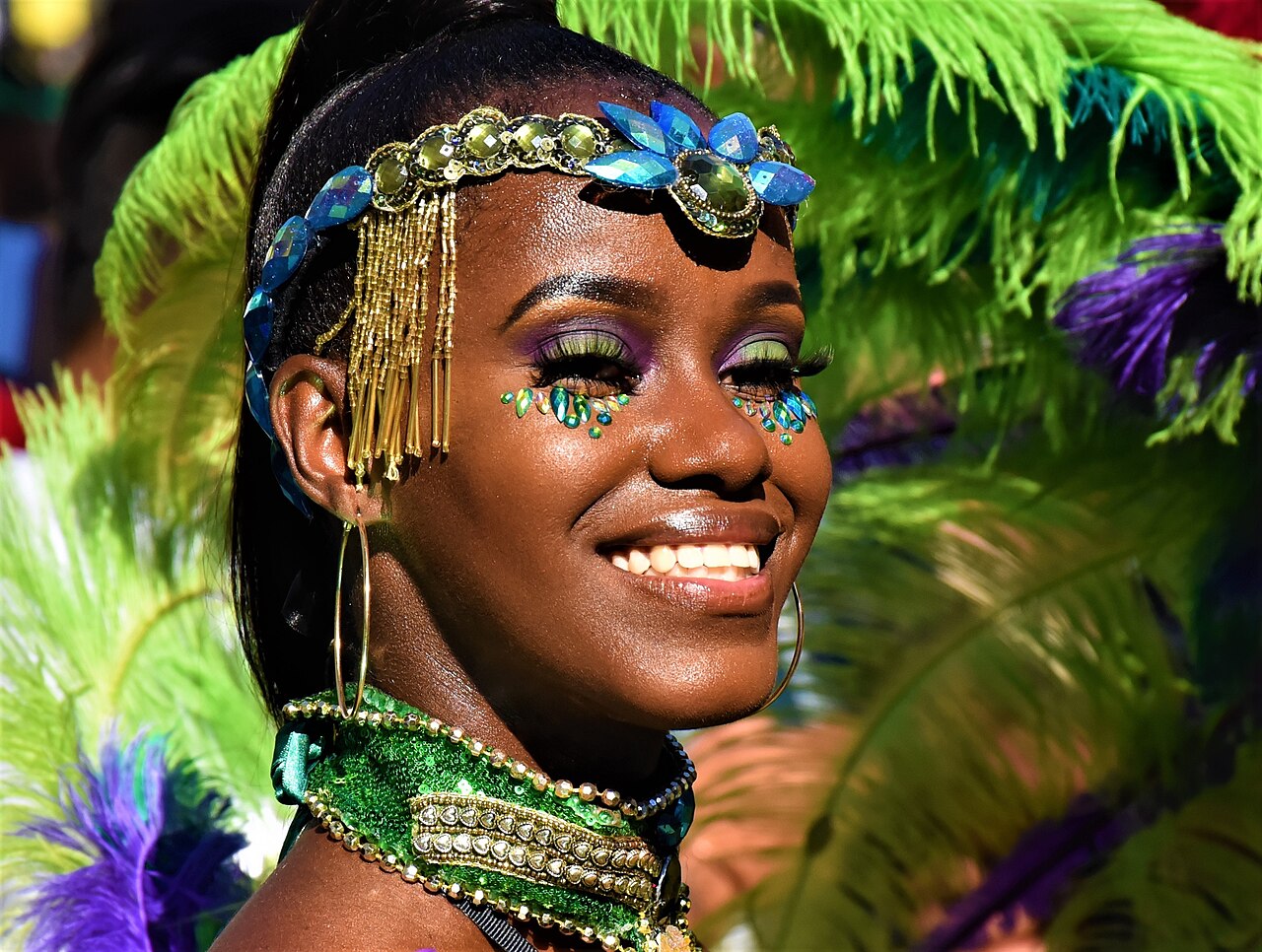
Featured image. A participant at Notting Hill Carnival in London, photographed on 26 August 2019. Photograph: David Sedlecký, 26 August 2019, via Wikimedia Commons. Image record · CC BY-SA 4.0
