Black women’s football history reaches back into the nineteenth century, but recovering it requires care with the records. Emma Clarke played for the British Ladies’ South team in the club’s March 1895 match at Crouch End. Newspaper descriptions helped later researchers identify her presence. A widely repeated account connected her with a family in Bootle. Research reported by the North West Labour History Society subsequently challenged that identification, using evidence of footballing sisters from Plumstead and a later newspaper account of Florence’s playing career. This distinction matters: a familiar name in a census does not automatically identify the person on a team sheet. The history includes both participation on the pitch and the difficult work of establishing whose life the surviving documents describe. 1
Playing under restriction
The wider opportunities available to women changed sharply in December 1921, when the Football Association excluded their matches from the grounds of its affiliated clubs. Women continued playing, including at smaller venues and rugby grounds, but access to established football facilities had been restricted. Their game survived through separate organisation and the work of clubs. The Women’s Football Association, formed in 1969, brought representatives of 44 clubs together. Its emergence and the first Women’s FA Cup competition in 1971 helped rebuild a national structure. This background is essential to the later careers of Black players. They entered a game whose competitions and institutions had developed through years of exclusion, with women themselves taking substantial responsibility for keeping teams and fixtures in existence. 2
International football and a working life
Kerry Davis made her England debut in September 1982, against Northern Ireland at Crewe, becoming the women’s team’s first Black international. Her career developed across several kinds of footballing opportunity. She played in the 1984 European final, the 1985 Mundialito invitational tournament and the 1995 World Cup. At club level, a move from Crewe took her into Italian football, where she spent four years with Lazio, Trani and Napoli. Returning to England, she later contributed to Croydon’s league and FA Cup double in 1995–96. Her route places overseas employment within the history of the English game. A player’s ambitions could involve changing countries and competitive settings, then bringing that experience back into a domestic club. 3
Brenda Sempare’s career makes the relationship between football and other work equally visible. While representing England during the 1980s, the midfielder also worked as a postwoman. She scored in the final of England’s 1985 Mundialito victory over Italy and played in all four of the team’s matches at the 1995 World Cup. Her achievements at Croydon included a decisive league goal against Arsenal in 1996 and a successful penalty in the FA Cup final shootout that completed the club’s double. These are records of sustained sporting accomplishment alongside a working life outside football. They also direct attention to what a player contributed within matches: creating chances, scoring under pressure and helping a team turn a season’s performances into trophies. 4
Leading teams and earning a living
Hope Powell’s work crossed the boundary between playing and directing a team. She began coaching qualifications at nineteen, while continuing a playing career that included Millwall Lionesses, Friends of Fulham and Croydon. In 1996 she captained Croydon to the league and cup double. Two years later, she became England women’s first full-time national coach. The appointment made coaching itself a more clearly defined professional responsibility within the national side. Powell remained in charge for fifteen years, taking England to two World Cups and the 2009 European final. Her career demonstrates the value of knowledge accumulated through playing, study and coaching education. It also places a Black woman within the practical development of the national team’s professional organisation. 5
Mary Phillip brought leadership to both defence and the dressing room. After starting with Millwall Lionesses, she joined Fulham at the beginning of its professional project and became club captain. In 2003 she also became the first Black woman to captain England. Her move to Arsenal the following year placed her in another successful team: across four seasons, the club won four league titles and, in 2007, the UEFA Women’s Cup. Phillip played in every England match at the 2007 World Cup. These overlapping responsibilities show how international leadership grew through regular club football. After retiring as a player she moved into coaching, including managing Peckham Town, extending her experience into a different level of the game. 6
Professional contracts altered what some players could expect from club football. Rachel Yankey signed one with Fulham in 2000, after developing at Arsenal and making her England debut as a teenager. Her subsequent career took her to Birmingham City and the New Jersey Wildcats before she returned to Arsenal in 2005. She then spent another eleven years at the club, contributing from the wing to domestic victories and its 2007 European success. Her record was built through repeated seasons, training and selection, rather than one breakthrough appearance. The sequence of clubs also shows that the women’s game was becoming a wider employment market. Players moved between ambitious British teams and opportunities abroad as they pursued their sporting careers. 7
Making experience public
Anita Asante’s career also connected English clubs with overseas football. After playing at Arsenal and Chelsea, she competed in the United States and Sweden before returning to England. In a 2021 interview, she explained that joining Aston Villa had given her a chance to explore a different region’s football culture and encourage girls in the Midlands. She also rejected the idea that athletes should avoid discussing discrimination. Her argument was that race, gender and sexuality already affected people’s lives within sport, as elsewhere. Speaking publicly was therefore part of her responsibility to people whose experiences received less attention. Her account connects the movement of a player between clubs with the questions she chose to raise through the platform football provided. 8
For Nikita Parris, the people who encouraged her were often close to home. Writing in 2021, she described learning Black history from her grandfather, community centres and youth clubs in Liverpool. Football was part of those settings: watching matches could lead into discussions about history and identity. She remembered local community leaders as important role models and argued for Black history to have an enduring place in education. Her recollections widen the meaning of a footballing upbringing. A child’s experience could be shaped by adults who organised activities and conversations, as well as by coaches teaching skills. Parris also described gradually recognising her own influence on younger children, linking her public role as a player to the community example she had encountered herself. 9
Support beyond a place in the team
Visibility did not remove the need for practical support. In July 2022 the Professional Footballers’ Association launched its See It. Achieve It. campaign, led by former player Fern Whelan. The union reported that only 29 of 300 Women’s Super League players were Black, Asian or of mixed heritage. Those combined categories should not be read as a count of Black players alone. The campaign proposed a network offering mentoring and specialist support, alongside videos about players’ experiences. It also set out plans to include women working in other football roles. These were organised responses to underrepresentation: they sought to connect individuals with colleagues and resources. The launch described an intended programme, rather than proving that lasting changes had already been achieved. 10
Coaching offered another route into sustained football work. In an account published in October 2023, Estelle Handy described beginning to coach at fourteen, then finding a weekend role with the all-girls club AFC Leyton while at university. Responsibilities expanded through youth teams and first-team management, followed by academy work and an England under-16s development opportunity. She emphasised communication and building relationships with players, including those older than herself. Handy also recalled how unusual it had been to encounter a Black woman coach: Hope Powell was an early example, and Mary Phillip coached her briefly at Peckham Town. Her experience links professional development with the local clubs where someone can first practise coaching, take responsibility and learn from working with different people. 11
Who gets the chance to develop?
Opportunities for players also depend on where training happens and how entry is organised. In February 2023 the FA announced a redesigned pathway, with Emerging Talent Centres for girls aged eight to sixteen and Professional Game Academies preparing older players for senior football. A stated aim was to put an emerging centre within an hour’s journey for 95 per cent of players by 2024. The design allowed girls to continue with grassroots clubs or school teams alongside their centre training, including opportunities in mixed football. These arrangements treated location and varied playing experience as part of talent development. The distance target was an ambition announced with the programme; the announcement alone cannot establish how many families subsequently benefited from it. 12
In its September 2024 review, the FA reported that 73 Emerging Talent Centres had been established. It also reported increased access to the pathway among underrepresented groups and people from economically deprived areas, alongside the operation of 21 Professional Game Academies. These findings describe a broader pool entering structured development. They do not, by themselves, show the experience of every Black girl or how many participants will eventually build a senior career. The distinction helps place celebrated achievements in context. A place at training, continued participation and eventual professional employment are different stages. A fuller history therefore follows opportunities across time: who is invited in, who can remain involved, and whose experience helps shape the teams and institutions that come afterwards. 13
Sources and further reading
1. Britain’s First Black Women Footballer: A Case of Mistaken Identity?. North West Labour History Society.
2. Kicking Down Barriers. The Football Association.
3. Kerry Davis Receives MBE. England Football.
4. Brenda Sempare. National Football Museum.
5. Hope Powell. National Football Museum.
6. Mary Phillip. National Football Museum.
7. Rachel Yankey. National Football Museum.
8. Anita Asante on Football and Advocacy. The Football Association.
9. Nikita Parris on Black History and Education. England Football.
10. See It. Achieve It. Campaign Launch. Professional Footballers’ Association.
11. Estelle Handy’s Coaching Journey. England Football.
12. Women’s and Girls’ Player Pathway. The Football Association.
13. Women’s and Girls’ Strategy: 2024 Review. The Football Association.
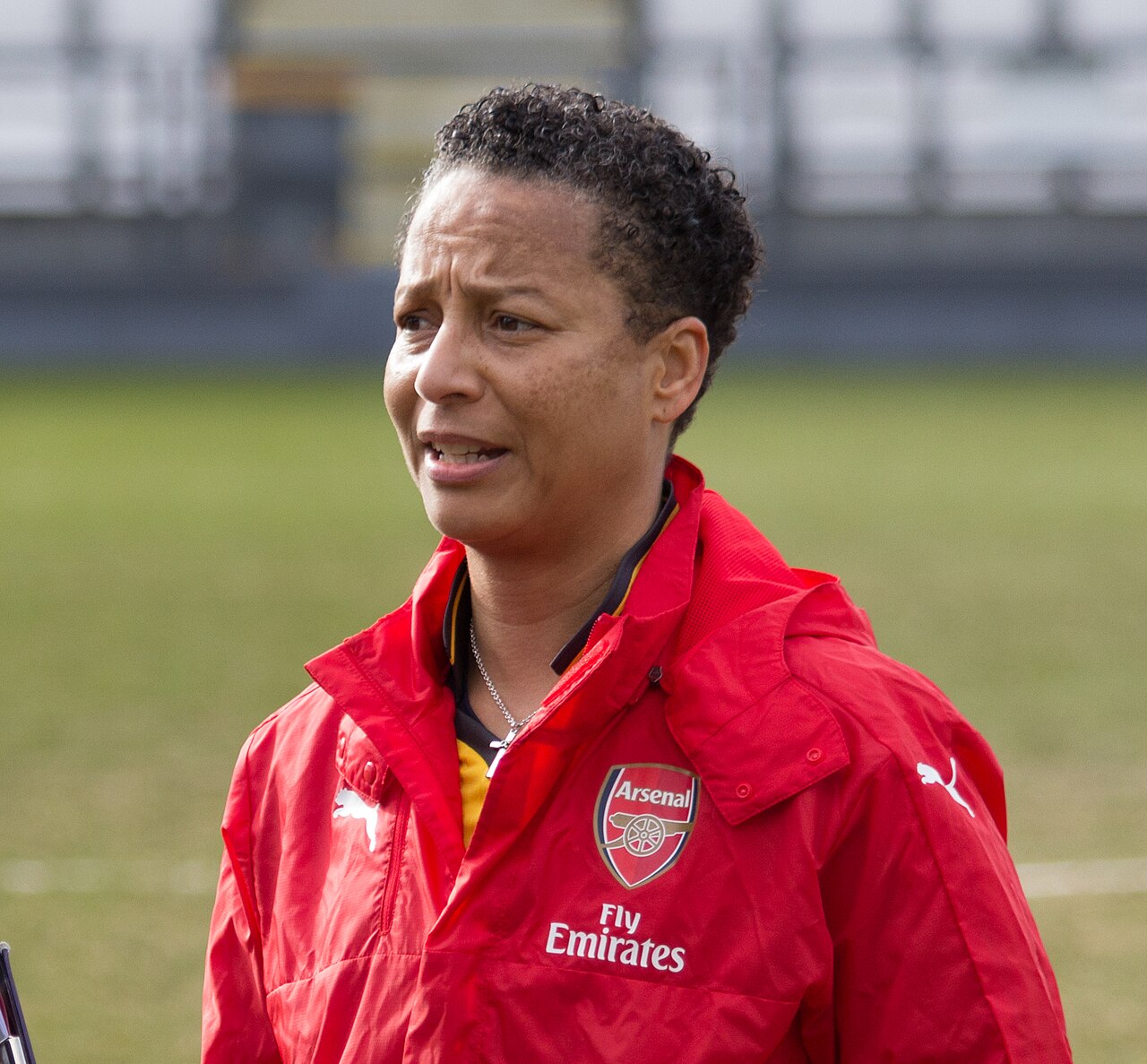
Featured image. Hope Powell before Arsenal LFC’s match against a Kelly Smith All-Stars XI, 19 February 2017. Photograph: Katie Chan, 19 February 2017, via Wikimedia Commons; source-provided crop. Image record · CC BY-SA 4.0
