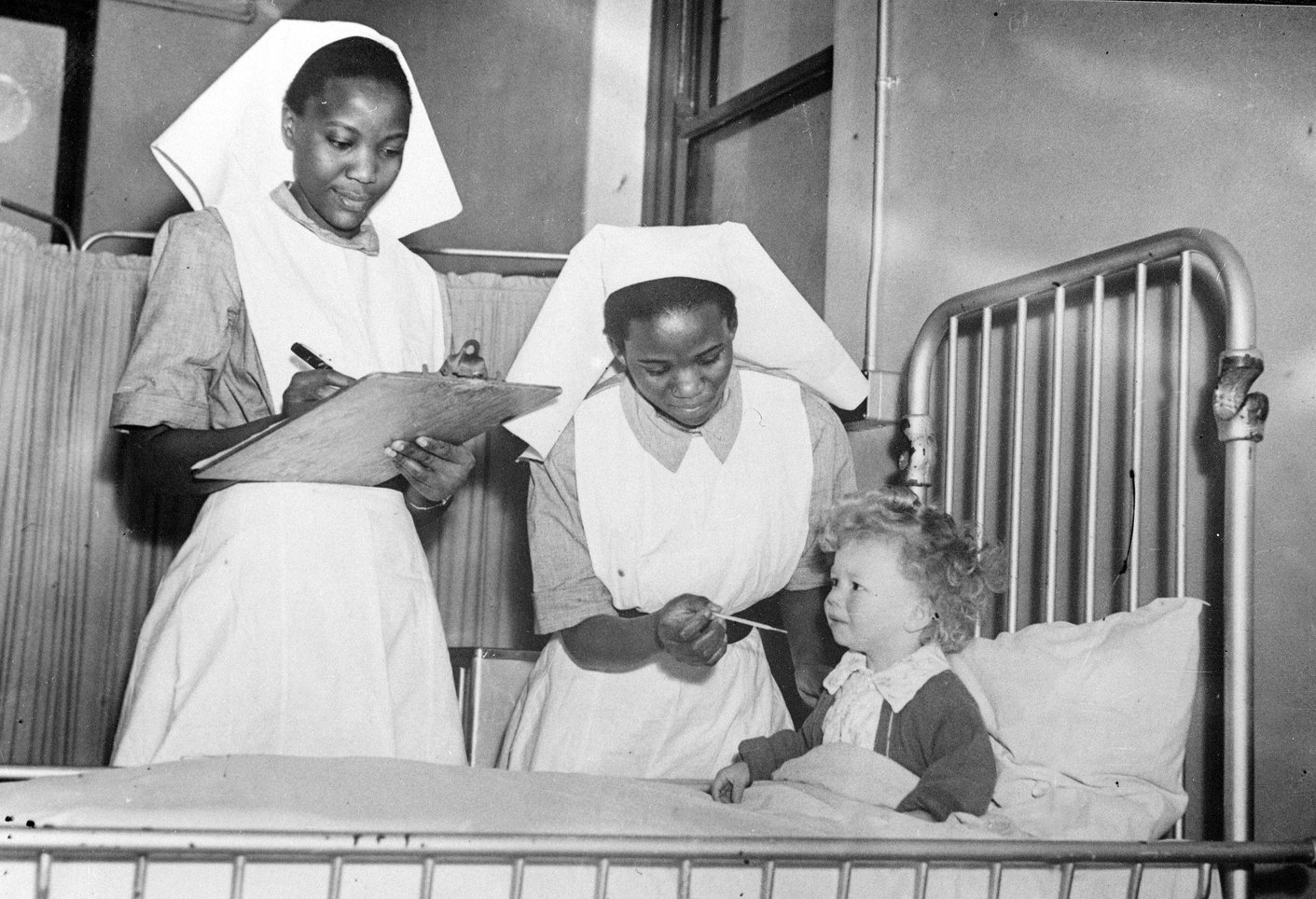
The NHS opened in 1948 with a promise of wider access to healthcare and a serious shortage of people to provide it. Hospitals already lacked nurses before the Second World War ended; the new service inherited those shortages while treating needs that had previously gone unmet. From 1949, the Ministries of Health and Labour worked with the Colonial Office and nursing organisations to recruit women from the Caribbean. Recruitment helped sustain an expanding service, but it also brought thousands of individual ambitions into British hospitals: ambitions that did not always match the positions employers were willing to offer. Nursing formed part of a wider staffing effort that also included hospital porters, cleaners, cooks and other workers. The everyday operation of a hospital depended on these occupations alongside the work of doctors and qualified nurses. 1
Professional education in the Caribbean
The Caribbean had its own developing nursing institutions. In January 1949, forty-seven women entered the University College Hospital of the West Indies’ basic nursing programme in Jamaica. Their preliminary course combined teaching at Mona with practical experience at Kingston Public Hospital; the university hospital itself opened in 1952. Nurses campaigning for stronger professional education helped shape this development, including through the Jamaica General Trained Nurses Association. The Nursing Registration Law of 1951 provided a new framework for registration. These developments matter to the migration story because professional preparation was also being built within the Caribbean. Training could support work at home or overseas, and graduates could themselves become tutors. Britain was one destination within this changing professional world. 2
Reasons for travelling varied. Historian Karen Flynn interviewed Caribbean nurses who trained in Britain before moving to Canada. Some had relatives already in Britain; others applied directly to hospitals or received scholarships that required a return home after qualification. Several remembered travel as an opportunity for independence and adventure. Their family circumstances differed too: some came from households able to invest in education, while others needed borrowed money for the fare. Nursing might be a longstanding choice, an alternative to an unaffordable medical education, or an occupation encouraged by relatives. Such decisions help explain why the same recruitment system attracted people with different expectations. A hospital could see a staffing vacancy where a young applicant saw education, a salary and room to make her own decisions. Nor did arrival necessarily mean permanent settlement: Flynn’s interviewees later moved again, carrying British training into further professional lives in Canada. 3
Learning while keeping the wards running
For much of the early NHS period, training took place inside hospitals and depended heavily on students’ labour. After preliminary instruction, probationers undertook cleaning and clinical duties under ward sisters while continuing their studies. The distinction between employee and learner was therefore difficult to maintain: patients needed care even when a student needed teaching or revision time. Residence in a nurses’ home could also place accommodation and private conduct under the authority of the matron. The Horder committee, which investigated nursing between 1942 and 1950, criticised the burden placed on trainees and recommended better hours, accommodation and education. For newly arrived trainees, the hospital was therefore a workplace, a school and often a home, each governed by rules they had to learn. 4
The qualification offered could shape an entire career. State Enrolled Nurse training normally lasted two years, compared with three years for State Registered Nurse training. The Royal College of Nursing’s historical exhibition records that many overseas recruits were directed towards the enrolled route, where opportunities and recognition were more limited. Some subsequently undertook additional training to become registered nurses. Shirley Ramnarine, recruited from Trinidad in 1967, began enrolled nurse training in Bath and later became a registered general nurse and a practice nurse. Her route shows why an initial appointment should not be treated as the final measure of someone’s capabilities. It also helps explain the importance of access to further study: progression could require another substantial investment of work and time after the first qualification. 5
Accommodation, friendship and unequal treatment
Hospital life could create lasting friendships without protecting nurses from racism. Allyson Williams arrived from Trinidad in 1969 to train at the Whittington Hospital in London. Of thirty students in her group, sixteen came from Trinidad, although they had not previously known one another. She recalled building friendships that lasted long after training. She also described patients refusing her care and other racist treatment, which she learned to challenge. Her subsequent career included specialist midwifery, further qualifications and senior management. The combination is significant: professional achievement and a supportive peer group could coexist with repeated discrimination. Nurses could be respected for their work by some people and rejected by others during the same career, rather than experiencing a simple progression from hostility to acceptance. 6
Mental health nursing and the organisation of care
Caribbean men also entered nursing, particularly mental health work. Denzil Nurse travelled from Barbados and began training at Stanley Royd hospital in Wakefield in 1963. In testimony recorded for a Huddersfield history project, he described being assigned work on a hospital farm when he had come to learn nursing. He later became a charge nurse, but recalled managers questioning whether colleagues would accept orders from a Black person. The account places discrimination within the allocation of work and authority, rather than only in personal insults. 7
The same project recorded how employment shaped family life. Alda Flowers explained that night shifts allowed her to be with her children around the school day and brought additional pay. Informal childcare between families helped make difficult working hours manageable. 7
The Bethlem and Maudsley archives reveal another route into psychiatric nursing. Josephine St John came from Trinidad to Britain in 1958 and served in the army nursing corps before joining the joint hospitals in 1963. Her experience included postings in Singapore and Malaya. She became deputy sister in 1964 and sister on Bethlem’s Fitzmary 1 ward in 1965. This was a career built across institutions and countries, with responsibility extending beyond an initial recruitment placement. Around it, the nursing school’s photographs record a broader body of students and staff working across two hospital sites. The school, based at Brakspeare House on the Maudsley site, was part of the machinery through which recruits became practitioners and practitioners moved into positions of responsibility. 8
Care beyond the hospital ward
Community nursing brought professional work into a different setting. Louise Da-Cocodia trained at St Olave’s Hospital after arriving from Jamaica in 1955, then worked as a midwife and health visitor before becoming Assistant Superintendent of District Nurses in Manchester in 1966. Her career encompassed both nursing leadership and efforts to challenge unequal treatment. She served on regional Race Relations Board committees and published research on racism in nursing. These activities placed professional experience within wider arguments about access to employment and public services. The same person could supervise nursing work and address discrimination outside the immediate workplace. Da-Cocodia’s later role in the North West Regional Health Authority’s training division also reflects the importance of education and staff development within a long nursing career. 9
Those careers unfolded while the NHS itself changed. The 1960s hospital-building programme envisaged district general hospitals, and the 1974 reorganisation sought closer integration of local services. Nursing education also moved away from the older arrangement in which a hospital’s staffing requirements could dominate students’ lives. Project 2000, developed in the 1980s, advanced the move towards education in the university sector and students learning in addition to the ordinary staffing establishment. These changes altered the setting in which experienced nurses supervised their successors. A nurse recruited during the era of hospital apprenticeships could spend a later career working within very different structures of management and education. Recruitment in the 1950s or 1960s was therefore the beginning of a continuing contribution, not a single founding moment. Experienced staff had to learn new systems as well as passing on what they already knew. 10
Who appeared in the public picture?
The films through which hospitals presented themselves did not distribute attention evenly. The British Film Institute’s examination of nursing films identifies Caribbean nurses with few speaking parts, even when the workforce shown was multinational. In the 1978 London Line story Modern Day Nightingales, filmed at Guy’s Hospital, a Black nurse appears in the background of a maternity setting organised around new medical techniques. Margaret Thomson’s earlier films gave more attention to the international composition of nursing teams. These images help explain how a profession could depend upon Caribbean staff while its public presentation offered them limited space to describe their work. A visible uniform was not the same as a named practitioner discussing knowledge, responsibility or decisions about patient care. 11
Keeping the professional record
Nurses’ own records preserve a fuller range of experience. The Royal College of Nursing archive holds photographs of training, hospital work and social occasions, together with letters and recorded interviews. Some photographs arrived without the names of the people shown, making identification by former colleagues and families particularly valuable. Interviews preserve details that an appointment record rarely contains: finding accommodation, adjusting to a new workplace, making friends and forming first impressions of unfamiliar surroundings. The RCN’s History of Nursing Forum has also worked to increase the range of nurses represented in the Oxford Dictionary of National Biography, including people from overlooked backgrounds and specialties. Alongside records of recruitment and qualifications, these collections retain the voices of people whose daily work made the health service function. 12
Sources and further reading
1. People’s History of the NHS. The Windrush Generation and the NHS: By the Numbers.
2. UWI Museum. Pioneers of Nursing at The UWI.
3. UK Association for the History of Nursing. Caribbean nurses in Britain and Canada.
4. People’s History of the NHS. Student nurses: When is a nurse a student?.
5. Royal College of Nursing. Nursing diversity.
6. Royal College of Nursing. Nursing voices of the Windrush generation.
7. UK Association for the History of Nursing. Huddersfield and the NHS: The Caribbean Connection.
8. South London and Maudsley NHS Foundation Trust. Bethlem and Maudsley Nursing School archives.
9. Louise Da-Cocodia Education Trust. Our Founder: Louise Da-Cocodia.
10. Royal College of Nursing. NHS 75: the history of our National Health Service.
11. British Film Institute. Nurses on film: a story of unequal representation.
12. Royal College of Nursing. Celebrating BAME nursing history.
Featured image. The Royal College of Nursing in London, photographed on 21 September 2024. Its archives and oral histories are among the sources used in this article. Photograph: Matt Brown, 21 September 2024, Flickr, via Wikimedia Commons. Image record · CC BY 2.0
