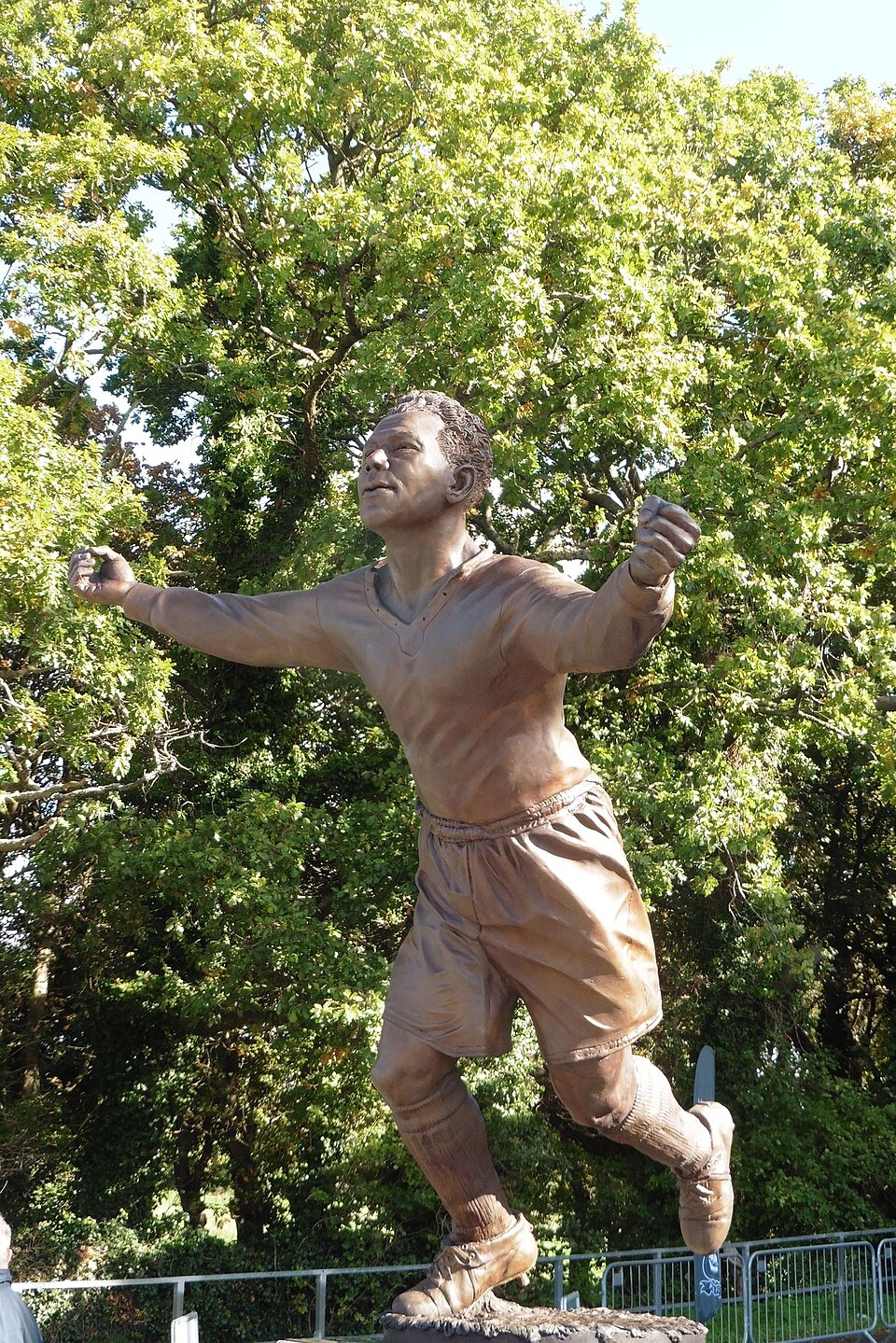
At Plymouth Argyle, Jack Leslie played inside-left alongside the prolific Sammy Black. Their partnership helped give the club a formidable attack, and Leslie contributed 137 goals across around 400 appearances. He could make opportunities as well as finish them. That sustained record explains why his name reached England’s selectors in 1925: he was an accomplished professional whose work was already familiar to the crowds at Home Park.2
From east London to Home Park
Born in Canning Town on 17 August 1901, Leslie was the son of a Jamaican father and an English mother. His father worked at Beckton gasworks; his mother was a seamstress. Leslie trained as a boilermaker while playing for Barking Town, then joined Plymouth in 1921. His first seasons included reserve football before he established himself in the senior side. Moving west meant building both a career and a home: after marrying Win Garland, he settled close to the ground in Peverell.1
Argyle repeatedly came close to promotion, finishing runners-up in their division for six successive seasons before finally reaching the Second Division. Leslie’s football belonged to that long collective effort. His passing, movement and scoring mattered across whole campaigns, through the repeated demands of league competition. The international opportunity arrived during a substantial club career, and his importance at Plymouth continued after England’s selectors had passed him over.3
The selection that disappeared
The newspaper trail is specific. Following the selection meeting on 5 October 1925, reports named Leslie as one of two travelling reserves for England’s match against Ireland in Belfast on 24 October. Subsequent reports drew attention to his race. By 19 October, the published reserves were other players. Leslie remained in Plymouth, where he scored twice in a 7–2 victory over Bournemouth and Boscombe on the day England drew 0–0 in Belfast.4
The story was contested almost immediately. When the FA subsequently denied that Leslie had been selected, the Press Association stood by its original announcement. His name’s appearance and removal are therefore documented in contemporary reporting. Decades later, Leslie recalled learning that the problem had been his colour. The surviving press record and his later testimony illuminate different parts of the same exclusion.4
The FA has since recognised that Leslie was deselected because he was Black and should never have been treated that way. His original place was as a reserve, so selection would not itself have guaranteed a playing appearance. It offered a route towards international football which discriminatory treatment closed. He never received another opportunity to play for England.5
A footballer with a trade
Leslie’s playing career ended in 1935. Football had provided years of employment and public recognition, but it did not remove the need to earn a living afterwards. His subsequent working life crossed between the industrial trade he had learnt as a young man and practical roles within the sport. The change also placed him in a different relationship with clubs: preparing and supporting other players after his own time in the first team had ended.7
After a period running a pub in Truro, Leslie returned to east London. He worked as a boilermaker in the docks through the war and into the 1960s, and became a trainer at Barking Town in 1938. In 1967 he joined West Ham’s staff under Ron Greenwood. The job was in the boot room, caring for the equipment of players including Bobby Moore, Geoff Hurst and Martin Peters. He finally retired from that work in 1982 and died in 1988.6
Recognition in Plymouth and at Wembley
Supporters’ campaigning brought renewed attention to the player and to the evidence of his treatment. A statue was unveiled at Home Park in October 2022. In March 2023 his family received a posthumous honorary England cap at Wembley before the match against Ukraine. The presentation publicly acknowledged a wrong that had remained part of the family’s history for almost a century.7
A cap comes back to the club
Later in 2023, Leslie’s granddaughters placed the honorary cap on permanent loan to Argyle. The club received it at a home match and arranged for it to be displayed alongside a model of the statue. Its return to Plymouth gives the recognition a particular setting: the place where Leslie had built his reputation over years of football. Visitors can connect the international opportunity he lost with the club performances that had earned it, and remember the forward through the work he accomplished on the pitch.8
Sources and further reading
1. Jack Leslie (1901–1988) — Historic England.
2. Jack Leslie — Plymouth Argyle.
3. Jack Leslie — National Football Museum.
4. The call-up — The Jack Leslie Campaign.
5. Wembley tribute planned for Harry Kane — England Football / The Football Association.
6. The boot room — The Jack Leslie Campaign.
7. Jack Leslie’s family presented with honorary cap — Plymouth Argyle.
8. Jack Leslie cap presented to Argyle — Plymouth Argyle.
Featured image. The statue of Jack Leslie at Plymouth Argyle, photographed in October 2022. Photograph: Mibmit, 9 October 2022, via Wikimedia Commons. Image record · CC BY-SA 4.0
