Tessa Sanderson’s first throw in the Olympic final on 6 August 1984 travelled 69.56 metres. The mark became the target for everyone else in the Los Angeles competition, and it stayed ahead through all six rounds. Finland’s Tiina Lillak reached 69.00 metres for silver; Britain’s Fatima Whitbread won bronze with 67.14. Sanderson had delivered her decisive performance at the beginning of the evening.1
School sport and a local club
Born in Jamaica in 1956, Sanderson moved to Britain as a child after spending her early years with her grandmother. Her family settled in Wolverhampton. In later interviews she described the racist bullying she encountered at school, alongside the encouragement of her parents and PE teacher Barbara Richards. School was also where an interest in several sports began to develop into a particular talent for throwing.2
She played hockey, rounders and netball, and a long cricket-ball throw helped draw attention to her ability. Joining Wolverhampton and Bilston Athletics Club gave her access to organised coaching and competition. In an England Athletics interview, she remembered the club’s track changing from cinder to a synthetic surface. Her development depended on places, equipment and adults who took a young athlete seriously, as well as on her own work.3
The distances begin to change
Sanderson won a national intermediate javelin title at fifteen and continued to improve through the junior ranks. At the 1976 Montreal Olympics she set a British record in qualifying. The next year brought a striking advance: after first passing 60 metres in June, she threw 67.20 metres at a European Cup meeting in Dublin in July. She defeated East Germany’s Ruth Fuchs, the Olympic champion and world-record holder, and moved to second on the world all-time list.4
Her range extended beyond the javelin. She competed in combined events and set a British heptathlon record in 1981. For a time she considered pursuing both events at the Los Angeles Olympics, but injury disrupted that plan. She eventually concentrated on the javelin, making a choice about where to direct her preparation and competitive effort.3
The route to Olympic gold
The years before Los Angeles included both major medals and missed opportunities. Sanderson won Commonwealth gold and European silver in 1978, but did not reach the Olympic final in Moscow in 1980. Injury kept her out of the major European and Commonwealth championships in 1982. Her eventual Olympic victory emerged from a career that had already included success, interruption and the work of returning to competition.5
In the 1984 Olympic qualifying round, Sanderson’s 61.58 metres placed her fifth among the finalists. Whitbread led qualifying, ahead of Lillak. The final began afresh the following day. Sanderson’s opening throw established an Olympic record, and none of her own later attempts went further. One correctly delivered effort had settled the championship, although she and her rivals still had the remainder of the competition to complete.1
The victory made Sanderson the first Black British woman to win an Olympic gold medal. It also made her the first British athlete to win an Olympic throwing title.2
Six Olympics, three Commonwealth titles
Sanderson continued through the Seoul, Barcelona and Atlanta Games, completing six successive Olympic appearances between 1976 and 1996. She finished fourth in Barcelona and was forty when she competed in Atlanta. Her three Commonwealth javelin golds came in 1978, 1986 and 1990, a sequence spanning twelve years. Staying competitive required repeated preparation for new seasons and championships long after the Los Angeles medal had been won.5
Maintaining that career also required income. Sanderson has described losing employment when the company she worked for went into liquidation, and turning to speaking, broadcasting and other media work. Olympic distinction did not automatically provide financial security. She combined these opportunities with the demands of continuing to compete.2
Making more room in sport
In October 2025 Sanderson became president of the charity Women in Sport. The appointment connected her public advocacy with an organisation working on women’s and girls’ participation. She has continued to emphasise the importance of good PE and the effect a supportive teacher can have. That focus returns attention to the practical beginnings of an athletic career: a child getting the chance to try, someone recognising her ability, and a route into a club where she can develop it.6
Sources and further reading
1. Javelin throw, women: Los Angeles 1984 — Olympedia.
2. The story of Tessa Sanderson — Team GB.
3. Podcast 79: Tessa Sanderson reminisces — England Athletics.
4. Tessa Sanderson CBE — The Athletics Museum.
5. Tessa Sanderson — Olympedia.
6. Olympic champion Tessa Sanderson CBE joins Women in Sport as President — Women in Sport.
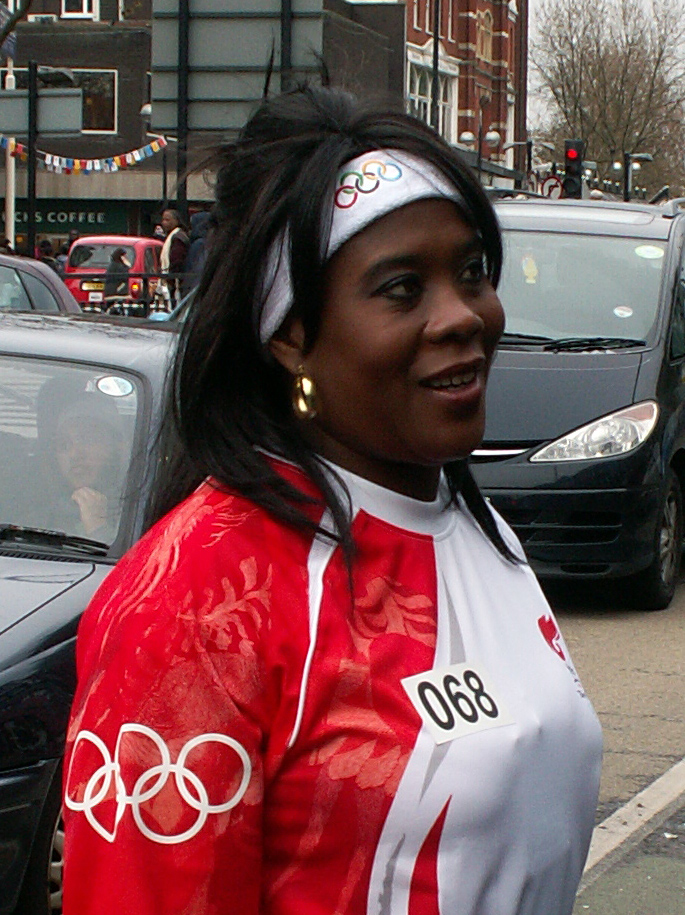
Featured image. Tessa Sanderson giving an interview after taking part in the Olympic torch relay in Stratford, London, on 6 April 2008. Photograph: Indianathletics, 6 April 2008, via Wikimedia Commons. Image record · CC BY-SA 2.5
