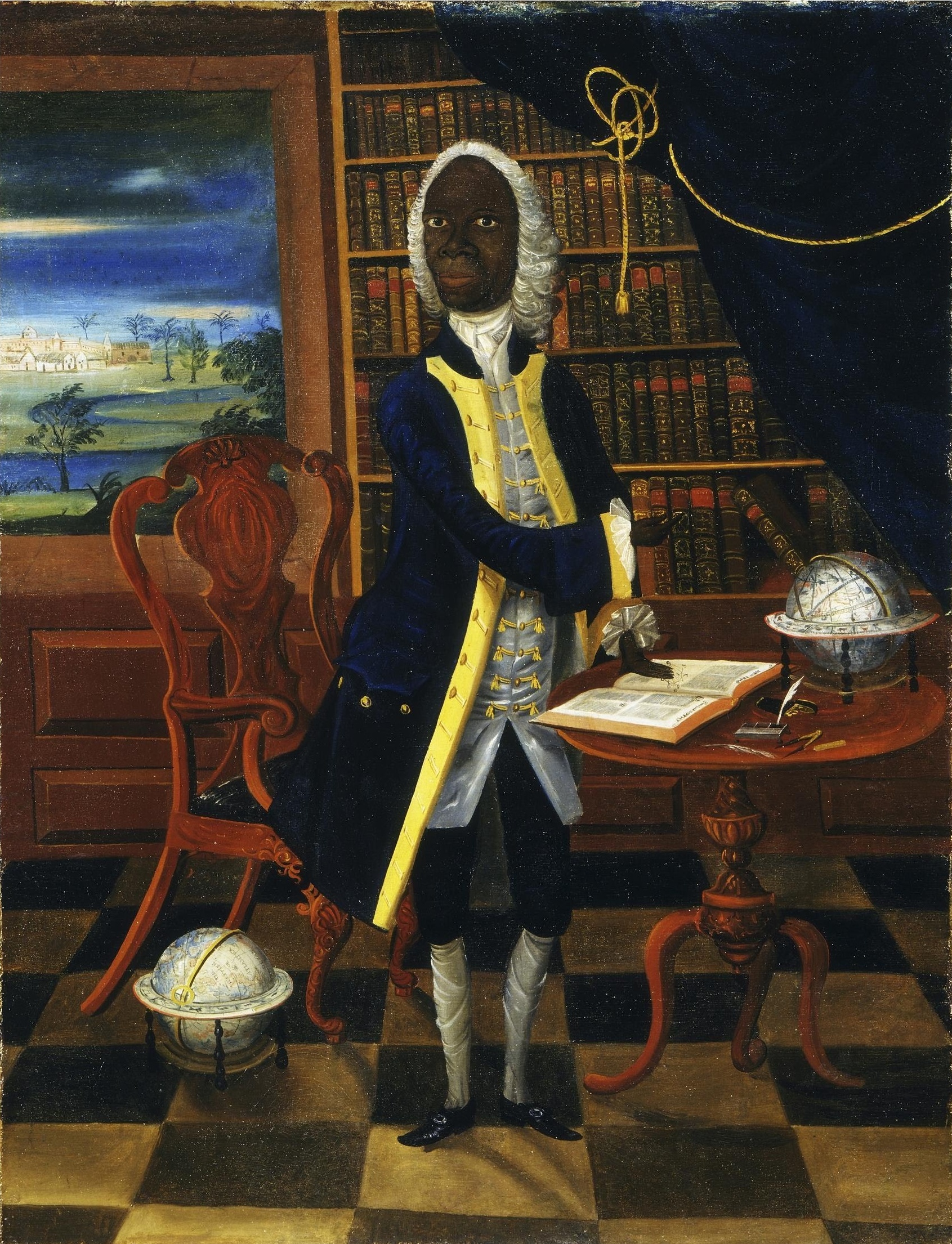
Books surround Francis Williams in his portrait at the Victoria and Albert Museum. The Jamaican Black scholar rests a hand on an open volume. Painted about 1760, the work has no securely identified artist.1
Between Jamaica and London
His family’s wealth grew after his father’s emancipation, supporting an unusual scholarly life in colonial Jamaica. Williams also held enslaved people on inherited estates. Intellectual achievement and participation in an oppressive society were both part of his life.1
A firm record of his time in England survives at Lincoln’s Inn. Its register admitted Francis Williams on 8 August 1721, identifying him as the youngest son of John Williams, a Jamaican merchant. Admission placed him within an important professional and social institution, although he was not called to the Bar. Nor is there secure evidence for the often-repeated stories of study at Cambridge or Harvard.2
After returning to Jamaica, Williams taught in Spanish Town. His school offered reading, writing, Latin and mathematics to Black pupils. The work joined subjects that later appear together in his portrait: language, number and the wider intellectual life available through books. He died in 1762, leaving an unusually visible, though incomplete, record of a Black scholar’s career.2
A poem for the governor
His surviving literary work is a 1759 Latin ode to Jamaica’s governor, George Haldane.1
The poem opens as a formal welcome. Haldane’s arrival is presented as the promise of improved government, relief from burdens and a happier future for the island. Williams praises his service to the British king and invokes Scotland as a country proud of him. The language is political and ceremonial: a writer is publicly addressing the representative of imperial authority. Its praise of a governor gives the poem a specific occasion and audience, rather than making it a statement detached from colonial affairs.3
Williams draws freely on classical literature. Mars and Minerva, the figures of war and learning, enter his account of what a poet can properly celebrate. He also names George Buchanan, the Scottish Latin poet, placing Haldane’s praises within an established literary tradition. The references create a meeting between Jamaica, Britain and the classical past. His skill lies partly in handling the language and conventions through which educated readers recognised a serious author.3
The Black Muse speaks
As the ode develops, the poet’s own position comes into view. Williams presents a Black speaker addressing a powerful governor and asks how such a voice should be received. He insists that moral worth, judgement and artistic ability cannot be assigned a colour. The argument rests on a shared human soul: God has not distributed inward capacities according to the outward distinctions on which racial hierarchies depend.3
He then addresses his own Muse, imagining the poetic voice approaching the governor’s elevated household. Black skin should not be a reason for shame or hesitation. In this part of the poem, an act of praise becomes an assertion that its author is entitled to speak. The appeal concerns the standing of his words and the learning that makes them possible. It is carried by the Latin itself as well as by the argument expressed through it.3
Near the close, Williams identifies the island as his birthplace and Britain as a place that nurtured him. Those connections belong together in his account of himself. The poem combines attachment to Jamaica, British education and classical accomplishment. It also leaves the governor in command: the ending asks for the continued flourishing of the people and their land under his rule. Its assertion of intellectual dignity therefore sits within a form of political praise.3
Reading the painted study
Scientific examination has helped researchers see the portrait more closely. A study by Lucia Noor Melita and colleagues used X-rays, infrared imaging, microscopy and other techniques to investigate its materials and construction. The results revealed changes made during painting, including a different underlying landscape, and clarified small details such as book titles. A finished portrait can conceal decisions taken while it was being made; these methods recover evidence of that process. They also create a firmer basis for asking what the books, setting and gestures were intended to communicate.5
Historian Fara Dabhoiwala has proposed a more specific reading. He argues that the open volume of Newton’s Principia, astronomical details and the Jamaican setting connect the portrait with Halley’s Comet’s return in 1759, and may celebrate Williams’s own calculations. This is an interpretation advanced through close study of the painting, not a settled finding supported by a surviving notebook of Williams’s work. It adds a significant question to the study of his intellectual life while leaving the distinction between evidence and inference visible.4
The poem already offers direct access to something Williams chose to say. Its language asks readers to recognise judgement and artistic ability without assigning them a colour. Read alongside the portrait’s books, it gives substance to the figure in the painted study: a writer arranging words, traditions and arguments to claim his place among people of learning.3
Sources and further reading
1. Francis Williams: a portrait of a writer — Victoria and Albert Museum.
2. Francis Williams: earliest known Black member of Lincoln’s Inn — Lincoln’s Inn archives.
3. Latin ode to George Haldane, 1759 — Francis Williams; transcription hosted by University at Buffalo.
4. A Man of Parts and Learning — Fara Dabhoiwala, London Review of Books.
5. Francis Williams: shedding light on the portrait of a Jamaican scholar — Lucia Noor Melita and colleagues, X-Ray Spectrometry.
Featured image. Francis Williams, the Scholar of Jamaica, an eighteenth-century portrait in the Victoria and Albert Museum. The artist and precise date remain subjects of research. Victoria and Albert Museum, P.83&A-1928; reproduction via Wikimedia Commons. Public-domain painting. Image record · Public domain
