On the day before his wedding in August 1788, George Africanus appeared on a marriage bond as a brass founder. He was preparing to marry Esther Shaw in Nottingham. The document places him in the town as a skilled worker forming a household: a very different position from that of the enslaved child brought to England more than twenty years earlier. 1
A childhood in Wolverhampton
Africanus is believed to have come from Sierra Leone and to have been about three when he arrived in England. He entered the Wolverhampton household of the Molyneux family, whose name also appears as Molineux. They provided for his education and later training as a brass founder, a trade involving the melting and casting of metal. 2
He was baptised in Wolverhampton in 1766 as George John Scipio Africanus. The name by which his African family had known him is not recorded. The baptism preserves an imposed identity that followed him through his adult life, into business directories, legal documents and the names given to later generations. 3
How he obtained his freedom remains uncertain, as does his route to Nottingham in the 1780s. His training gave him a skilled occupation. The missing details of his release leave a gap between the child placed in a household and the adult making a living in a different town. 2
Marriage and a growing family
George and Esther married at St Peter’s Church, Nottingham, on 3 August 1788. They had seven children, but only their daughter Hannah survived to adulthood. The family’s expanding business therefore developed alongside repeated losses. Later records of property and inheritance concern a household whose experience included far more than commercial success. 4
Hannah married Samuel Cropper, a watch and clock maker, in 1825. They had three children, extending the family into another generation of Nottingham life. The household’s history continued through children and grandchildren, linking a man taken from Africa to families whose lives could be followed through the town’s parish records. 4
The office in Chandlers Lane
By the 1790s, George and Esther were running a servants’ register from their home in Chandlers Lane. The Africanus Register of Servants connected people seeking domestic work with households looking to employ them. Its address was 28 Chandlers Lane, near the centre of Nottingham. Home and business occupied the same small part of the town. 3
Esther had commercial work of her own. Directories describe her variously as a milliner, straw-hat manufacturer, dressmaker and register-office keeper. Those entries give her a visible role in the household’s livelihood, bringing clothing trades together with the service of finding employment. 3
An 1818 trade directory records George’s servants’ register in Chandlers Lane. Together with the earlier marriage bond, it shows more than one occupation across his life. Brass founding and finding places for domestic servants involved different kinds of work; his livelihood was not confined to a single trade. 1
Property and public responsibilities
In 1816, Africanus was included among Nottingham’s special constables, responsible for watching local streets and protecting property during social unrest. In 1829, he bought substantial property in Chandlers Lane, including two premises let to tenants. These records place him among people with a direct stake in the town’s buildings, streets and public order. 1
He was also a voter. The 1826 poll book records his support for John Smith Wright of Rempstone. Voting was public, so the choice survives alongside his name. It establishes his participation in an election; it does not supply a complete account of his political beliefs. 5
Providing for those who followed
Africanus’s will took particular care over what would happen to the property and money he left. It provided for Esther and made a bequest for Hannah’s own use, excluding her husband from control. As historian Sarah Murden’s research explains, relations with Samuel Cropper had become strained. The arrangement was intended to protect the daughter’s benefit within those circumstances. 6
Esther continued the family business after George’s death in 1834. She also pursued money from her son-in-law through the courts for maintaining Hannah and her children. The newspaper reports examined by Murden show Esther handling both commercial and family responsibilities. She remained an active figure until her own death in 1853. 6
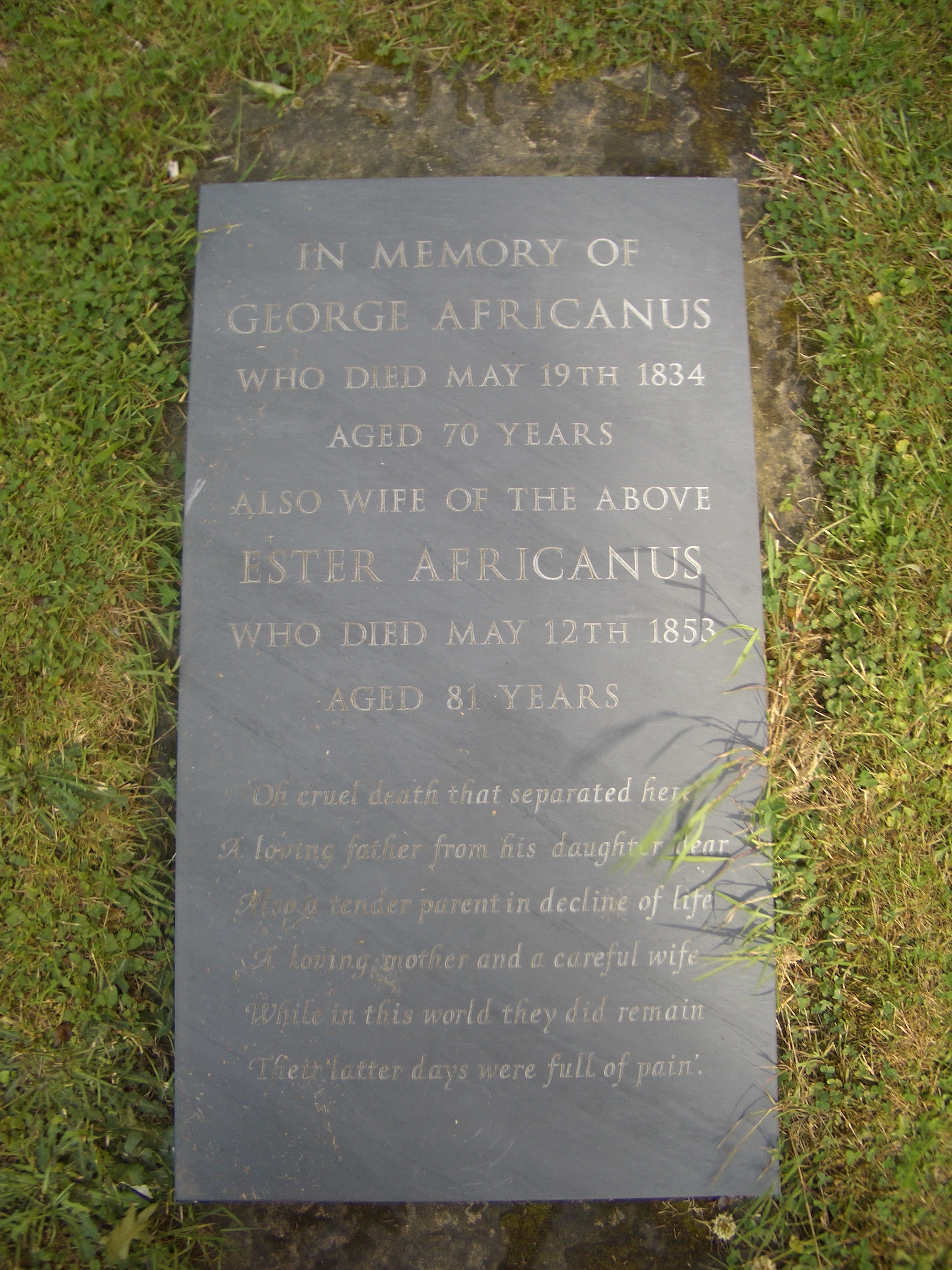
George was buried at St Mary’s Church in Nottingham. His grave connects a life shaped by forced movement with the town where he worked, married and raised a family. 2
That family history was later traced by Len Garrison, a founder of Black Cultural Archives. His hand-drawn family tree, dated 1987, forms part of a collection of documents donated by Ray Gale. It follows relationships across generations, preserving Africanus as a husband, father and grandfather as well as a business owner. 4
Sources and further reading
1. Black History Month: George Africanus. University of Nottingham, Manuscripts and Special Collections. 2013-10-01.
2. Biography of George Africanus. Nottinghamshire Archives, MyLearning.
3. George John Scipio Africanus: Nottingham Schools and Transatlantic Slavery Project. Nottingham Museums. 2021.
4. Hand Drawn Family Tree of George Africanus. Black Cultural Archives, Google Arts & Culture.
5. Records of George’s Life. Nottinghamshire Archives, MyLearning.
6. George John Scipio Africanus. All Things Georgian. 2019-09-12.
Featured image. George Africanus’s grave marker at St Mary’s Church, Nottingham, in a photograph uploaded in 2008. Photograph: Andrewrabbott, via Wikimedia Commons; released into the public domain by the photographer. Image record · Public domain
