A small tuning fork in the British Library is associated with George Bridgetower. Kept in a wooden case, it is said to have been given to him by Beethoven. The catalogue preserves that qualification. The object is a reminder of the practical world Bridgetower inhabited: instruments, pitch and musicians working together, alongside the portraits and famous names through which he is often remembered.1
A childhood on concert platforms
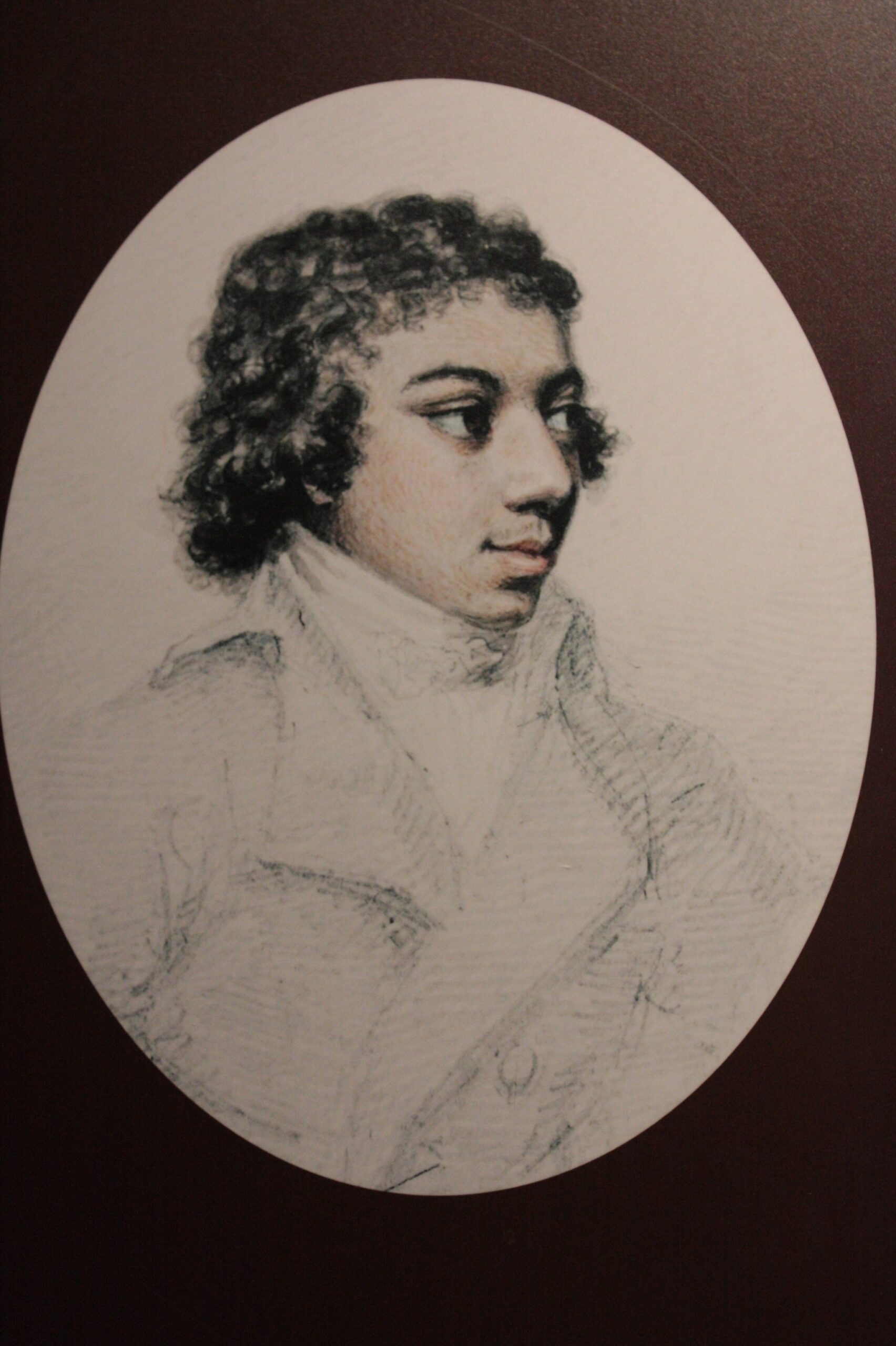
Born in Poland in 1778 to an African father and a mother of Polish or German background, Bridgetower began performing as a child. He appeared in Britain in 1789, building a career that would span court employment, public concerts, teaching and composition.2
The Prince of Wales, later George IV, became his patron. His teachers included the violinist François-Hippolyte Barthélemon and the composer Thomas Attwood. These relationships placed a gifted young performer in contact with established professionals, and provided further training as well as access to audiences.3
Accounts of his early appearances identify substantial repertoire. Charlotte Papendiek recorded a Viotti concerto and music by Haydn in 1789; a London concert report in 1791 praised his playing. He was participating in the musical life around Haydn’s visits while still a boy.6
A sonata in Vienna
In 1803 Bridgetower travelled to Vienna, where Prince Lichnowsky introduced him to Beethoven. That May, violinist and composer gave the first performance of the sonata now known as the Kreutzer Sonata, Op. 47, with Beethoven at the piano. Preparation was hurried: for the slow movement, Bridgetower used Beethoven’s handwritten music because a clean copy was not ready. The performance called for a musician capable of responding to demanding new material in close partnership with its composer.4
Beethoven initially intended the published work to bear Bridgetower’s dedication. Following a dispute, it appeared in 1805 dedicated to the French violinist Rodolphe Kreutzer. The change has made another player’s name inseparable from the piece. Bridgetower’s place in its history remains concrete: he was the violinist who first brought it before an audience, working with Beethoven in its earliest performance.4
A place among fellow musicians
The Royal Society of Musicians holds Bridgetower’s application of 1807. He subsequently served as a governor between 1809 and 1811 and chaired meetings on two occasions. Its minutes also preserve an ordinary professional disagreement: in 1808 he was asked to explain sending a deputy to a performance expected of members. The records show him sharing obligations and decisions with colleagues. Their everyday detail gives a useful sense of his standing within a working musical community. He signed his name Bridgtower, a spelling found throughout these records.3
Cambridge supplied another setting for his work. With encouragement from his friend Charles Hague, the university’s Professor of Music, Bridgetower received a Bachelor of Music degree in June 1811. Its examination required composition: he set an anthem by F. A. Rawdon for chorus and orchestra, performed at Great St Mary’s on 30 June. The score is now lost, but the degree recognises a creative achievement alongside his work as a performer.2
Music for an occasion
One substantial surviving composition is Jubilee, written in 1809 for George III’s jubilee celebrations. It begins with Rule, Britannia! and proceeds to a theme and four variations on God Save the King. Scored for flute and strings, it makes familiar public melodies the material for a smaller ensemble. The players can transform a tune listeners already know through changes in texture, rhythm and instrumental exchange. This was music written for a particular occasion, with invention exercised inside that brief.5
A modern edition prepared by Mark Ferraguto and Nicole Cherry pairs Jubilee with Bridgetower’s arrangement of the overture to Cherubini’s opera Lodoïska. The distinction between the two pieces matters: the first is Bridgetower’s composition, while the second adapts another composer’s theatre music for an instrumental group. Together they show different kinds of musical labour, both requiring judgement about what players could achieve together.5
The teacher at the keyboard
His 1812 publication Diatonica Armonica approaches music from a pupil’s perspective. These piano studies turn scale practice into short pieces with contrasting characters. One hand may carry the scale while the other supplies a melody or accompaniment; styles include dances, marches and more songlike writing. They give a glimpse of a teacher thinking about how repetition could become musically engaging. The violin virtuoso also understood the needs of people developing their skills at a keyboard.6
Bridgetower lived until 1860. His surviving scores put his decisions within reach of performers: how to vary a tune, distribute parts and make practice engaging. Playing them restores an active role to their maker, a musician who fashioned work for others to learn and perform.6
Sources and further reading
1. Tuning fork associated with Beethoven and Bridgetower — British Library.
2. George Bridgetower, 1778–1860 — Trinity Hall, Cambridge.
3. From the Archives: George August Polgreen Bridgtower — Colin Coleman, Royal Society of Musicians.
4. George Bridgetower: miniature and biographical note — Beethoven-Haus Bonn.
5. Two Quintets for Flute and Strings — Mark Ferraguto and Nicole Cherry, A-R Editions.
6. Review of George Bridgetower: Two Quintets for Flute and Strings — W. Dean Sutcliffe, Nineteenth-Century Music Review.
Featured image. Henry Edridge’s 1790 portrait of the young violinist George Bridgetower. Henry Edridge, 1790; photograph by Stephencdickson, 27 September 2014, via Wikimedia Commons. Photograph reused unchanged. Image record · CC BY-SA 4.0
