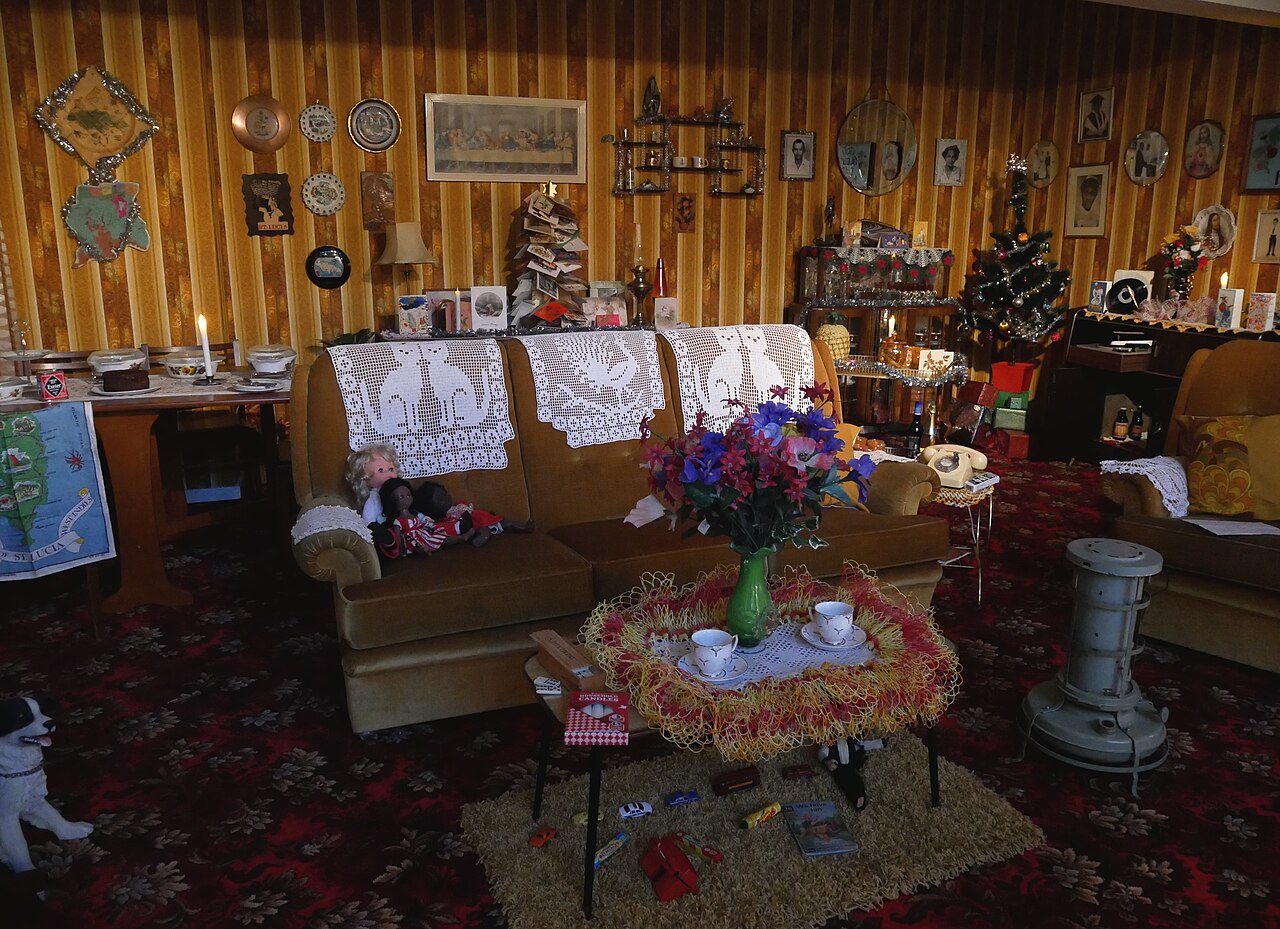
In Michael McMillan’s account of growing up in Britain, the front room had rules. Guests were welcomed, glasses brought from the cabinet and music played on the radiogram. Children entered when invited and could be sent out when adult conversation resumed. The room presented the household to visitors, even as its objects carried intimate family associations.1
A room prepared for company
McMillan connects this formality with the Victorian parlour and with ideas about respectability that travelled through colonial Caribbean society. Cleaning, polishing and arranging possessions helped establish how a family wished to be seen. Money might be short while the room remained carefully maintained. In his interpretation, this involved both social expectations and a claim to dignity amid hostile assumptions about Black families.1
His mother decided how the room was dressed and maintained. Decoration was household work, carrying judgements about motherhood, taste and conduct.1
The work in the stitches
Crochet gives that labour a visible form. The Museum of the Home’s display includes pieces belonging to McMillan’s mother, Letha, and family friends Cynthia and Linda. The museum records that women made such pieces to supplement their incomes. A doily could therefore be decoration, skilled work and a contribution to the household budget at once.2
Colour and arrangement mattered too. Patterned fabrics, ornaments and layered surfaces produced an interior through many small decisions. The museum’s room places these choices within the lives of a working-class British Caribbean family in social housing. It is a constructed interpretation, with objects brought together to convey a particular setting.2
Music at the centre
The radiogram combined a radio and record player in a substantial cabinet. It belonged to the furniture as well as the sound of a room. Museum of Oxford’s account names performers including Millie Small, the Supremes and Nat King Cole, suggesting a listening world that reached across countries and musical styles.3
The museum also places home entertainment in the context of racial exclusion from some public venues. Families and friends organised their own gatherings, with the radiogram supplying music. A domestic room could become a place for sociability that was difficult to secure elsewhere. Playing records involved choosing company, repertoire and the conditions of an evening together.3
Remembering, collecting and rebuilding
McMillan’s artistic interest developed through oral-history interviews with Caribbean elders in High Wycombe. In an interview with the Art Gallery of Ontario’s magazine, he recalled recognising arrangements of possessions that resembled his own family’s. An invitation from the local history museum led him to borrow furniture and objects from relatives for an early installation, including his mother’s crochet and his aunt’s three-piece suite.4
That process brought ordinary possessions into a new setting. Familiarity could encourage visitors who recognised similar rooms to contribute their own memories, making the installation a meeting point for different experiences of home.4
Oxford’s community-curated reconstruction followed a related process of searching and borrowing. Heirlooms and a radiogram found in a relative’s garage helped furnish its evocation of a 1950s or 1960s front room. The display included a glass cabinet, crochet, Caribbean souvenirs and religious objects. Together they showed how a room could gather evidence of travel, faith, family and everyday consumption.5
Different lives behind the furniture
McMillan has changed the imagined household between installations. For Life Between Islands at Tate Britain, he created a room for Joyce, a fictional, educated Caribbean woman named in honour of his aunt. Joyce is single, teaches at a Saturday school and hosts parties. Those choices give the room a different social life from that of a couple raising children.6
In describing his process to University of the Arts London, McMillan explains that donated personal objects are combined with furnishings obtained elsewhere. The result draws on lived experience without being a complete reconstruction of one person’s home.6
A place within British domestic history
In 2021, The Front Room became a permanent period-room installation at the Museum of the Home. McMillan links its architectural setting with his family’s time in a council flat on the De Beauvoir Estate in the 1970s. Its position within a history of British homes makes room for those experiences of furnishing, entertaining and raising families.7
The installation continues to change. Objects can acquire new neighbours and the imagined household a different moment in its life. That movement suits a subject made from people arranging their homes over time, carrying some things forward and replacing others.7
Sources and further reading
1. The Front Room: Diaspora migrant aesthetics in the Home. Michael McMillan, WritersMosaic.
2. A Front Room in 1979. Museum of the Home.
3. Radiogram. Museum of Oxford.
4. Constructing The Front Room with Michael McMillan. Matthew Rolfe, Art Gallery of Ontario.
5. West Indian/Caribbean Front Room. Museum of Oxford.
6. Michael McMillan on curating A front Room in 1970. University of the Arts London.
7. The Front Room (Museum of the Home). Michael McMillan.
Featured image. A museum reconstruction of a late-1970s British Caribbean living room, photographed at the Museum of the Home in November 2022. Photograph: Doyle of London, 23 November 2022, via Wikimedia Commons. Image record · CC BY-SA 4.0
