Ayuba Suleiman Diallo’s route to London began with a letter. Enslaved in Maryland and separated from his family, he wrote in Arabic to his father, hoping that the message would secure help. It passed through the hands of merchants and eventually attracted influential attention in England. His learning had travelled with him even when almost everything else had been taken away.1
A scholar within a trading world
Diallo came from Bundu in Senegambia and belonged to a family of Muslim religious scholars. His name appears in several spellings; English publications commonly called him Job ben Solomon. He had received an Islamic education and was already a husband and father when he was captured in the early 1730s.1, 3
His family also participated in the trade in enslaved people. Thomas Bluett’s account describes a journey on which Diallo was to sell two people and buy paper and other supplies. After failing to agree terms with an English captain, he crossed the River Gambia with an interpreter and made a sale elsewhere. On the return journey, both men were seized and sold to the same captain he had recently approached as a trader.1
Recognising who Diallo was did not immediately secure his release. The captain allowed an attempt to arrange a ransom, but the distance to his father and the approaching sailing date defeated it. Diallo and his interpreter were carried across the Atlantic. His position within an influential family had offered protection at home; it could not prevent a ship from leaving with him aboard.1
Prayer, flight and communication
In Maryland, Diallo was sold to a man Bluett names as Tolsey. Tobacco labour damaged his health, and he was moved to tending cattle. He withdrew to pray, only to be harassed by a white boy. Unable to explain his situation effectively in English, he eventually left. He was detained and imprisoned as a suspected runaway.1
Bluett encountered him during this confinement. Diallo wrote and read aloud, giving his visitors clues to his religion. Communication improved when an older Black man who spoke a language Diallo understood visited him. That intervention allowed the jailer to discover where he had come from and contact the man who claimed ownership of him. The route towards release therefore involved another African’s linguistic knowledge as well as the better-known English intermediaries.1
Returned to Tolsey, Diallo received some concessions, including space for prayer. He still sought freedom. His Arabic letter was passed through the merchant Vachell Denton and then to London. James Oglethorpe saw it and arranged financial backing for Diallo to be brought to England. In Bluett’s telling, correspondence crossed the barriers that Diallo himself could not yet cross.1
Learning English on the Atlantic
Diallo sailed from Maryland in March 1733 on the William, with Bluett among the passengers. During the voyage, Bluett and the captain helped him learn English. By their arrival in late April, he could follow much ordinary conversation. He also maintained his prayers and religious dietary practices at sea, refusing pork and taking care over how animals were slaughtered for food.1
In London, arrangements involving the Royal African Company provided accommodation and a prospective passage home. A public subscription secured his freedom. The company’s involvement in the wider trade in enslaved Africans sits uneasily beside its assistance to this particular man: the same commercial world could transport people into bondage and arrange an exceptional release.1, 2
Diallo met members of intellectual and aristocratic society. Bluett records his visit to Sir Hans Sloane, his wish to see the royal family, and the introduction that followed. He received gifts for his return journey. These encounters gave him access to powerful patrons, while his knowledge and religious commitment made him a participant in conversations that crossed languages and faiths.1
A portrait on his own terms
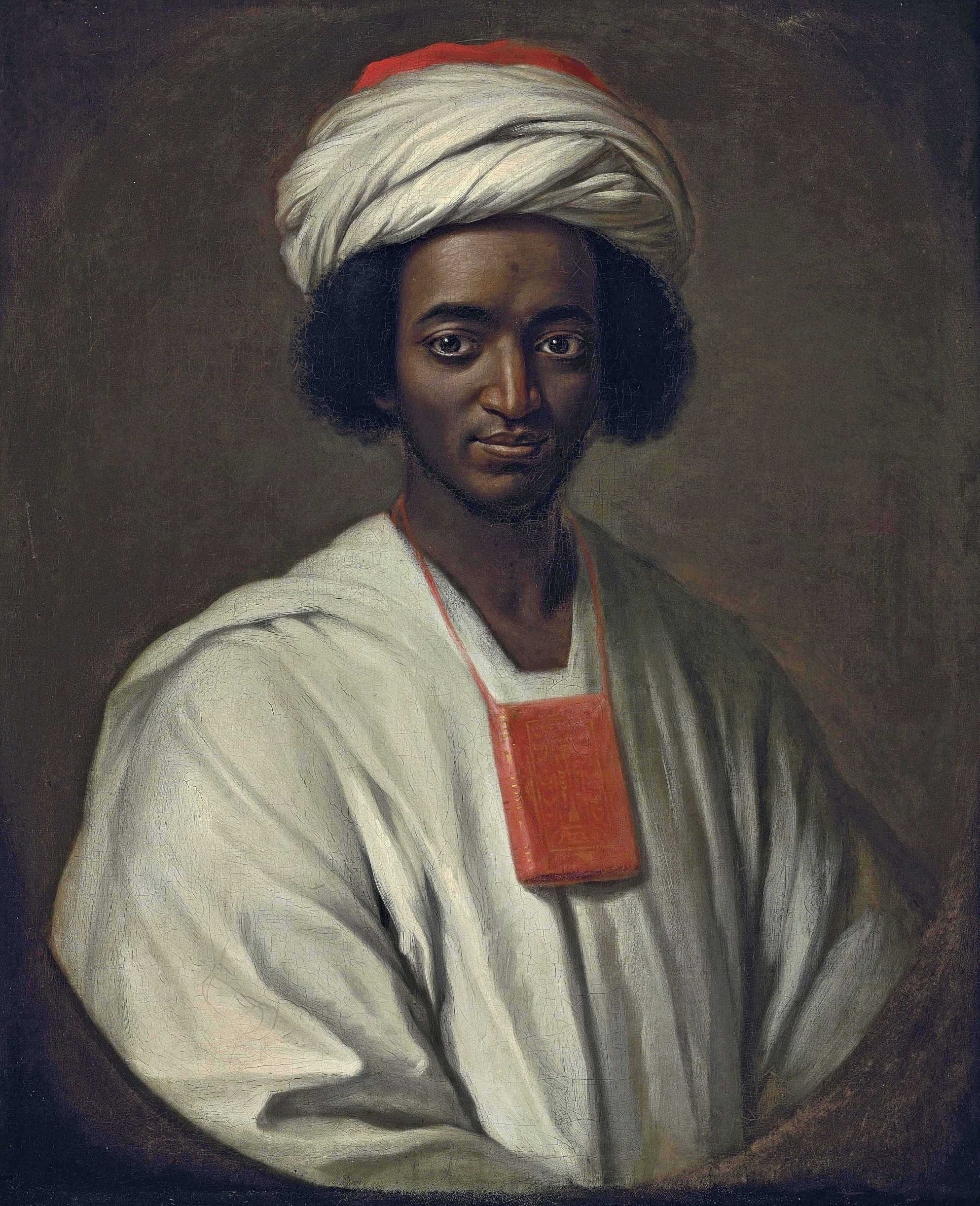
William Hoare painted Diallo in 1733. He is shown in clothing associated with his own background, with a small Qur’an suspended at his chest. The National Portrait Gallery’s account records that Diallo influenced this choice of dress. The resulting image gives his religion and learning a visible place within a British portrait.2
That image should be read beside the writing he produced. Research by Paul Naylor and Marion Wallace brings together his letters, handwritten Qur’ans and notes arising from discussions of Arabic. Their work restores Diallo’s own scholarship to a story often approached through a European painter and an English biographer.3
Returning home, leaving records
Diallo returned to West Africa in 1734. Bluett’s Some Memoirs of the Life of Job, published that year, helped circulate his story in English. The book contains valuable observations, but its praise of British benefactors is also part of its purpose. Its account of a successful rescue cannot stand for the experience of everyone transported on the ships of the Atlantic trade.1, 3
The interpreter captured with Diallo brings that difference into sharp focus. When Bluett wrote about their seizure, he identified the companion as still enslaved in Maryland. One man’s celebrated passage through London had not delivered the same outcome for the person taken beside him.1
Diallo’s letters and portrait remain records of a particular life: a Muslim scholar, a participant in slave trading, a man subjected to slavery and someone who worked persistently to return to his family. Holding those circumstances together gives a fuller account of his place in eighteenth-century Britain than making him a straightforward emblem of abolition.1
Sources and further reading
1. Some Memoirs of the Life of Job, the Son of Solomon (1734), excerpts. Thomas Bluett; historical excerpts edited by John-Charles Duffy.
2. Ayuba Suleiman Diallo by William Hoare. National Portrait Gallery.
3. Author of His Own Fate? The Eighteenth-Century Writings of Ayuba Sulayman Diallo. Paul Naylor and Marion Wallace.
Featured image. William Hoare’s eighteenth-century portrait of Ayuba Suleiman Diallo, shown with a small Qur’an suspended at his neck. William Hoare; image via Wikimedia Commons. Public-domain painting and faithful reproduction. Image record · Public domain
