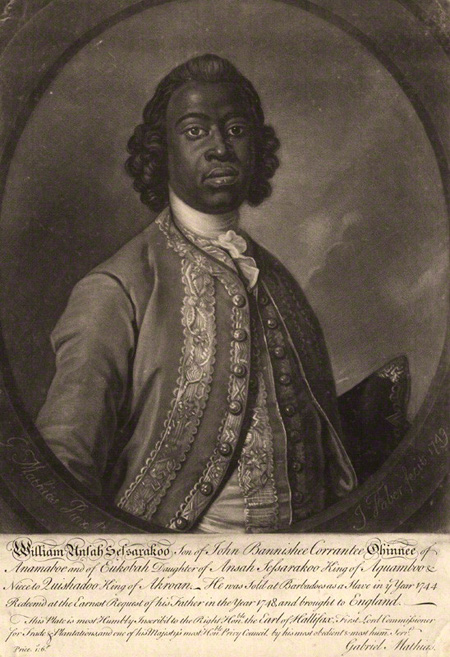
On 1 February 1749, William Ansah Sessarakoo attended Oroonoko at the Theatre Royal, Covent Garden. Thomas Southerne’s play concerned an African prince betrayed into slavery. Newspapers reported that Sessarakoo was distressed and left the performance. A man whose own experience resembled the plot had become part of the evening’s public spectacle.1
A family with Atlantic connections
Sessarakoo came from an influential family at Anomabu, on the coast of present-day Ghana. His father, John Corrantee, was a Fante leader and a wealthy trader in gold and enslaved people. Education in Europe formed part of the family’s commercial ambitions: one son went to France, while England was chosen for Sessarakoo.2
Corrantee dealt with European merchants competing for access to trade on the coast. These relationships gave him room to negotiate between rivals. Learning European languages and commercial practices could strengthen a family’s position within that system.3
The planned journey went catastrophically wrong. Sessarakoo ended up enslaved in Barbados. Accounts differ over the precise sequence of events, although his betrayal by the captain entrusted with taking him to England became central to the British telling of his story. His father’s influence would prove crucial to securing his release.4, 5
Freedom negotiated through commerce
When Corrantee learnt what had happened, he refused to continue trading with English merchants. The Royal African Company intervened. The National Portrait Gallery describes an arrangement in which the company promised to find Sessarakoo, obtain his release and provide passage through London in return for trade resuming.4
That intervention served the interests of an organisation deeply involved in trafficking enslaved Africans. Historian William Pettigrew and London Museum place the London visit within a struggle between the company and independent traders. Rescuing the son of an important African associate gave the company an opportunity to condemn its competitors’ conduct while presenting itself as a dependable partner.1
The company’s argument concerned control of the trade. Its intervention for one well-connected man coexisted with the continuing enslavement of many others.1
Being received in London
By 1749 Sessarakoo was in London, under the protection of George Montagu-Dunk, Earl of Halifax and president of the Board of Trade. He was introduced to George II. This was an official reception shaped by the standing of his family and the importance of maintaining commercial relations.2
British descriptions repeatedly presented him as a prince. That language gave readers a familiar way to understand a visitor from a different political society. It also made a story of enslavement marketable as the fall and restoration of a nobleman. The emphasis on rank helped determine which aspects of his experience reached the public.4
A life made into a publication
A book published in London in 1749 advertised the story as The Royal African: or, Memoirs of the Young Prince of Annamaboe. Its extended title promised an account of his family, his brother’s journey to France, his own enslavement in Barbados, release and reception in England. It also promised historical discussion of European commerce on the African coast.5
Even that title reveals how the account was packaged. A personal journey was placed alongside explanations of overseas trade. Family distinction, betrayal, rescue and public reception were offered as successive stages in a narrative for British readers. The publishers were selling access to an African visitor’s experiences while also drawing attention to the commercial world in which those experiences occurred.
The title’s emphasis on the reasons for his release is especially revealing. It invited readers to consider intervention and rescue as events requiring explanation. That question leads back to Corrantee’s negotiating power and to the British interests involved. The book belongs to the public presentation of Sessarakoo’s life; its existence should not be confused with a surviving signed autobiography.5
Other writers reshaped the story more freely. William Dodd’s The African Prince used imagined letters from a captured African nobleman to a lover. These were literary inventions, not correspondence written by Sessarakoo. His likeness also circulated in mezzotints by John Faber the younger after Gabriel Mathias.2, 4
After the London visit
Sessarakoo returned to West Africa. The Slavery and Remembrance project records later employment as a writer at Cape Coast Castle, followed by his dismissal in 1761 after the governor beat him. This later episode sits uneasily beside the honours described in accounts of his British visit.3
London’s publicity preserved one visible part of his life. His later work places him again within the coastal commercial world from which he had come. The honours of his British visit offered no permanent protection in his dealings with European authorities.3
Sources and further reading
1. William Sessarakoo: the Royal African. William Pettigrew and Alex Werner, London Museum, 2016.
2. William Ansah Sessarakoo. Sheldon Cheek, adapted by Sophie Alegi, Enslaved.org.
3. William Ansah Sessarakoo. Slavery and Remembrance, Colonial Williamsburg Foundation.
4. William Ansah Sessarakoo: biography and portraits. National Portrait Gallery.
5. The Royal African: or, Memoirs of the Young Prince of Annamaboe. London, 1749. Wellcome Collection catalogue, reproducing the original extended title and publication details.
Featured image. William Ansah Sessarakoo in a print by John Faber Jr, dated 2 January 1749. National Portrait Gallery, D9199. John Faber Jr; National Portrait Gallery, London; reproduction via Wikimedia Commons. Image record · Public domain
