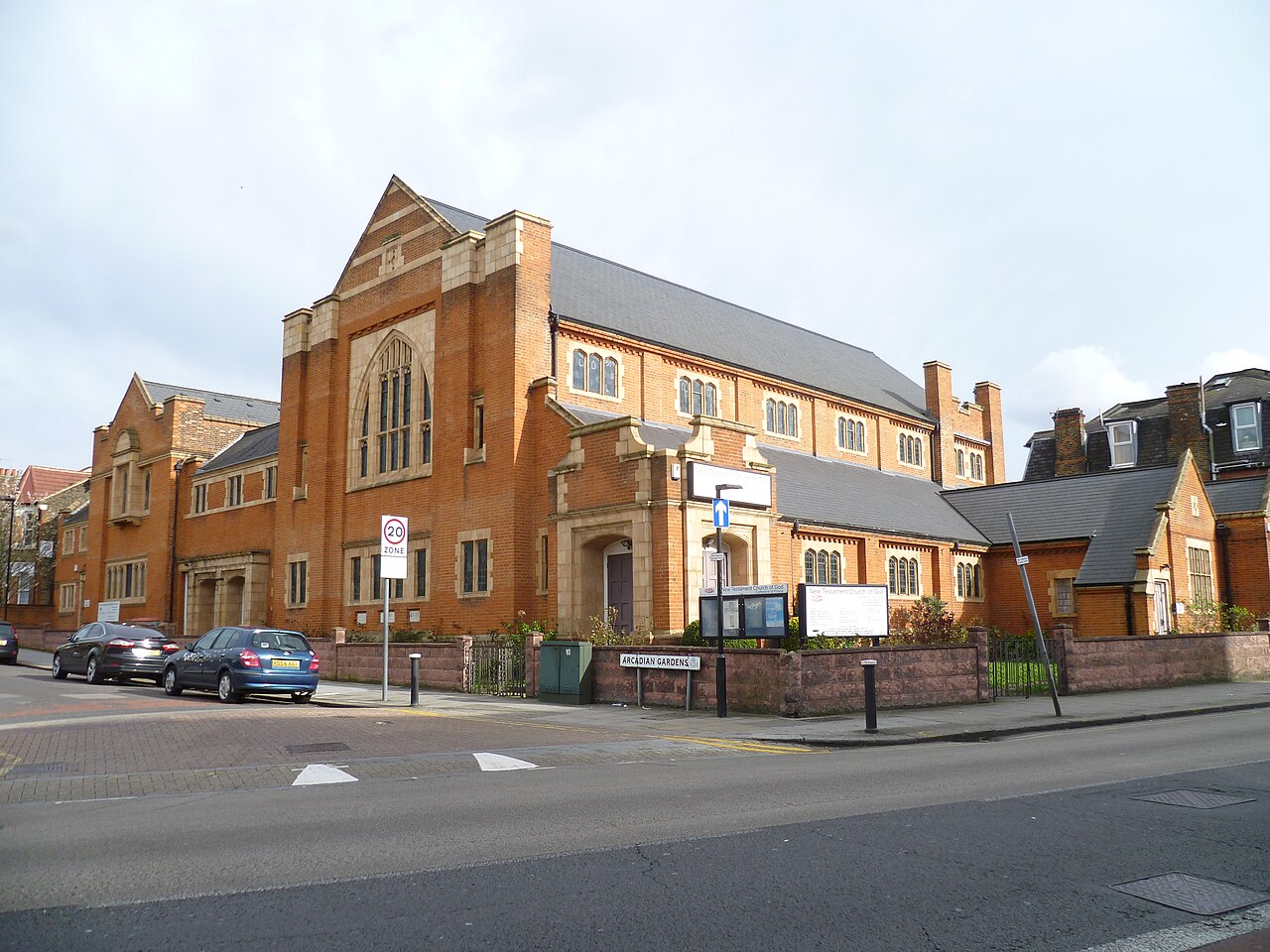
Black churches in Britain have developed through finding places to worship, forming congregations and deciding who could lead them. Black majority church is an umbrella term: it covers different denominations and traditions, rather than one shared form of religious life. 1
Foundations before and after Windrush
This history began before the postwar Caribbean migrations. Thomas Kwame Brem-Wilson, who had arrived from the Gold Coast, founded Sumner Road Chapel in Peckham in 1906. He was involved in the early Pentecostal movement in Britain. His work places an African minister within that movement’s formative years, rather than only in a later story about newcomers joining established churches. 2
The New Testament Church of God’s own history records its first English public service at Wolverhampton’s YMCA on 20 September 1953. Oliver Lyseight and Herman Brown led it. The church also records a fellowship beginning in Handsworth, Birmingham, that evening. Contact between the groups helped connect worshippers in two Midlands communities before the denomination developed a wider national organisation. 3
Caribbean-founded churches were followed by African congregations with their own histories and connections. The Church of the Lord, an Aladura church with headquarters in Nigeria, established a London congregation in 1964. Later decades brought further African Pentecostal churches. These were overlapping developments: people arrived with differing beliefs, forms of church government and expectations of religious life. 2
Finding a place to belong
Racism shaped this landscape. Some Black Anglicans and Methodists encountered rejection in familiar denominations. Congregations renting premises could face unequal treatment from established churches. Yet exclusion alone cannot explain these institutions: religious conviction, missionary work and the continuation of existing traditions also mattered. 1
The work behind the congregation
Elaine Foster’s 1990 study investigated women’s contribution to churches, principally around Birmingham, with material from London, Leeds and Sheffield. Interviews, recordings of services and church publications revealed work that institutional histories often missed. Women raised money through regular giving, evangelised, supported other members and helped sustain communities facing racism and economic inequality. 4
Foster also examined a tension within this work. Churches could offer support while restricting women’s authority through male-dominated structures. Recognising women’s contribution therefore requires more than adding a few prominent names to a list of pastors. Her research asked who financed the institution, maintained its daily relationships and gained recognition or influence within it. 4
Learning through church life
In a published recollection, Sheena Daley described learning public speaking, event planning and mentoring through her New Testament Church of God congregation. She took responsibility for music and Sunday school, and joined prison ministry. Church members also supported her musical interests before she studied classical music at university. Her account describes one upbringing, but shows how practical responsibilities could connect religious participation with education and working life. 1
Institutions also invested in formal education. In 1979, the New Testament Church of God bought Overstone Hall in Northamptonshire for a Bible college and convalescent home. Its Heritage Centre and Roswith Gerloff Library later moved to Northampton’s Cheyne Walk in 2014. Teaching, care and historical preservation became part of the denomination’s infrastructure. 3
Churches within the city
Andrew Rogers’s Being Built Together research, conducted between 2011 and 2013, identified at least 240 new Black majority churches in Southwark. Most had African majorities. Many drew worshippers from across London and beyond, so their communities did not correspond neatly to a parish boundary. A church could be physically local while maintaining a much wider network of relationships. 5
Finding suitable premises was a continuing difficulty. The research examined tensions involving space, planning permission, traffic and noise, alongside congregations’ support networks and community activities. These practical questions belong within church history too: the ability to hire or purchase a building affects where people gather and how an institution develops. 5
Recovering the fuller record
Black Christian history also survives within long-established denominations. Beginning in January 2025, the Birmingham Baptist Churches exploring their Black History project brought adults and young people into archival research and oral history interviews. Its focus included early Black members, deacons and ministers. Such work widens the record beyond church founders to the people who sustained congregations over many years. 6
Sources and further reading
1. Black Majority Churches and the Transformation of British Christianity. Open University.
2. Black Majority Churches in London. Open University.
3. Our Story. New Testament Church of God.
4. Black Women in Black-led Churches. University of Birmingham.
5. How Are Black Majority Churches Growing in the UK?. London School of Economics.
6. Birmingham Baptist Churches Exploring Their Black History. Angus Library and Archive.
Featured image. The New Testament Church of God Cathedral of Praise in Wood Green, London, photographed in April 2016. Photograph: Philafrenzy, 9 April 2016, via Wikimedia Commons. Image record · CC BY-SA 4.0 · Church location
