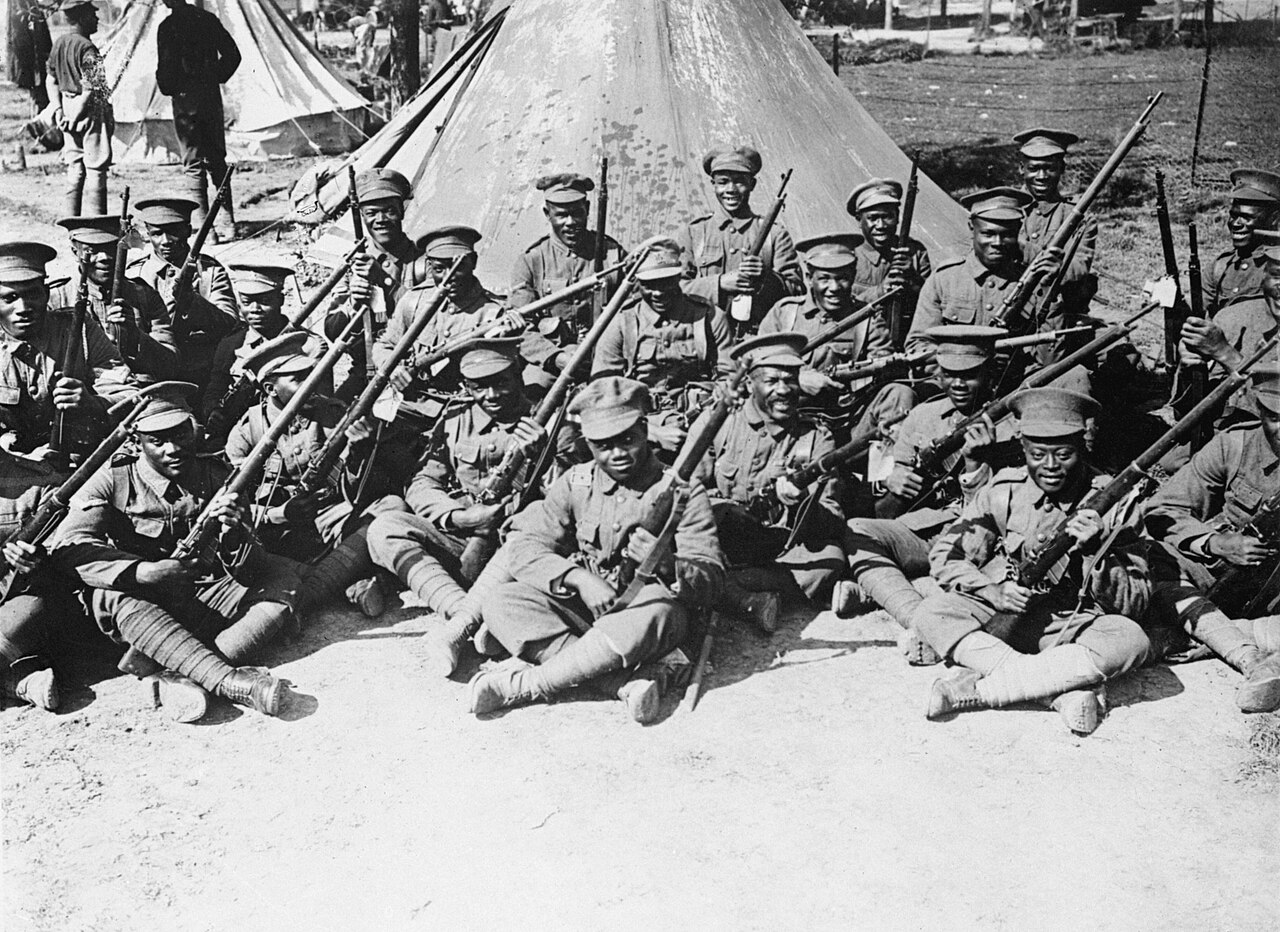
When the British West Indies Regiment was formed in 1915, it brought together volunteers from Britain’s Caribbean colonies in a new army unit. More than 15,600 men eventually enlisted, across eleven battalions, with Jamaica supplying the largest contingent. Their service connected the Caribbean to military camps in Britain and campaigns thousands of miles from home. 1
A new regiment
The name can cause confusion. The West India Regiment already existed when the First World War began; the British West Indies Regiment was a separate wartime formation. Some Caribbean men had entered other British units independently. Creating the BWIR followed pressure to accept more volunteers, against a War Office preference for employing them as labourers. 1
Training in Sussex
The 1st Battalion trained at Seaford, on the Sussex coast. Troops entered a landscape already altered by war: camps, accommodation blocks and training grounds had expanded around the town. Earlier divisions had departed, leaving space for newcomers. Britain was therefore part of these soldiers’ experience before their overseas deployment. 3
Nineteen BWIR men were buried in Seaford Cemetery between October 1915 and January 1916. Among them was Thomas David Primo, a chemist and pharmacist from British Guiana. The graves record lives cut short during the training period, before the battalion’s campaigning abroad. The burial records also preserve links to the Caribbean communities from which the army recruited. 3
Different kinds of service
The regiment’s battalions did not all have the same war. On the Western Front, men dug trenches, carried wounded soldiers, built roads and gun positions, and handled supplies at railway stations and ammunition dumps. These tasks sustained the fighting army. They also exposed workers to artillery and snipers: being assigned a support role did not place a soldier beyond enemy fire. 2
In the Middle East, duties included guarding prisoners and holding outposts, alongside participation in combat. The War Office relaxed its resistance to using BWIR men in fighting roles in 1916. Members of the regiment subsequently fought in Palestine. Their deployment shows how racial restrictions shaped military decisions even while the army depended on Caribbean soldiers’ work. 2
The danger of handling ammunition
The 3rd Battalion’s records make the scale of that work more tangible. After arriving in France in September 1916, its soldiers supported artillery units on the Somme and later worked in the ports of Boulogne and Marseille. By April 1917, detachments were handling supplies around Arras as another major British offensive began. 4
On 10 May 1917, a fire broke out in a cartridge store at an ammunition site known as Q Dump. Soldiers prevented the whole site from being destroyed, but six men died and three others needed hospital treatment. Privates Henry, Pottinger, Williams, Clayton, Cover and Brown are buried together at Faubourg d’Amiens Cemetery. Their deaths expose the danger concealed by the administrative description of a labour battalion. 4
Demanding the promised treatment
Soldiers also challenged the terms of their service. A petition preserved by The National Archives records twelve BWIR men protesting against exclusion from a pay increase and restrictions on commissions for Black West Indians. Their argument concerned promises made when they volunteered: they expected treatment comparable to other British regiments, having undertaken the same duties. 5
After the Armistice, tensions sharpened at Taranto in Italy, where men awaited transport home. A further petition carried the signatures of 180 Black sergeants demanding the pay rise. Mutiny broke out in December 1918, and forty-nine men were found guilty. Correspondence from February 1919 records the extension of the increases to men from Barbados and other named Caribbean territories. 5
A history across borders
The Commonwealth War Graves Commission commemorates more than 1,400 members of the regiment across over twenty countries. Seaford is one part of that wider geography. Reading the cemetery records alongside the regiment’s working conditions and soldiers’ petitions brings together military service, family history and the unequal obligations of empire. 3
The British West Indies Regiment was disbanded in 1921. Its short institutional life left a much longer record of Caribbean participation in Britain’s war. 1
Sources and further reading
1. British West Indies Regiment. National Army Museum.
2. The British West Indies Regiment in the First World War. Imperial War Museums.
3. Seaford Cemetery. Commonwealth War Graves Commission.
4. One Guide’s Look at the British West Indies Regiment. Commonwealth War Graves Foundation.
5. Petitions to the Recruiting Committee, CO 28/294/24. The National Archives.
Featured image. Men of the British West Indies Regiment in camp on the Albert–Amiens Road in France, September 1916. Photograph: Ernest Brooks / Imperial War Museums, Q 1202, via Wikimedia Commons. Expired Crown copyright. Image record · Public domain
