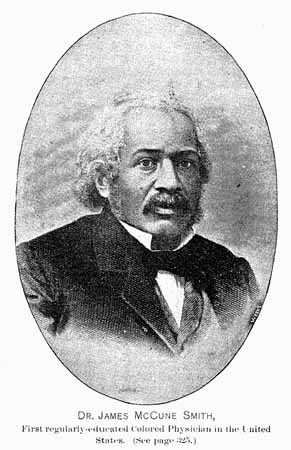
In July 1837, James McCune Smith prepared to leave Britain with a medical doctorate from Glasgow and an unfinished argument. Another doctor had accused him of deception over a hospital treatment. McCune Smith replied with figures extracted from the hospital’s own books, asking what its apparently successful results had left out. 1
Some patients counted as having left the institution had died. Others had refused further treatment. Relapses and pain complicated the claims made for a remedy that senior doctors defended. The young physician’s answer was to set out the evidence and make the dispute public. 1
The journey towards Glasgow
McCune Smith’s education began in New York’s Black community. His mother, Lavinia, and other women around the family supported his learning; he attended the African Free School and continued studying with mentors afterwards. The Reverend Peter Williams Jr helped him pursue further education when American colleges refused him because of his race. 2
He arrived in Glasgow in 1832. The journey grew out of years of preparation, including classical languages, rather than a sudden discovery of his abilities in Scotland. His family, teachers and supporters had already invested in an intellectual future that racial exclusion threatened to prevent. 2
An education across subjects
The university’s surviving records follow him through Greek, logic, anatomy, physics and moral philosophy. He earned a BA in 1835, an MA in 1836 and an MD in 1837. Glasgow’s archive identifies him as the first known African American graduate in medicine. 3
His library borrowing also survives, alongside class lists and prize records. These traces show a student moving across the arts and sciences, developing the habits of reading and comparison that a medical education required. The doctorate was the result of sustained study across several years. 3
Learning in the hospital
A clerkship at Glasgow’s Lock Hospital brought him into contact with women being treated for sexually transmitted infections. William Cumin and Alexander Hannay alternated as medical supervisors there. In 1837, Hannay published a favourable account of treatment with silver nitrate, supported by other practitioners. McCune Smith disputed that account. 4
The disagreement placed a recent student against established medical authority. It concerned the relationship between what happened to patients and what doctors claimed in print. McCune Smith had worked with the hospital’s records and could bring particular cases into an argument that might otherwise have been settled by professional standing. 4
What the figures concealed
His July letter compared the hospital’s transactions during the two halves of 1836. He separated patients recorded as cured from those who had left irregularly, remained in the hospital or died. Grouping different outcomes together, he argued, made a treatment look more successful and a patient’s stay shorter than a careful reading justified. 1
He also drew attention to women whose refusal to continue treatment appeared in the records. That refusal mattered to his assessment. A patient leaving the ward could not simply be treated as evidence that the intervention had worked. The recorded reasons for leaving gave a different account of what had happened. 1
From an examination of fifty-nine cases, he identified relapses, substantial pain and the use of additional treatment. He did not ask readers to accept a conclusion merely because he had a new qualification. He showed how the claim had been constructed and where, in his view, it failed. 1
The publication also preserves the limits of his opportunity to answer. Its editor omitted his detailed case descriptions while printing the conclusions. Even in shortened form, the letter made patients’ experiences part of a public challenge to the hospital’s presentation of its work. 1
A student in the emancipation movement
Medical study took place alongside abolitionist activity. At the Glasgow Emancipation Society’s annual meeting in March 1837, McCune Smith supported a motion to continue the work of the campaigner George Thompson. He connected his own exclusion from American education with the wider denial of citizenship and freedom to Black people. 5
His speech urged continued public argument and campaigning across the Atlantic. He opposed military intervention and insisted that Black Americans had their own attachment to the country of their birth. He wanted access to its institutions and rights, not removal from its future. 5
By July, his return journey was approaching, but he was still insisting that the medical record should be corrected before he left Britain. He signed his reply from Glasgow with the degree he had earned. The letter carried the work of his Scottish education into print: comparison, criticism and a demand that professional claims withstand examination. 1
Sources and further reading
1. Letter to the Medical Gazette, 11 July 1837. London Medical Gazette; scholarly transcription by Amy Cools Murphy. 1837. Public-domain historical text.
2. James McCune Smith and Glasgow: A Scholar’s Transatlantic Journey. University of Glasgow. 2021.
3. James McCune Smith: Information sheet. University of Glasgow Archives. 2024.
4. The Medical Education of James McCune Smith. Journal of Medical Biography; Glasgow repository. 2026.
5. Remarks to the Glasgow Emancipation Society, 15 March 1837. Glasgow Emancipation Society; scholarly transcription by Amy Cools Murphy. 1837. Public-domain historical text.
Featured image. Portrait of James McCune Smith reproduced in Daniel Alexander Payne’s Recollections of Seventy Years, published in 1888. Unknown artist; reproduction from the 1888 book, via Wikimedia Commons. Public-domain original. Image record · Public domain
