When John Alcindor offered his services to the Royal Army Medical Corps in 1914, his qualifications did not secure acceptance. The Trinidad-born doctor was rejected because of his origin. He nevertheless took part in the medical response to the war through the British Red Cross, treating wounded soldiers returning to London. 1
By then, he had built a career across hospitals and general practice. He also belonged to a network of Black professionals, artists and political organisers whose connections reached beyond Britain. Medicine was central to his working life, alongside the associations through which he pressed for greater equality. 2
From Trinidad to medical school
A scholarship took Alcindor from Trinidad to the University of Edinburgh, where he graduated in medicine in 1899. His subsequent work included hospital appointments and involvement in committees concerned with preventing tuberculosis and syphilis. The university’s account places these public-health interests alongside his treatment of individual patients. 3
Born in July 1873, he had studied at St Mary’s College in Port of Spain. He was one of four recipients of the Island Scholarships in 1893. The award enabled further study overseas, followed by professional work in Britain. 2
A career built across London
Alcindor’s early London career involved several moves. Historian Jeffrey Green traced family papers recording work at a tuberculosis hospital in north London into 1901 and an appointment at the Hospital of St Francis in 1902. That experience preceded the settled Paddington practice with which he is most closely associated. 4
The 1901 census places him at a boarding house in Fulham, where another resident was the Nigerian law student John O. Payne. By 1908, a medical directory gives Alcindor an address in Elgin Avenue, Paddington. His life connected the movement of Caribbean and African students with the working routines of the capital’s professions. 4
He eventually established his own practice on Harrow Road. The work anchored him in a neighbourhood, while the organisations he joined brought wider concerns into his life. Treating local patients and taking part in Black associations developed together during his years in London. 5
War work outside the army
The British Red Cross records his service at London railway stations, where wounded men arrived from the battlefields. He received a Red Cross medal for that work. His experience exposes a division within the wartime response: a doctor refused by the army could still use his training in the voluntary services receiving its casualties. 1
Friends and political associations
Alcindor attended the Pan-African gathering in London in 1900 and belonged to the United African League. In 1921, he succeeded John Archer as president of the African Progress Union. The position placed him within a continuing effort to organise people of African descent across differences of birthplace and profession. 5
The United African League’s 1903 constitution names him alongside the composer Samuel Coleridge-Taylor. Their friendship connected professional and cultural life with political association. Alcindor remained close to the family, attending Coleridge-Taylor’s funeral and, later, his daughter’s wedding. 4
His correspondence with W. E. B. Du Bois preserves another aspect of organising. The University of Massachusetts Amherst catalogues a letter sent from London on 12 October 1923 about arrangements for that year’s Pan-African Congress, with a circular from the African Progress Union enclosed. Such correspondence connected the meetings to the work needed to prepare them. 6
A physician within a community
Medical practice and collective action required different forms of attention. Alcindor’s involvement in preventing infectious disease concerned conditions beyond a single consultation, while his political associations addressed the position of Black people more widely. His career made room for both kinds of work. 3
Alcindor died in 1924, aged fifty-one. Local newspaper coverage of his funeral remembered his familiar presence in Paddington and his sympathetic manner with patients. Behind that reputation stood years of appointments, a neighbourhood practice and work as a Poor Law medical officer. The doctor encountered at the surgery was also the colleague corresponding with organisers abroad. 2
Sources and further reading
1. John Alcindor: The Famous Black Doctor of Paddington. British Red Cross. 2023.
2. Dr John Alcindor (1873–1924). Jeffrey Green, Historian.
3. John Alcindor. University of Edinburgh. 2026.
4. The ‘Missing’ Years of Dr Alcindor, 1901–1905. Jeffrey Green, Historian.
5. Medicine, Race and Activism. Black Cultural Archives.
6. Letter from John Alcindor to W. E. B. Du Bois. University of Massachusetts Amherst. 1923-10-12.
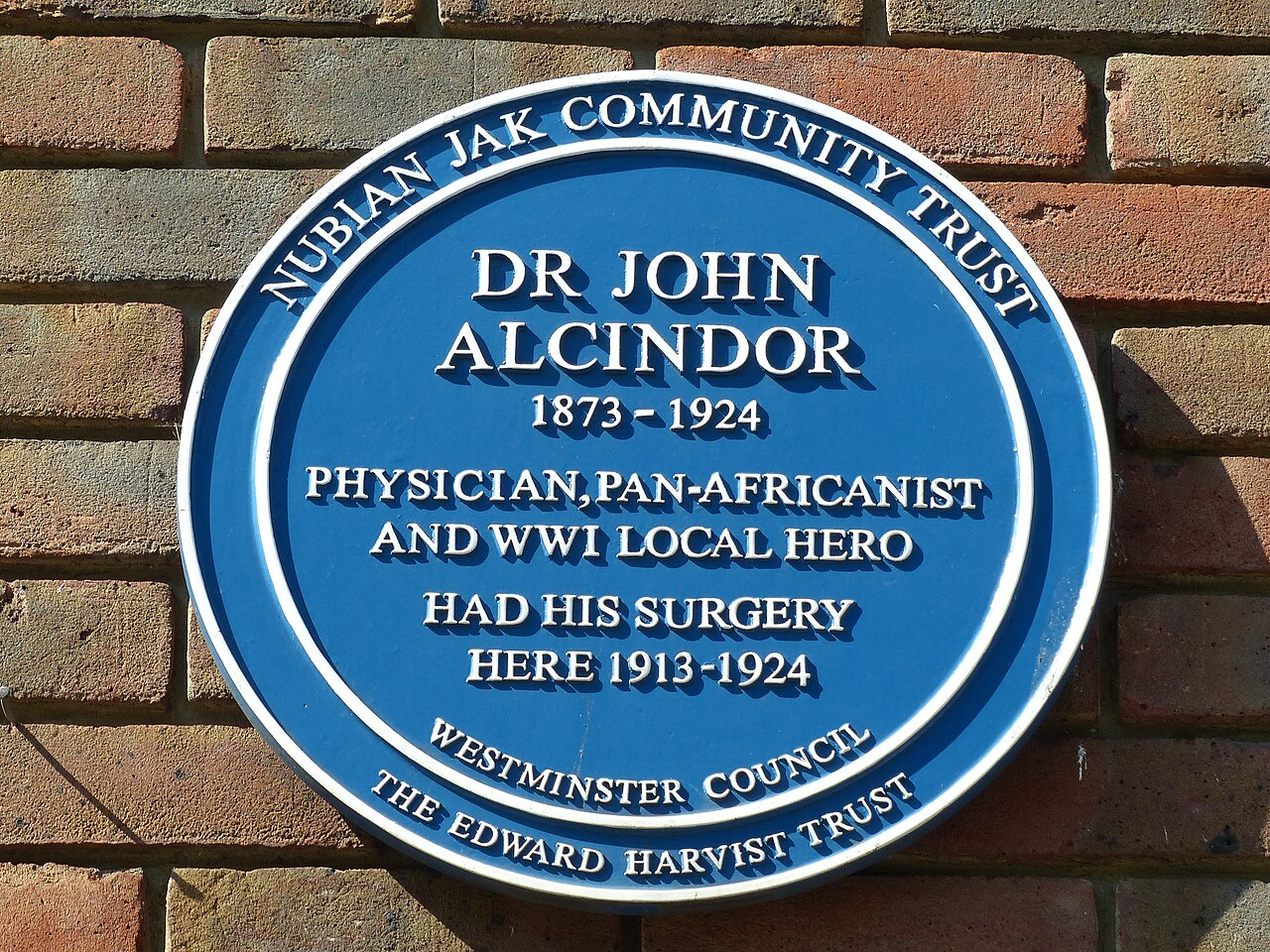
Featured image. A memorial plaque for Dr John Alcindor, photographed in 2020. Photograph: Megalit, 31 May 2020, via Wikimedia Commons. Image record · CC BY-SA 4.0
