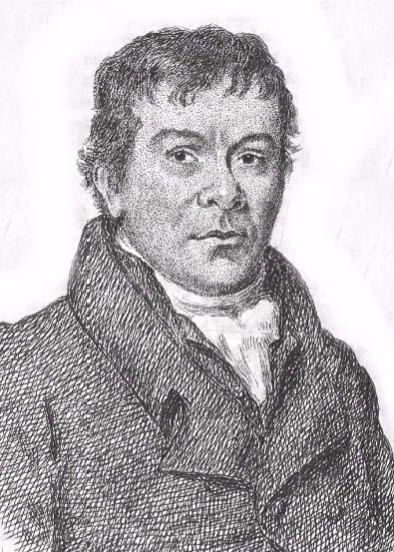
When Robert Wedderburn published The Horrors of Slavery in 1824, he made the argument personal. He named his father, the Scottish plantation owner James Wedderburn, and described the treatment of his mother, Rosanna. He also printed a hostile response from his half-brother Andrew Colvile, followed by his own reply. The respectable family’s version of itself would not go unchallenged. 1
The pamphlet was an accusation against a system that gave men power over women’s bodies, labour and children. Wedderburn used the experiences of his own family to expose how that system worked. He refused to let the wealth and position of his white relatives determine whose account would be heard. 1
Rosanna and Talkee Amy
Born in Jamaica in 1762, Robert grew up with enslavement close around him. Rosanna was enslaved; his father profited from the plantation economy. The contrast between their positions would become central to his writing and to his understanding of the relationship between wealth and coercion. 2
His memoir describes James obtaining Rosanna through a deceptive purchase, knowing that she did not want to enter his household. Robert presented her relationship with James as coerced. When she was sold again during pregnancy, he said, the agreement provided that her unborn child would be free. He identified himself as that child. 1
Robert was brought up by his grandmother, known as Talkee Amy. Although herself enslaved, she sold goods for Kingston merchants and traded on her own account. His description is full of work: retailing food and cloth, earning commissions and building the confidence of customers. She appears as an experienced trader navigating conditions she had not chosen. 1
The violence in these women’s lives did not erase their capacity to resist. Wedderburn answered descriptions of his mother as rebellious by explaining the treatment that had provoked her. He took pride in her refusal to submit. Her anger became part of his political inheritance, rather than a defect he needed to excuse. 1
Making a life in London
After service in the Royal Navy, Wedderburn settled in London in the late 1770s and earned money as a tailor. Work did not secure him against poverty. He became involved in working-class radical circles, including the Spencean Philanthropist Society, which called for sweeping social reform founded on equality. 2
He also travelled to see his father in Scotland. In the account he later published, the visit ended in rejection and a threat of imprisonment if he continued to trouble the household. Wedderburn described returning to London with assistance from others. The encounter made family inequality tangible: his father had wealth and standing, while he was asking for help. 1
Land, food and liberty
In 1817, Wedderburn published the periodical The Axe Laid to the Root, addressing both planters and enslaved people in Jamaica. Across six issues he developed an argument that freedom required more than an end to ownership of people. Those who worked the land needed secure access to it. Without a means of feeding themselves, they could remain dependent on the people who controlled the estates. 3
The provision grounds on Jamaican plantations gave that argument a practical foundation. Enslaved people grew food on these plots, sustaining families and forms of community life within an oppressive system. As Katey Castellano’s research at the British Library explains, Wedderburn treated such practices as resources for freedom. His politics drew on knowledge developed by African Jamaicans, as well as on debates circulating in Britain. 3
This placed food and livelihood inside the meaning of emancipation. Legal release could not by itself answer the question of who would control the ground on which a family depended. 3
The chapel and the court
In 1819, Wedderburn opened a Unitarian chapel in a converted Soho hayloft. Its lectures brought theology, morality, natural philosophy and politics into the same room. The chapel offered a setting where people could debate authority in religious and political life. His teaching connected the oppression of poor workers in Britain with that of enslaved people in the Caribbean. 4
His position could be confrontational. A debate in August 1819 asked whether an enslaved person had a right to kill an enslaver who refused freedom. This was a politics of resistance that went well beyond appeals to benevolent reform. It also attracted the attention of the authorities. 4
Convicted of blasphemous libel, Wedderburn was sentenced in May 1820 to two years in Dorchester Jail. His defence challenged the use of criminal law to enforce religious belief and insisted on freedom of inquiry. The punishment made the right to discuss such questions part of his own struggle. 2
The trial itself became another publication. George Cannon edited the printed account, which was sold by Jane Carlile. A copy survives at the John Rylands Library. Wedderburn’s arguments therefore continued to circulate through the printers, booksellers and readers who sustained radical debate while speakers faced prosecution. 4
Putting the family argument in print
The Horrors of Slavery returned the discussion to the relations between an enslaver, an enslaved woman and their children. Colvile denied that Robert was James Wedderburn’s son. Robert answered by recounting his mother’s history and challenging his half-brother to test the evidence. Publishing both sides made their dispute available to readers outside the family. 1
He dedicated the work to William Wilberforce, but did not write as a grateful witness waiting for others to define freedom. His voice could be angry, mocking and insistent. The stories of Rosanna and Talkee Amy placed Black women’s experience inside an argument about British wealth and power. Speaking from those relationships, Wedderburn claimed authority to judge the society that had treated his family as property. 1
Sources and further reading
1. The Horrors of Slavery. Original 1824 text, reproduced in Iain McCalman’s 1991 edition; Montclair State University-hosted extract. 1824. Public-domain historical text.
2. Robert Wedderburn (1762–1835/6). Humanist Heritage, Humanists UK.
3. Food and Freedom in 19th-Century Jamaica. British Library. 2022-06-01.
4. Robert Wedderburn, Revolutionary and Abolitionist. John Rylands Research Institute and Library, University of Manchester. 2020-10-19.
Featured image. Portrait of Robert Wedderburn published with The Horrors of Slavery in 1824. Unknown artist, 1824; reproduction via Wikimedia Commons. Image record · Public domain
