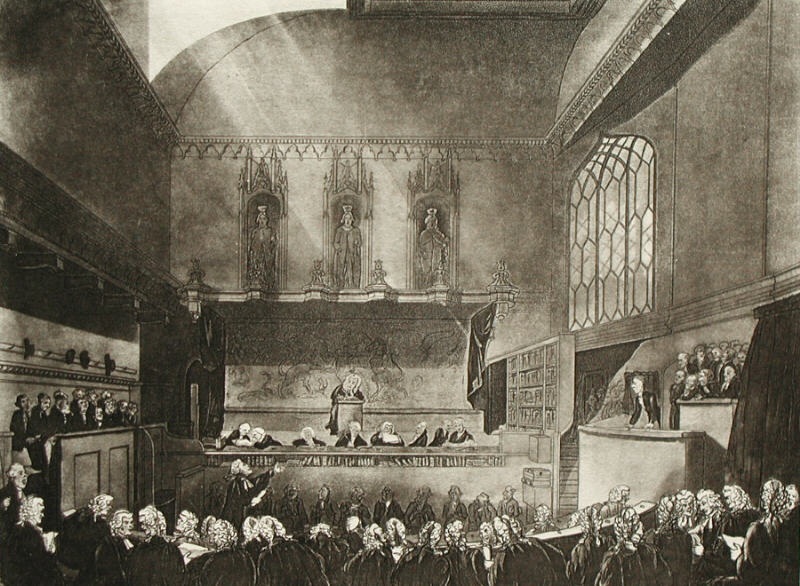
On 22 June 1772, James Somerset visited Granville Sharp with news. Judgment had been given in his favour. Sharp recorded the visit in his diary, leaving a brief glimpse of Somerset as the bearer of his own victory, after months of legal argument about whether he could be detained and sent to Jamaica. 1
The case arose because Somerset had refused to remain in service. Charles Stewart, who claimed to own him, responded by ordering his removal from England for sale. Somerset’s resistance forced a question into court: what legal authority allowed one person to imprison another and carry him overseas as property? 2
A life across the Atlantic
Somerset had been taken from West Africa as a child and sold in Virginia. Stewart later took him to Boston and then to England in 1769. In London they lived in Baldwin’s Gardens, Holborn. Those journeys followed the business of the man who enslaved him, carrying Somerset through several parts of Britain’s Atlantic world. 3
In 1771 he left Stewart’s service and refused to return. His capture led to confinement aboard the Ann and Mary, a ship lying in the Thames under Captain John Knowles. The planned destination was Jamaica, where Somerset was to be sold. He faced a forced journey to a place where the plantation system would determine the conditions of his labour. 4
Friends who brought the detention to court
Somerset had been baptised at St Andrew’s, Holborn, in 1771. Thomas Walkin, Elizabeth Cade and John Marlow became his godparents. Baptism was sometimes understood as a route out of slavery, although it did not by itself provide a secure legal guarantee. The relationships attached to it proved more immediately useful. 3
On 3 December 1771, his godparents made sworn statements about his imprisonment. Their intervention secured a writ of habeas corpus directed to Knowles. This required the captain to produce Somerset and explain the grounds for holding him. The procedure challenged the detention itself, placing a legal obstacle between the prisoner and the ship’s departure. 4
Knowles brought Somerset before Lord Mansfield on 9 December. He relied on Stewart’s asserted ownership and his instruction to take Somerset to Jamaica. Somerset was allowed out of custody while the case proceeded, subject to an undertaking to appear. This mattered: he could pursue the argument from shore, rather than remain confined on the vessel meant to remove him. 4
He also sought help personally. Sharp’s diary records a visit from Somerset on 13 January 1772 to complain about Stewart. Later that month Sharp paid to retain counsel. These entries show a man approaching an ally and discussing his position, alongside the godparents whose earlier action had brought him before a judge. 1
The question before the judges
The arguments ranged across colonial law, property, service and the history of English institutions. Somerset’s lawyers challenged the claim that a person could be treated as property in England merely because another jurisdiction had permitted his purchase. They also disputed attempts to make Atlantic slavery fit older forms of English servitude. 2
Stewart’s side wanted the rights claimed under colonial slavery to remain enforceable after arrival in England. The consequences were large for merchants and planters who travelled with enslaved servants. But the immediate issue was painfully concrete: whether Stewart’s claim entitled Knowles to keep Somerset aboard a ship and deliver him for sale. 2
Mansfield repeatedly encouraged a settlement. He was conscious that a judgment might unsettle arrangements involving many people and substantial commercial interests. The published report records him distinguishing a commercial dispute about a sale from a case in which the person claimed as property was himself before the court. Somerset’s presence made that distinction unavoidable. 2
A decisive ruling with defined limits
On 22 June, Mansfield ruled that the stated reason for detention was insufficient. Such an extreme power over another person needed a basis in the law of the country where it was exercised. Slavery, he reasoned, required positive law to support it. He could find no authority in English law for what had been done to Somerset and ordered his discharge. 2
The order prevented this forcible removal for sale. It did not abolish slavery throughout Britain’s empire or end the slave trade. Nor did it supply a complete settlement of every question about an enslaved person’s status, wages or obligations within England. Those limits are part of understanding the judgment’s reach, rather than grounds for minimising Somerset’s achievement. 2
The decision also acquired a life in print. Capel Lofft included it in his law reports, making the ruling available in a form lawyers could use. Lincoln’s Inn notes how valuable this was to abolitionists, who otherwise depended on newspaper accounts and manuscript notes. The argument could travel beyond the people who had heard it in court. 5
News carried from one person to another
It travelled through personal connections too. A letter of 10 July 1772 reported that a man called Dublin had left his own enslaver after receiving a letter from Somerset saying they had gained their freedom. The writer called Somerset Dublin’s uncle; whether that was a family relationship is uncertain. What survives is evidence of Somerset passing the news on. 3
Somerset’s actions belong at the centre of the case that bears his name. He left service, resisted removal and approached people who could help him contest detention. By June he could deliver news of the decision himself. A court had rejected the power claimed over him, and he had survived the attempt to carry him away. 2, 1
Sources and further reading
1. Granville Sharp’s diary: Somerset entries, 1772. Gloucestershire Archives, D3549/13/4/2; Appendix O, transcript 3. 1772; modern archival transcription. Public-domain historical text.
2. Somerset against Stewart, Lofft’s Reports. Historical English Reports scan, hosted by the Nonhuman Rights Project. Case decided 22 June 1772; historical reprint. Public-domain historical text.
3. The Somerset v Stewart Case. English Heritage.
4. The Case of James Sommersett: historical case report. Digital teaching transcription of historical legal reports. 1771–1772 case; historical compilation. Public-domain historical text.
5. Lofft. Lincoln’s Inn Rare Books and Manuscripts Online. 2022-09-26.
Featured image. A later view of the Court of King’s Bench at Westminster Hall, published in 1808. Somerset’s case had been decided by this court in 1772. Thomas Rowlandson; engraved by John Bluck. Reproduction via Wikimedia Commons. Image record · Public domain
