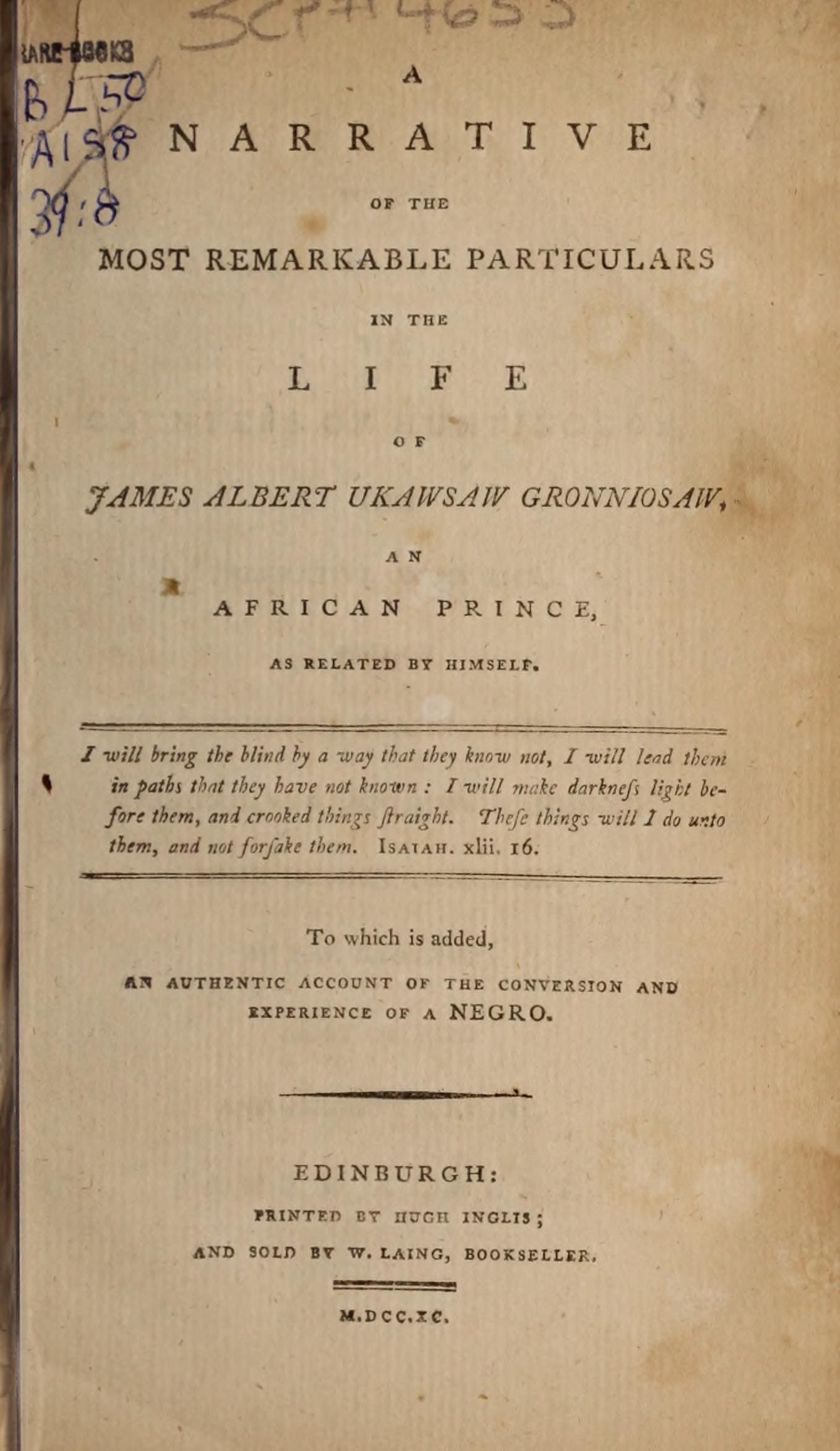
In 1772, a sixpenny book printed in Bath offered readers the life of James Albert Ukawsaw Gronniosaw. Its account ranged across Africa, the Caribbean, North America and Europe, before reaching a household struggling to pay its way in Kidderminster. The promised proceeds were for Gronniosaw and his family. Publication was both a religious undertaking and an attempt to keep them fed.1
A journey away from home
Gronniosaw began with memories of Bournou, where he said his mother was a king’s eldest daughter. The place is generally associated with the Borno region of present-day Nigeria. His birth date remains approximate; the familiar description of him as an African prince comes from the narrative itself.1, 2
In his account, a visiting merchant offered to take him to the coast, promising a return home. The journey instead exposed him to threats, separation and sale. A Dutch captain bought him and took him across the Atlantic. At Barbados he was sold again, to a man who brought him to New York. Each change of owner carried him further from the family whose protection he had once known.1
The adult narrator organised these childhood memories around questions about God and the meaning of his survival. His descriptions were recorded many years after the journey, within a book intended for Christian readers. They give us his remembered experience, rather than a contemporary travel diary with independently checked dates.1
Books in a slaveholding household
One remembered encounter with a book became especially striking. Watching the Dutch captain read prayers, the young Gronniosaw thought the book was speaking. Later he held it to his ear. When it remained silent, he understood the rejection through the hostility he associated with being Black. The episode links his discovery of reading with the racial hierarchies he was entering.1
In North America he was purchased by a minister whom the narrative calls Mr Freelandhouse. Here he learned to read and became deeply involved in Christianity. His work included domestic service and cutting wood. Religious books could trouble as well as comfort him: accounts of sin and judgement produced intense anxiety before he found reassurance in the faith he would describe throughout his life.1
He remembered the minister with affection, while also recording that this man had bought him. On the minister’s death, Gronniosaw received his freedom and a legacy of ten pounds. He remained with members of the household for a time. Freedom changed his legal position, but earning a living and finding people he could trust continued to shape his choices.1
England, Holland and Betty
Debt and employment took Gronniosaw to sea. He described service as a cook on a privateering vessel and later enlistment in the 28th Regiment of Foot, with fighting in the Caribbean. England drew him partly through religion: English visitors and the books he had read had encouraged him to imagine a country of upright Christians. Landing at Portsmouth challenged that expectation almost immediately.1
His subsequent travels included London and a period in Holland, where ministers questioned him about his spiritual experience and he found household employment. He returned to England wanting to see Betty, a woman he had met in London. She was a widow with a child and debts. Friends tried to discourage the marriage because of her poverty, but he sold possessions to clear what she owed and remained determined to marry her.1
Betty’s skilled weaving became central to their livelihood. Gronniosaw’s description of their marriage gives her an active place in the story: she worked, considered possible moves and endured repeated reversals alongside him. His account of Britain is consequently also the history of a working household, measured in jobs, rent, cloth and food.1
Work that could disappear
The couple’s income was precarious. Disruption among London’s weavers curtailed Betty’s work. Later, in Norwich, Gronniosaw struggled to obtain wages from an employer while Betty hired a loom. When their children contracted smallpox, caring for them interrupted her earning. Rent accumulated, and their landlady threatened eviction. Assistance from a Quaker benefactor paid the debt and secured household goods and the loom.1
Gronniosaw then took up chopping chaff, but competitors undercut his prices. The death of a daughter brought another ordeal when successive religious authorities refused to arrange her burial. A parish clergyman eventually agreed to bury her without reading the service. The family’s search for belonging involved such practical and painful encounters, alongside the friendships that sustained them.1
Kidderminster offered the prospect of textile work and a religious community connected with books he admired. He initially found work twisting silk and worsted. At the narrative’s close, age and ill health limited his contribution, while Betty continued at the loom and charitable help supplemented their earnings.1
Who shaped the printed life?
The preface explains that a woman in Leominster wrote down Gronniosaw’s spoken account. It does not name her. Walter Shirley supplied the preface, and the book was dedicated to the Countess of Huntingdon. These connections placed it within a network of religious patronage. Shirley presented the forced journey into a Christian society as providential, giving the reader a theological interpretation before Gronniosaw’s story began.1
Historian Ryan Hanley has examined how Calvinist and Dutch Reformed networks shaped this publication. Their influence helps explain why an account by a formerly enslaved man could describe slavery without offering a general argument for its abolition. Gronniosaw’s religious convictions, his gratitude towards particular people and the purposes of his publishers all matter when reading the book.3
Its last pages leave the family facing familiar expenses and uncertain work. That unfinished material struggle gives the narrative much of its force. Alongside conversion and Atlantic travel, it preserves Betty’s labour, the cost of illness, the difficulties of finding employment and the effort required to maintain a home.1
Sources and further reading
1. A Narrative of the Most Remarkable Particulars in the Life of James Albert Ukawsaw Gronniosaw (1772). James Albert Ukawsaw Gronniosaw; preface by Walter Shirley.
2. From slavery to freedom: J. Gronniosaw’s Narrative. Ryan Hanley.
3. Calvinism, Proslavery and James Albert Ukawsaw Gronniosaw. Ryan Hanley.
Featured image. Title page of an Edinburgh edition of Gronniosaw’s Narrative, printed by Hugh Inglis in 1790. His account had first appeared in Bath in 1772. James Albert Ukawsaw Gronniosaw; Hugh Inglis, printer, 1790. Princeton Theological Seminary Library / Internet Archive. Public-domain original. Image record · Public domain